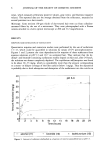
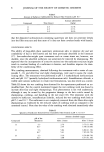
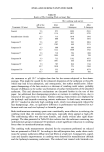
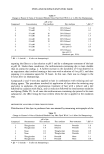
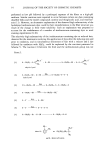
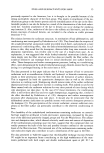
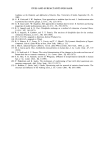
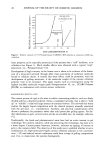
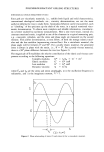
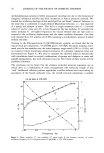
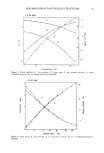
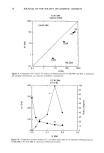
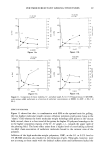
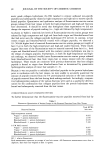
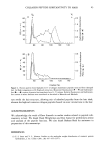
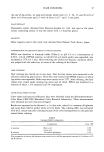
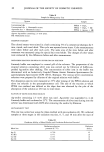
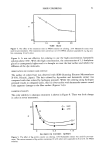
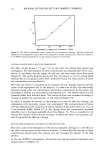
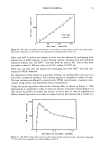
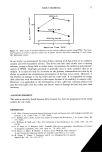
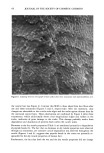
56 JOURNAL OF THE SOCIETY OF COSMETIC CHEMISTS 2.0 1.0 - -_ __ .... ! 1 O0 200 Time (sec) Figure 12. The effect of silver ion concentration on the oxidation reaction. The time-course of the absorp- tion was measured for each concentration of silver. 4.62 mM PPDA solution was used. decrease of the silver ion elution. Thus it is not easy to cause a reaction, a marked tendency in hair coloring systems rather than in solution systems. This is because in the former system, there is a poorer dispersion, owing to hair in the solution, than in the latter system. It is necessary to control the quantity of Ag-zeolite and the composition of the solution in order to prepare good conditions for silver elution from zeolite in the development of hair coloring products. These results show that various levels of coloring can be produced by means of control of these factors. Furthermore, we ventured to use the plant extract containing tannin for increased safety. Tannin is expected to be a coupler because of its polyhydroxy benzene structure which reacts with oxidized PPDA and prevents the formation of Bandrowski base. We have found that hamamelis extract accelerated the polymerization of melanin in a pre- vious study. We used it in our hair dye system as a source of tannin. Mutagenicity by the Ames test consequently decreased. Hamamelis extract lowered the mutagenicity of the reaction of PPDA and hydrogen peroxide alone. Furthermore, the use of Ag-zeolite instead of hydrogen peroxide decreased the mutagenicity and damage to the hair fiber. 2o0, 1.0 4.6 2mM 3.70_.m.•_. __ 200 T•.ne (sec) Figure 13. The effect of PPDA concentration on the oxidation reaction.

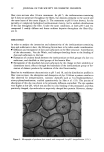
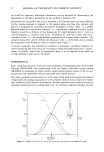
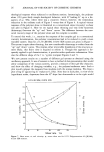
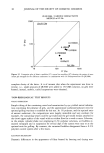
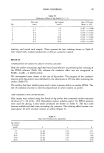
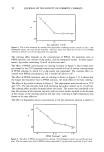
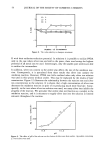
HAIR COLORING 57 lOO PPDA/H• O• Reaction Time (min) Figure 14. Time-course of mutation frequency on the various oxidation systems using PPDA. The muta- tion frequency of 2-AA as a positive control was 363/plate. Ag-zeo: Ag-zeolite containing 2.5 wt% silver. HE: Hamamelis extract. In our study, we investigated the basis of hair coloring with Ag-zeolite as an oxidative catalyst and with hamamelis extract. The silver ions that elute slowly into a coloring solution, owing to being held in zeolite pores, can promote the oxidation and polymer- ization of PPDA. Hydrogen peroxide is generally used in most oxidative dyes as an oxidant. It is used not only by its action on the primary intermediates but also by its ability to promote the simultaneous decoloration of the hair to be tinted. However, it has resulted in damage to the hair fiber and the scalp itself. It is impossible to change dark color hair with the method in this report because of its inability to remove color. However, it is applicable to the development of new, safer hair coloring products for gray hair and light color hair when one doesn't want to damage the hair any more than necessary. ACKNOWLEDGMENT The authors sincerely thank Sinanen-New Ceramic Co. Ltd. for preparation of the metal zeolites for our study. REFERENCES (1) H. Zahn, Chemical processes during bleaching of wool and human hair with hydrogen peroxide and peracids, J. Soc. Cosmet. Chem., 17, 687 (1966). (2) C. Robbins and C. Kelly, Amino acid analysis of cosmetically altered hair, J. Soc. Cosmet. Chem., 20, 555 (1969). (3) L. Wolfram, K. Hall, and I. Hui, The mechanism of hair bleaching,.]. Soc. Cosmet. Chem., 21, 875 (1970). (4) B. N. Ames, H. O. Kammen, and E. Yamasaki, Hair dyes are mutagenic: Identification of vaner,, of mutagenic ingredients, Proc. Natl. Acad. Sci., 72, 2423-2427. (5) K. Brown, A. Mayer, B. Murphy, T. Schultz, and L. Wolfram, Hair coloring A novel system for imparting durable yet reversible color effects, J. Soc. Cosmet. (6) M. Nagao, T. Yahagi, Y. Sugimura, and N. Ito, Mutagenicities of quinolit Mutation Res., 42, 335-342 (1977).
Purchased for the exclusive use of nofirst nolast (unknown)
From: SCC Media Library & Resource Center (library.scconline.org)