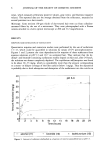
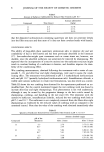
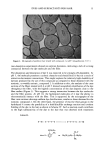
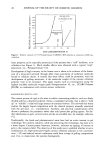
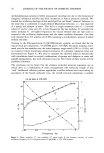
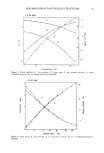
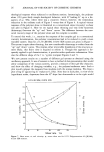
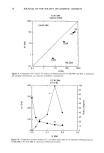
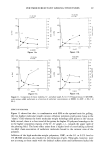
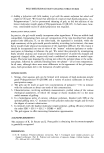
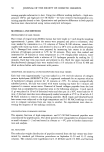
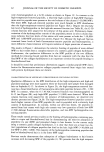
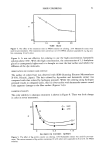
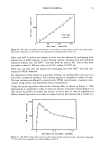
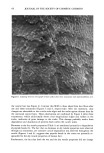
26 JOURNAL OF THE SOCIETY OF COSMETIC CHEMISTS rheological response when subjected to oscillatory motion. Interestingly, the polymer alone (1%) gave fairly simple rheological behavior, with G" leading G' up to a fre- quency of ca. 5Hz, where there was a crossover. Notice, however, the tremendous reduction in the ordinate scale of Figure 5 versus that of Figure 4. A typical viscous response of the polymer alone is illustrated in a conventional stress (viscosity) vs shear rate plot in Figure 6. Here we see typical shear thinning and very little hysteresis (thixotropy) between the "up" and "down" curves. The difference between the mea- sured viscosity range of the polymer alone and the complex is notable. To extend this work, i.e., examine the response of the complex gel in a conventional viscosity determination, the polymer concentration had to be reduced to yield a more tractable system. Data for a 0.2% JR30M, 0.02% SDS system are given in Figure 7. The system is again shear thinning, but now considerable thixotropy is evident from the "up" and "down" curves. This implies either irreversible breakdown of the structure or, more likely, that finite time is required to reform it. Though this approach is fre- quently applied in gel characterization, it provides rather qualitative information. Note also the different shape of the ß vs. •/plots (compare Figures 6 and 7). We now present results on a number of different gel systems as obtained using the oscillatory approach. It was of interest to have a method of data presentation that would allow comparison of the various systems, provide a measure of their gel-like character, and show the effect of changing variables, e.g., the polymer/surfactant ratio. Such a plot would compare the measured loss modulus with the storage modulus. We chose a plot of log G" against log G' (values at 0.2 Hz). Note that in such plots, in view of the logarithmic scales, departures from the 45 ø slope line downwards or to the right would 700, 600. 500 400 300 •00 •00 0.2% JR 30M, 0.02% SDS t0 5 'io •o 6o i6o 2oo Shear rate 1/s Figure 7. Shear stress, t•, and viscosity, x I, versus shear rate for 0.2% Polyquaternium-10 (JR30M), 0.02% SDS mixture.

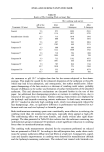
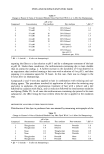
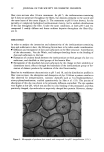
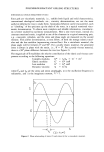
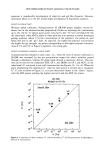
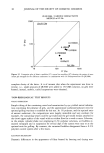
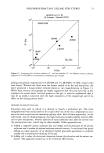
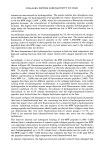
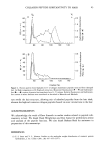
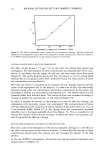
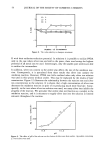
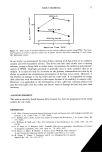
POLYMER/SURFACTANT GELLING STRUCTURES 27 represent a considerable development of elasticity and gel-like character likewise, movement above or to the left would imply development of liquid-like character. EFFECT OF SURFACTANT Without added surfactant, Polyquaternium-10 0R30M grade) displays viscous be- havior, but as the solutions became progressively thicker on increasing the concentration up to 2%, the G", G' datum point moves very close to the "45 ø line" (see Figure 8). On the other hand, when SDS is added to these solutions in an amount to realize maximum gelling tendency (about 1/10 the concentration of the polymer), the points lie well below this line in the "gel" field. As expected, the higher the polymer concentration the higher the gel strength: the points corresponding to the higher polymer concentra- tions of 1% and 2% in Figure 9 represent very strong gels. EFFECT OF DIFFERENT ANIONIC SURFACTANTS A general pattern emerged in most cases, viz., when the ratio of anionic surfactant to JR30M was increased (in the pre-precipitation range) the elastic modulus passed through a maximum, whereas the phase angle showed a monotonic decline. This pat- tern can be seen for the surfactants SDS, ES-3, and DDBS for ES-2 and AOT, on the other hand, G' continued to rise with concentration (see Figures 10, 1 la-d). When the point representing the maximum G' value for each system is entered into a composite G", G' plot as shown in Figure 12, it is seen that points cluster in the "elastic" region, with the SDS system yielding the highest elasticity and the AOT the lowest. Itt 30M Yodult at 0.2 Hz 10 • I i i I I I /'/1 • 10 -'• - O• 10 -'• 10 -• -/ G_el Ltk_e 10 -4 / • I I I I ! 10 -• 10 -2 10 -1 10 ø 101 10 2 10 • c' (Po) Figure 8. Comparison of elastic modulus, G', and loss modulus, G" for Polyquaternium-10 (JR30M) as a function of concentration.
Purchased for the exclusive use of nofirst nolast (unknown)
From: SCC Media Library & Resource Center (library.scconline.org)