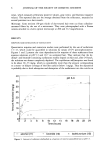
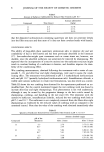
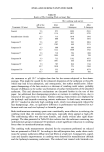
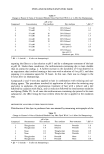
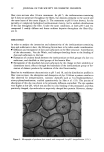
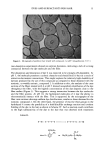
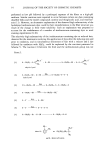
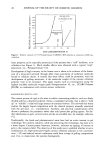
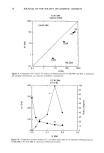
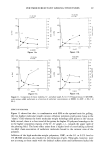
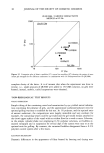
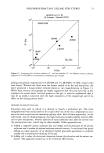
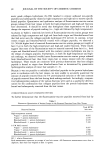
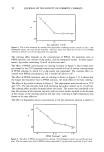
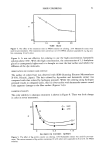
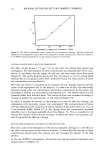
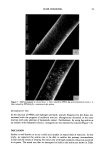
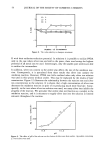
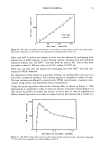
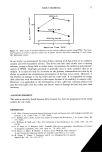
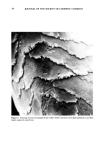
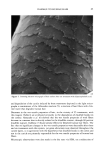
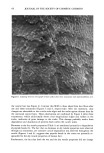
66 JOURNAL OF THE SOCIETY OF COSMETIC CHEMISTS Figure 6. Scanning electron micrograph of hair surface after three treatments with diperisophthalic acid. the control hair (see Figure 4). Contrast this SEM to those taken from hair fibers after one and three treatments (Figures 5 and 6, respectively). After one treatment, clear changes are observable at the cuticle scale edges and the scales appear thinner than for the untreated control hairs. These observations are confirmed by Figure 6 (after three treatments), which additionally shows clear longitudinal ridges and valleys in the scales, indicative of gross damage to the scales. This damage probably results from degradation and dissolution of proteins from within the cuticle scales. Decreases in the dry tensile properties (Table 1) are attributed primarily to degradation of peptide bonds (6). The fact that no decreases in dry tensile properties were observed through six treatments, yet extensive cuticle degradation was observed throughout the cuticle (Figures 3 and 6), suggests that peptide bonds in the cortex are primarily re- sponsible for the dry tensile properties of human hair. Furthermore, the fact that both the wet and the dry tensile properties did not change

DAMAGE TO HUMAN HAIR 67 simultaneously is in agreement with the conclusion that different bonds are primarily responsible for the wet and the dry tensile properties of human hair. CONCLUSIONS Oxidation of hair fibers with diperisophthalic acid can produce extensive damage to the cuticle that can be readily observed microscopically. At the same time, no detectable changes in the tensile properties (wet or dry) are detectable. These results are consistent with the hypothesis that the tensile properties of human hair are due primarily to the cortex, with essentially no cuticle involvement, and support the two-phase model of Feughelman (4) that explains the mechanical properties of human hair in terms of its cortical components. Furthermore, these results show clearly that one cannot rely on the tensile properties alone to assess damage to human hair. This study shows that it is possible to produce extensive damage to the cuticle with no detectable changes in the tensile properties of human hair. LITERATURE CITED (1) C. R. Robbins, in "Chemical and Physical Behavior of Human Hair," 2nd ed. (Springer-Verlag,, New York, 1988), p. 226. (2) L.J. Wolfram and M. K. O. Lindemann, Some observations on the hair cuticle, J. Soc. Cosmet. Chem., 22, 839-850 (1971). (3) D. R. Rao and S. K. Chopra, The effect of the medulla on the stress-strain properties of wool fibers, J. Text. Inst., 78, 306-308 (1987). (4) M. Feughelmann, The physical properties of alpha-keratin fibers, J. Soc. Cosmet. Chem, 33, 385-407 (1982). (5) K. Allworden, Properties of wool--Detection of damaged wool by chemical means, Z. Angew. Chem. 29, 77 (1916). (6) P. Alexander, M. Fox, and R. Hudson, Reaction of oxidizing agents with wool. V. Oxidation products of the disulfide bond and the function of a sulfonamide in the peptide chain, Biochem. J., 49, 129 (1951). (7) C. R. Robbins, in "Chemical and Physical Behavior of Human Hair," 2nd ed. (Springer-Verlag, New York, 1988), pp. 231-232.
Purchased for the exclusive use of nofirst nolast (unknown)
From: SCC Media Library & Resource Center (library.scconline.org)