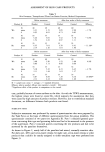
j. Soc. Cosmet. Chem., 45, 1-19 (January/February 1994) A multicenter comparison of different test methods for the assessment of the efficacy of skin care products with 368 human volunteers RUDOLF BIMCZOK, ACHIM ANSMANN, STEPHAN BIELFELDT, DORIS BILLEK, HANSJt3RGEN DRILLER, GERO FEISTKORN, FRIEDRICH HEINZE, RUDOLF Ht3TTINGER, BERND KOMP, HANS LAUTENSCHLJ4GER, MARIE-CHRISTINE LENEVEU-DUCHEMIN, LOTHAR MOTITSCHKE, LOTHAR POHL, ALWIN RENG, HANS-JOACHIM SCHULZE, BIRGIT THOMASKAMP, KLAUS TOLKIEHN, HAGEN TRONNIER, HANS-ULRICH WEKEL and KLAUS PETER WITTERN, DGK (the German Society of Cosmetic Chemists) "Skin Care" Task Force. Received June 4, 1993. Presented at the 17th IFSCC Congress, Yokohama, Japan, October 16, 1992. Synopsis In a multicenter study, commonly used objective and subjective methods for the assessment of the efficacy of skin care products were compared. The study was performed with two different all-purpose skin care creams at eleven centers in Germany, with a total of 368 healthy female volunteers. Measurement of skin hydration with the corneometer demonstrates a fundamental improvement of skin condition and correlates with subjective assessment by the volunteers. Results are statistically highly significant, and there is a fair correlation between the different centers. The methylene blue method, surfometry, and image analysis are also suitable for performance measurements, but show broader standard deviations and lower statistical significance. Under the chosen conditions, results for TEWL and skin surface lipid measurements were not significant at the p ( 0.05 level. INTRODUCTION AND OBJECTIVES Progress in cosmetic science has created many new skin care products with new and highly sophisticated active ingredients. Most of them claim improvement of skin con- ditions, especially skin hydration, reduction of wrinkles, and improvement of skin smoothness. For substantiation of performance claims, subjective as well as objective tests are recommended (1-7), but do objective assessments correlate with consumer perception? Some authors have reported comparisons between performance measure-

2 JOURNAL OF THE SOCIETY OF COSMETIC CHEMISTS ments and clinical assessments (8-10), but until now a comparative study between different centers with a great number of panelists have not been performed. In order to get an answer about reproducibility, correlation, and expressiveness of objective and subjective assessment, the German DGK "Skin Care" Task Force, whose members are scientists from cosmetic companies, consultants, and dermatologists, performed a mul- ticenter comparison of different test methods for the assessment of the efficacy of skin care products. The main objective of this study was to answer the following questions: ß Is the change of the skin condition after treatment objectively measurable by means of biophysical methods? ß Which biophysical methods are best suited? ß Is there a correlation between objective and subjective assessment? ß Do the test results between the various test centers correlate? PROCEDURE The study was performed with two different creams in a complete double-blind crossover design, with subjective tests at all centers and objective tests at centers that were experienced in performance measurements. The first step was to agree to standardized test procedures, as discussions showed that objective and subjective test conditions were different in each laboratory. Two different all-purpose skin creams were chosen as test products: an oil-in-water-type "N" and a water-in-oil-type "K," which were well accepted in the German market (see composition according to CTFA rules in Appendix I). The creams were fragranced with the same perfume for the test. The test was performed from January 1990 to March 1990, at the same time in 11 centers in Germany. The test panel consisted of a total of 368 healthy female volunteers, aged 16 to 74 years (Figure 1). Test persons were advised to use a cream for four successive weeks on their face as usual, and those who participated in objective tests were also asked to apply cream to the volar aspects of one of their forearms using normal amounts of cream. The opposite forearm was left untreated for control. In order to avoid weather influences, in the first period half of the panelists started with "K," the others with "N," and after a one-week wash-out period, the applications were reversed. All biophysical measurements were made on the forearms. For all objective tests, intermediate measurements were performed after two weeks. The data were comparable with the four-week values. We therefore report only the four-week figures bec•iuse subjective tests also lasted four weeks. METHODS AND RESULTS OBJECTIVE TESTS Skin hydration. Skin moisture contents were measured in four centers by the capaci- tance method (11-24) with the corneometer CM 420 © (Courage & Khazaka GmbH, Ki51n, Germany).
Purchased for the exclusive use of nofirst nolast (unknown)
From: SCC Media Library & Resource Center (library.scconline.org)