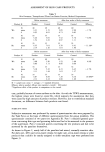
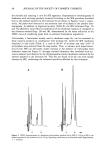
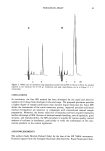
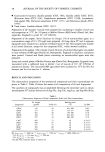
TRICLOSAN ASSAY 37 methanol-acetonitrile-tetrahydrofuran-water (35:25:10:30, v/v) at a flow rate of 1.1 ml/min. The mobile phase was filtered through GV-type filters (0.22-1•m Millipore, Bedford, MA) and on-line degassed by a model ERC-3311 automatic solvent degasser (Erma, Tokyo, Japan). Chromatography was carried out at ambient temperature. The identity of the triclosan peak was assigned by co-chromatography with the authentic compound and confirmed by comparison of the UV spectra relative to the peaks in the deodorant sample and in the reference standard. Peak areas were used for quantification. STANDARD SOLUTIONS A triclosan stock solution was prepared at a level of 1 mg/ml in methanol, and appro- priate aliquots of it were diluted with the mobile phase to give standard solutions in the concentration range of 5-100 I•g/ml. SAMPLE PREPARATION BY SFE Supercritical fluid extractions of deodorants were performed with a computer-controlled Hewlett-Packard 7680A SFE module (Hewlett-Packard, Avondale, PA). The sample was cut into small pieces, homogenized, and accurately weighed (0.10-0.15 g). Soap products were directly loaded into the extraction cell (7.0-ml stainless steel thimble), whereas sticks were smeared on a piece of filter paper that was rolled and placed in the thimble. After insertion of the thimble into the extraction chamber, the SFE apparatus delivered the supercritical carbon dioxide through the sample and then through the restrictor to an internal trap. The sudden depressurization at the restrictor caused the supercritical fluid to evaporate, depositing the extracted components on the trap packed with small (diameter, 0.36-0.43 ram) stainless steel beads. Finally, an appropriate solvent rinsed the analytes from the trap into glass vials, and the extract, after making to volume (5 ml), was ready for HPLC analysis. All the instrument operating parameters (i.e., supercritical carbon dioxide density and flow rate, extraction time and tempera- ture, trap temperature, amount of rinse solvent, and number of rinse steps) were controlled by the software program in the personal computer. The specific extraction conditions used for the deodorants are reported in Table I. RECOVERY AND REPRODUCIBILITY A deodorant stick test sample was prepared in-house by adding to the formulation components a 50-1•1 aliquot of triclosan spiking solution in ethanol, corresponding to a level of 0.150% w/w. The percentage recovery was determined by comparing the peak areas of triclosan extracted from the test sample with those obtained by direct injections of an equivalent amount of the bacteriostat. The intra-assay precision was tested by analyzing, on ten different days, 10 I•1 of the same stock sample solution from a deodorant stick. The inter-assay variability was evaluated by extraction with supercrit- ical carbon dioxide and HPLC analysis of independent samples (n = 10) from the same deodorant stick product.

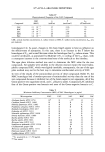
38 JOURNAL OF THE SOCIETY OF COSMETIC CHEMISTS Table I SFE Operating Conditions Carbon dioxide density Carbon dioxide flow rate Extraction temperature Equilibration time Extraction time Restrictor temperature Trap temperature Rinse solvent Rinse volume Rinse steps 0.85 g/ml 2 ml/min (measured as a liquid) 40øC for stick matrices 50øC for soap matrices 1.0 min 7.5 min 45øC for stick matrices 55øC for soap matrices 30øC extraction 40øC rinse Methanol 1.2 ml 1 RESULTS AND DISCUSSION In a previous investigation (15) we described one of the first examples of the use of SFE as a pretreatment technique for the analysis of cosmetic creams and cleansing milks. As an extension of this work, the present study was designed to determine the optimum conditions for the extraction of triclosan from deodorant stick and soap matrices using supercritical carbon dioxide. Initial development of the SFE procedure was carried out using a stick sample spiked with triclosan at 0. 150% w/w and performing 10-min extractions at 40øC with super- critical carbon dioxide at a flow rate of 2 ml/min and at a density of 0.5 and 0.85 g/ml, respectively. To prevent the matrix from being extruded into the transfer line, the sample was smeared on filter paper. At a density of 0.5 g/ml the recovery of triclosan ranged from 64.4 to 67.1%. Increasing the density to 0.85 g/ml yielded improved recoveries (85.2-87.9%) due to the enhanced solvating power of the supercritical fluid (13). No discernible effect on the extraction efficiency was observed when the temper- ature was increased to 60øC at a constant density of 0.85 g/ml. Consequently, all further SFE experiments were performed at 40øC. The influence of the extraction time on the recovery of triclosan from the stick matrix was investigated at 0.85 g/ml fluid density. As illustrated in Figure 1, quantitative recovery (98%) was obtained after just 15 min. The optimized SFE procedure consisted of two 7.5-min extraction steps carried out under identical conditions (Table I) and preceded by a 1-min equilibration. The use of two shorter extraction steps minimized blockages at the restrictor and at the trap inlet filter. A linear correlation was obtained between peak area and amount of triclosan in the range of 0.025-1 •xg on-column weight (r = 0.999, slope = 212240, intercept = - 1688), which corresponds to concentrations in the deodorants of 0.01-0.4% w/w. The mini- mum quantifiable amount (0.01% w/w) was at least five times below the levels normally present in deodorant formulations (3,6). Applying the foregoing SFE procedure to a commercial deodorant stick preparation, triclosan (0. 154% w/w) was determined with a relative standard deviation (RSD) of 1.3% (n = 10) for the intra-assay reproducibility and 2.4% (n = 10) for the inter-assay reproducibility. The accuracy of the method developed in this study was evaluated by comparison of the assay results obtained for the same deodorant products with the proposed SFE technique and an established procedure
Purchased for the exclusive use of nofirst nolast (unknown)
From: SCC Media Library & Resource Center (library.scconline.org)