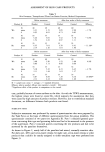
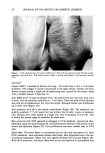
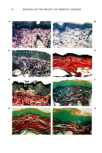
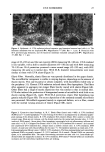
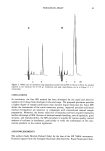
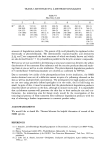
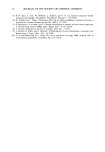
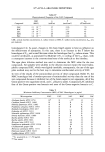
TRANS-3-METHYLBUTYL 4-METHOXYCINNAMATE 47 Table II NMR Data of 3 •H-NMR Coupling constants 8 [pprn] J [Hz] H-2 H-3 H-5 H-6 H-7 H-8 H-10 H-11 H-12 H-13 H-14 4-OMe 3.22 (s) H-2'/6' 7.215 } AA'BB'-System H-3'/5' 6.88 H-7' 3.20 (m) H-8' 3.20 (m) H-10' 4.13 (t) H-11' 1.55 (m) H-12' 1.65 (m) H-13' 0.91 (d) H-14' 0.91 (d) 4'-OMe 3.80 (s) 3.545 (d) 2 2.99 (brd) 8 5.78 (dd) 10.5 1 6.38 (d) 10.5 6.84 (d') 16 6.15 (d) 16 4.20 (t) 7 1.60-- 1.50 (rn) O.935 (d) 7 O.935 (d) 7 following structural features of product 2 are recognizable by their characteristic signals in the •H NMR spectrum: ß One 1,4 disubstituted aromatic (AA'BB' system) ß One each cis and trans double bonds (10 Hz/16 Hz) ß One each aromatic and aliphatic methoxyl groups ß Two 3-methylbutyl esters ß One trisubstituted double bond (H-2) ß Three up-field shifted signals that by spin decoupling completed the sequence 2-3- The allylic couplings of H-2 to H-6 and H-7 facilitate the linkage of the sequences. The •H/•3C hetero correlated COLOC spectrum (long range correlation through two or three bonds) allows for a definitive statement. The NOE experiments also summarized in Table I established the stereochemistry. The cycloaddition takes place between the trans double bond of a cinnamic acid ester and the 3,4 double bond of the aromatic ring of a second cinnamic acid ester. A similar reaction between 4-cyanoanisole and trans- cinnamonitrile in acetonitrile solution to give bicyclo-[4.2.0.] derivatives was recently reported (6). When compound 2 is exposed to atmospheric oxygen, it spontaneously oxidizes to form the epoxide 3. The structure of 3, which we were not able to isolate in pure form, was determined on the basis of the •H NMR spectrum of a 3'1 mixture with 2. The •H

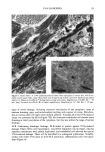
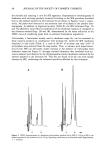
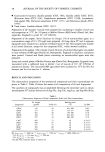
48 JOURNAL OF THE SOCIETY OF COSMETIC CHEMISTS Table III NMR Data of 4 Coupling •H-NMR constants • 3C-NMR • [ppm] NOE J [Hz] õ [ppm] H-2 H-3 H-5 H-6 H-7 H-8 H-10 H-11 H-12 H-13 H-14 H-2'/6' H-3'/5' H-7' H_8 I 4-OMe 4'-OMe 2-OH 4.46 (brdd) H-3 (7%) 5.5 2.5 H-7' (6%) H-8 (20%) 3.28 (dd) H-2'/6' (5%) 9 2.5 H-2 (5%) 5.14 (d) H-6 (8%) 3.5 4-OMe (5%) 6.41 (d) 7.35 (d) 6.23 (d) 4.21 (t) 1.56 (dt) 1.71 (tqq) 0.93 (d) 0.93 (d) 7.18 } AA'BB'-System 6.89 2.66 (dd) 3.21 (d) 3.40 (s) 3.81 (s) 1.84 (d) H-2'/6' (5%) H-2 (4%) H-2'/6' (5%) H-5 (10%) H-8' (5%) 3.5 16 16 7 7 7 7 7 7 7 7 9 7 7 5.5 C-1 136.7 (s) C-2 63.2 (d) C-3 47.6 (d) C-4 75.1 (s) C-5 77.8 (d) C-6 132.1 (d) C-7 143.1 (d) C-8 121.5 (d) C-9 166.3 (s) C- 10 63.5 (t) C-11 37.4 (t) C-12 25.0 (d) C-13 22.5 (q) C- 14 22.5 (q) C-i' 131.7 (s) C-2'/6' 127.7 (d) C-3'/5' 114.4 (d) C-4' 159.1 (s) C-7' 36.4 (d) C-8' 48.1 (d) C-9' 175.1 (s) 4-OMe 51.8 4'-OMe 55.4 OCH 3 o CHO 05, ..... Figure 4. Formation of 4. OR
Purchased for the exclusive use of nofirst nolast (unknown)
From: SCC Media Library & Resource Center (library.scconline.org)