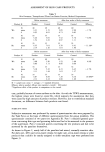
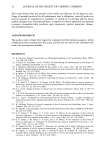
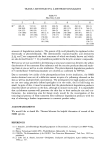
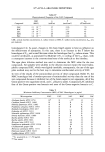
TRANS-3-METHYLBUTYL 4-METHOXYCINNAMATE 49 Table IV NMR Data of 5, 6, and 7 5 6 Z Coupling 5 •H-NMR •H-NMR •H-NMR constants •3C-NMR 8 [pprn] 8 [ppm] 8 [ppm] J [Hz] 8 [ppm] H-2/6 7.20 7.25 6.84 C-1 133.3 (s) } AA'BB' system } AA'BB' system } AA'BB' system C-2/6 127.9 (d) H-3/5 6.845 6.865 6.66 C-3/5 113.9 (d) H-7 3.61 3.87 4.28 C-4 158.6 (s) } AA'BB' system } A2B 2 system } AA'BB' system C-7 46.9 (d) H-8 3.35 3.16 4.28 C-8 45.0 (d) H-10 4.15 (t) 4.16 (t) 4.16 (t) 7 C-9 172.7 (s) H-11 1.51 (dt) 1.51 (dr) 1.75- 7 7 C-10 63.6 (t) H-12 1.64 (tqq) 1.63 (tqq) 1.50 (m) 7 7 7 C-11 37.3 (t) H-13 0.90 (d) 0.89 (d) 0.92 (d) 7 C-12 25.0 (d) H-14 0.90 (d) 0.89 (d) 0.92 (d) 7 C-13 22.5 (q) OMe 3.79 (s) 3.80 (s) 3.71 (s) C-14 22.5 (q) -O-Me 55.3 (q) NMR data are similar to those of compound 2, with the exception of the chemical shift of H-2. Table II lists the •H NMR data. The ready oxidizability of the material is worthy of note because of the high reactivity of epoxides. The mechanism of the formation is not known. Usually, by exposure to the molecular oxygen, the double bond reacts to form a hydroperoxide. The stereochemistry of the epoxide ring in 3 is assumed to be opposite to that of the cis-annellated cyclo- butane ring. Further evidence for the stereochemistry of 3 is supplied by lactone 4, which is formed as a degradation product of compound 3. In the •H NMR spectrum of 4 (Table III) only one set of signals for the side chain appears. The sequences established by the spin decoupling correspond to those of 2 and 3, differing only in the chemical shifts of signals for the six-membered ring. The presence of a •/-lactone ring is evident from the IR-spectrum (1789 cm-•). Furthermore, H-2 couples with a D20 exchange- able signal, indicating the position of the hydroxy group. The •3C NMR spectrum (Table III) is in accordance with the structure. The signals were assigned with aid of a hetero correlated spectrum. The formation of compound 4 could be easily explained in terms of a homolytic cleavage of an ester residue leading to a reactive carboxy radical, which subsequently would give 4_ according to the scheme (Figure 4). An ionic mechanism under the experimental condition is rather unlikely. In addition to these products, minimal amounts of three truxinic/truxillic acid deriva- tives were found (5-Z). The NMR data are listed in Table IV the structures are based on comparison with the values in the literature (7-10). A further identified compound that occurred in minimum amounts only was 8. The •H NMR spectrum (Table V) shows two sets of signals that correspond to type-2 cyclo- butane derivatives. Starting with the H-8 signal in each set, decoupling experiments led to two sequences that can then be linked by means of coupling between H-2 protons. A dimeric dimer is thus likely to be the structure. Long-range couplings between

50 JOURNAL OF THE SOCIETY OF COSMETIC CHEMISTS Table V NMR Data of 8 Dienophile Diene NOE Coupling Coupling 1H-NMR constants •H-NMR constants Dienophile 8 [ppm] J [Hz] 8 [ppm] J [Hz] (dp) Diene (di) H-2 1.60 (dd) 11 2 2.19 (brd) 11 H-8 H-3 2.62 (brd) 9 2.59 (brd) 9 H-2'/6' H-2'/6' H-5 6.01 (brd) 10.5 5.50 (brd) 10 H-6 6.31 (d) 10.5 6.54 (d) 10 H-7 6.84 (d) 16 6.045 (dd) 2.5 4.5 H-8 5.83 (d) 16 3.06 (brd) 4.5 H-7 H-6 (dp) H-10 4.23- 4.23- 4.03 (m) 4.03 (m) H-11 1.71- 1.71- H-12 1.44 (m) 1.44 (m) H-13 0.91 (d) 7 0.88 (d) 7 H- 14 0.91 (d) 7 0.88 (d) 7 H-2'/6' 6.92 7.25 } AA' BB' -System } AA' BB'-System H-3'/5' 6.76 6.87 H-7' 3.09 (m a) 2.96 (dd) 10 9 H-2 H-2'/6' H-8' 3.09 (m a) 3.13 (d) 10 H-10' 4.23- 4.23- 4.0o (m) 4.00 (m) H-11' 1.71- 1.71- H-12' 1.44 (m) 1.44 (m) H-13' 0.91 (d) 7 0.88 (d) 7 H- 14' 0.91 (d) 7 0.88 (d) 7 4-OMe 3.01 (s) 2.72 (s) H-5 H-8' H-5 4'-OMe 3.81 (s b) 3.76 (s b) Not first order, when C6D 6 H-7' 3.24 dd (J = 10 Hz 9 Hz) and H-8' 3.20 d (J = 10 Hz) are added. Possibly interchangeable. olefinic and aliphatic protons complete the structure formed by a Dieis-Alder addition of two molecules of 2, an endo product in respect to the side chain. In the mass spectra all compounds show a similar fragmentation pattern. The data are listed in Table VI. The main pathways are retro [2 + 2] reaction, Mc-Lafferty rearrangement, and ho- molytic cleavage of the ester residues. DISCUSSION UV irradiation of 3-methylbutyl 4-methoxycinnamate causes it to isomerize in the first reaction phase to a cis/trans ratio of 1:25. The photoproduct 2 from the trans compound results directly from [2 + 2] cycloaddition. 2, however, is unstable, and is thus oxidized to molecule 3 containing an epoxide group. The quantitative ratio of photo- product 2 to 3 is 5:3 in freshly irradiated solutions and 1:3 after storage for a number of days. Repeated measurements confirm the instability of 2. The lactone 4_ described as a degradation product of 3 within the reaction mechanism probably results from radical formation. Only traces of the tetrameric molecule 8 have been detected in the very small
Purchased for the exclusive use of nofirst nolast (unknown)
From: SCC Media Library & Resource Center (library.scconline.org)