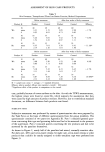
j. Soc. Cosmet. Chem., 45, 53-63 (January/February 1994) Physicochemical and antimicrobial properties of N"-acyI-L-arginine dipeptides from acid-hydrolyzed collagen J. SEGUER, J. MOLINERO, A. MANRESA, J. CAELLES, and MaR. INFANTE, Centro de Investigacion y Desarrollo (C.S.I.C. ) (J. S., J.M., J.C., MaR. I. ), Facultad de Farmacia, Universid•d de Barcelona (A.M.), Barcelona, Spain. Received February 1 i, 1993, Synopsis The present work describes the synthesis (at lab scale), the physico-chemical properties, and the antimi- crobial activity of long chain N%acyl arginine dipeptides with a chain length between 8-16 carbon atoms. The compounds were obtained by condensation of the corresponding long-chain N%acyl arginine homo- logue and a collagen hydrolysate from waste leather trimmings using the mixed anhydride method. As in a conventional series of surfactants with different chain lengths, changes in the chain result in changes in the physicochemical properties. A peak of antimicrobial activity is observed for the homologue of 14 carbon atoms. INTRODUCTION Long-chain N%acyl amino acids from collagen constitute an interesting class of sub- stances because of their limited tendency to defat or alter the pH of the skin and thus to decrease swelling of the skin (1). They contain an amino acid or peptide forming the hydrophilic part and a long chain forming the hydrophobic part, which is introduced in the amino acid structure through an acyl linkage. They can be considered anionic surfactants with a wide application in cosmetics, but since they are protein-derived, they can be an excellent growth medium for bacteria if not properly protected. Long-chain N%acyl amino acids derived from pure dibasic amino acids have been studied by our group with the aim of obtaining mild surfactants for preservative ap- plications (2-4). Of these, arginine-based cationic surfactants, particularly the methyl and ethyl ester derivatives (Figure la) have been found to have high surface activity (5) and an interesting polymorphic phase behavior (6). These compounds have also been shown to have effective antimicrobial properties (3). The fatty residue, the guanidine 53

54 JOURNAL OF THE SOCIETY OF COSMETIC CHEMISTS NH /(CH2)"• / • H3C 0 c R / %/ C CH 0 II I 0 OH2 H2C• OH 2 / HN I c H2N ' •,,," N H2. CI- 0 /(CH2)n% NH C / • H3C C CH 0 NH 2 0 H2C % NH :+.'C: H2C --OH 2 'NH 2 (a) (b) Figure 1. Chemical structure of a) long-chain N%acyl arginine alkyl ester and b) long-chain N%acyl arginine. basic residue, and the protection of the carboxyl group in the molecule of the arginine are essential structural factors for antimicrobial activity. On the contrary, arginine- derived surfactants that have the unprotected carboxyl group (with an amphoteric structure but probably basic compounds) are water-insoluble c}ystalline materials with little technological interest (Figure lb). This insolubility was attributed to the forma- tion of guanidinium-carboxylate intermolecular interactions that were probably stabi- lized by strong hydrogen bondings. The aim of this study was to obtain amino acid-based surfactants from long-chain N%acyl arginine and acid-hydrolyzed collagen, which are soluble in water and have an antimicrobial activity. The synthesis, at lab scale, of a novel series of surfactants is described. These compounds are long-chain N%acyl arginine dipeptides of 8-16 carbon atoms, obtained by condensation of the corresponding long-chain N%acyl arginine homologue and a mixture of amino acids from an acid-hydrolyzed collagen (see Formula 1). The structures of these compounds differ from those of commercial long-chain N%acyl - amino acid surfactants because of the presence of the arginine amino acid between the hydrophobic fatty chain and the terminal amino acid residues (from the collagen hy- NH /(CH2)n% / % H3C /• / c CH NH II I 0 CH2 / H2C% OH 2 / HN I c H2N' • 'NH 2 Cl- 0 R C CH OH \/ C II o Formula 1. Long chain N%acyl arginine dipeptides as hydrochloride salts, where n -- 6 (CAC) 8 (KAC) 10 (LAC) 12 (MAC) and 14 (PAC). R -- Amino acid residues from a collagen hydrolysate.
Purchased for the exclusive use of nofirst nolast (unknown)
From: SCC Media Library & Resource Center (library.scconline.org)