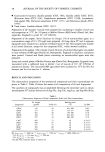
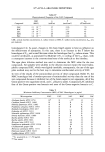
Nø'-ACYL-L-ARGININE DIPEPTIDES 57 and final compounds was performed in a Biotronic 5001 amino acid analyzer after acidic hydrolysis of products. Preparation of long-chain N%acyl L-arginine dipeptides from collagen. Long-chain Nø'-L - nitroarginine (XNA), 0.8 g, obtained following the method described in (8), was dissolved in dry DMF (40 ml), and then 0.22 ml of N-methylmorpholine was added. The mixture was cooled at - 15øC, and an equimolar amount of isobutylchloroformate (IBCIF) was added slowly. The resulting mixture was then stirred for 90 seconds with cooling. A suspension of 0.3 g of collagen hydrolysate plus 0.25 ml of N-methylmor- pholine and 40 ml of DMF was then added. Stirring was continued for 1 hr at - 15øC and for 4 hr at room temperature. The mixture was evaporated to dryness in vacuo and the residue dissolved in ethyl acetate. The solution was washed several times with water, dried over sodium sulphate, and evaporated to dryness. The N%acyl-L-nitroarginine dipeptide derivatives (XNAC) were thus obtained as an oil that did not crystallize from several mixtures of solvents. This oil did not contain either free amino acids or N% acyl-nitroarginine and gave a large spot by TLC the Ninhydrin reaction was negative. The N%acyl-L-arginine dipeptides (XAC) as acetate salts were obtained by hydroge- nating a solution containing 0.571 g of N%acyl-L-nitroarginine dipeptides, 1.5 ml of methanol, and 1.5 ml of glacial acetic acid over 0.2 g of Pd/C, for 8 hr. The elimination of nitro function was monitored by direct reading at 270 mm. The desired products were obtained in an oil form from a mixture of methanol (HC1)/diethyl ether. By amino acid analysis, thin-layer chromatography, and •H-NMR, it was shown that our samples did not contain either free amino acids, peptides, XNA, or urethane impurities. The amino acid composition of all N%acyldipeptides are indicated in Table II. The purity of the dried compounds was established to be in the range of 90 -+ 5 % (w/w). The pH of their 10% (w/v) aqueous solutions was 4 -+ 0.5. Method for surface tension A DuNoiiy tensiometer (Lauda) with a platinum ring was used for surface tension measurements ('y). Water/surfactant solutions of different concentrations were prepared and allowed to equilibrate at 25øC between 4 and 10 hr. Method for critical micellar concentration (CMC), surface excess concentration (I•), and area per molecule (A m) The critical micellar concentration (CMC) was determined from the break point of the surface tension/concentration curves. The surface excess concentration (F) values at the air/water interface and the area per molecule (Am) were calculated with the Gibbs adsorption equation (9). Method for antimicrobial activity The antimicrobial activity was performed by estimating the minimum inhibitory con- centration values (MIC) by the agar plate dilution method (10). The MIC was defined as the lowest concentration of antibacterial agent that inhibited development of visible growth. Bacterial strains. Gram-negative and Gram-positive microorganisms were used. ß Gram-negative bacteria: Alcaligenes faecalis ATCC 8750, Citrobacter freundii ATCC 11606, Klebsiella pneumoniae ATCC 13882, Pseudomonas aeruginosa ATCC 27853, Bordetella bronchiseptica ATCC 4617, Escherichia coli ATCC 23231, Salmonella typh- imurium ATCC 14028, and Serratia marcescens ATCC 13880.

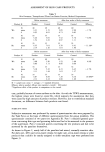
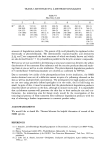
58 JOURNAL OF THE SOCIETY OF COSMETIC CHEMISTS ß Gram-positive bacteria: Bacillus pumilus ATCC 7061, Bacillus subtills ATCC 6633, Micrococcus luteus ATCC 9341, Staphylococcus epidermidis ATCC 12228, Corynebacate- rium agopyri CM, Micrococcus aurantiacus ATCC 11731, and Enterococcus faecalis ATCC 19433. ß Yeast strain: Candida albicans ATCC 10231. Preparation of the inoculum. Inocula were prepared by incubating a 1oopful of each test microorganism at 37øC for 24 hours in Muller Hinton (MH) broth (Oxoid Ltd, Bas- ingstroke, England) to yield 105-106 CFU/ml. Preparation of the samples. Serial dilutions (in Ringer 1/4) of antimicrobial agent in a concentration range of 0.5-256 )zg/1 were prepared. All long-chain N = acyl-L-arginine dipeptides were dissolved in a mixture of ethanol:water (5:20). The samples were soluble at all tested dilutions, except for the compound PAC, which showed turbidity. Preparation of the medium. One volume of each dilution of antimicrobial agent was added to nine volumes of MH agar (Oxoid Ltd, Basingstoke, England) in duplicate, and plates were poured. Control and blank plates containing no antimicrobial agent were also prepared. Assay and control plates of Muller Hinton agar (Oxoid Ltd, Basingstoke, England) were inoculated with a calibrated loop to deliver 2 •1 of inocula of 105-106 CFU/ml of population density. The inoculated MH agar plates were incubated at 35øC for 48 h for bacteria and for five days for C. albicans. RESULTS AND DISCUSSION The characteristic properties of the synthesized compounds and their intermediates are given in Table I. Table II shows the amino acid composition of all acyl dipeptides. The synthesis of compounds was accomplished following the procedure used to obtain monodisperse N = lauroyl derivatives ofArg-Gly, Arg-Glu, Arg-Lys, and Arg-Phe (8) by Table I Characteristic Properties of Final Compounds (XAC) and Their Intermediates M. weight Melting point Compound (g/mol) Yield (%) (øC) Rf (B)* CNA • 345 44 165-168 0.65 KNA • 373 47 175-177 0.69 LNA • 401 46 178-180 0.70 MNA • 429 51 182-184 0.70 PNA • 457 43 188-189 0.70 CAC 2 481 72 oil 0.2-0.5 KAC 2 509 67 oil 0.2-0.5 LAC 2 537 75 oil 0.2-0.5 MAC 2 565 68 oil 0.3-0.6 PAC 2 593 54 oil 0.3-0.6 IR: ]')(NH-CO(1)) = 1680 cm-• ]')(NH-CO(II)) = 1550 cm-• V(CH2 ) •--- 2880-2800 cm-• • UV: }t(NH_CO ) = 214 nm }t(N%) = 265 nm. 2 UV: }t(NH_CO ) = 214 nm. * Rf (B): TLC retention factor in solvent B.
Purchased for the exclusive use of nofirst nolast (unknown)
From: SCC Media Library & Resource Center (library.scconline.org)