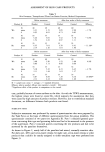
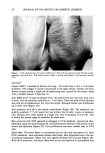
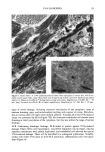
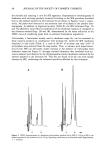
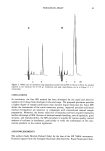
30 JOURNAL OF THE SOCIETY OF COSMETIC CHEMISTS .. - . ß Figure 6. B. SS-A protection prevented elastic fiber hyperplasia and the overproduction of microfibrils. Arrow indicates a small elastic fiber. Magnification )20,800. Bar = .05 Ixm. Inset: Typical normal- appearing elastic fibers with black elastin matrix covering most of the microfibrils. Magnification X44,000. Bar = .05 Ixm. DISCUSSION It was not surprising that avobenzone proved to be highly protective against the dam• aging effects of chronic UVA I radiation. On the basis of the absorption spectrum, with high absorbance between 310 and 370 nm (8), and its performance in acute-exposure studies (8,13), it was reasonable to expect efficacy. Our results with this particular oxybenzone-containing sunscreen (SS-B) were very surprising. The exacerbation of pho- todamage, compared to UVA alone, was in total disagreement with our other concurrent findings. Two different oxybenzone-containing sunscreens were tested in parallel with this study, using the same UVA source and irradiation protocol. On the basis of histochemical staining, protection was equal to that of the avobenzone•containing sun-

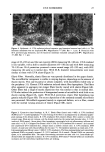
UVA SUNSCREEN 31 Figure 7. Vasculature. A. UVA radiation-induced extensive basement membrane duplication (*). Endo- thelial cells were damaged with, among other changes, extensive thinning ( --), rupture, retraction or gaps allowing leakage (I}), and swollen mitochanodria (•'). Magnification x8,300. Bar = 1 p•m. B. SS-A prevented vascular damage. The basement membrane (--) was not duplicated. Occasional thin areas (•') and mild vesiculation (•) were in the normal range. Magnification x9,700. Bar = I p•m. screen (SS-A), with one exception: SS-A was slightly more effective in preventing the increase in dermal GAGs. Furthermore, these two oxybenzone-containing sunscreens produced no clinical signs of irritation. The absorption spectrum of oxybenzone, with its peak at • 320 nm (8), would not predict such high efficacy against UVA I. However, formulation can be a positive factor. Included in the parallel experiment were findings from other irritating oxybenzone-containing sunscreens. We describe these in reference 14 as a UVA-induced phenomenon that we have termed "photoirritation." From all these results, we conclude that oxybenzone was not the cause of the photodamage observed in this study, but rather some unknown component in the vehicle. Given our experience with non-irritating oxybenzone-containing sunscreens, it was also surprising that Bissett et al. (3) reported that an SPF-15 oxybenzone-containing sun- screen afforded no protection against a total of only 710 J/cm • of low-irradiance, long-wavelength UVA as emitted by black-light fluorescent tubes. In our experiments (14) with SPF-15 sunscreens with the same concentration of oxybenzone (3%) as Bissett et al. (3) and 8,000 J/cm • of high irradiance, long-wavelength UVA, we saw very marked protection. The reasons for such a large discrepancy between our work and that of Bissett et al. (3) are not obvious. The addition of UVA absorbers to UVB absorbers to achieve an SPF of 15 is believed by some to provide adequate protection against UVA since it blocks •50% of the erythema-effective UVA (15). Furthermore, because it requires 500-1000 times more UVA than UVB to produce erythema in humans (16,17), the probability of accumu- lating enough UVA to affect connective tissue was thought to be negligible. However, in a recent study to determine an action spectrum for elastosis, Kligman and Sayre (18) found that the amount of UVA I, as delivered by a filtered solar simulator that was required to produce a 50% increase in elastic fiber hyperplasia, was only 30 times greater than for full solar-simulating radiation with its large, highly energetic UVB component. Thus, the histologic consequences of cumulative exposures may require lower multiples of energy compared to those for erythema. If extrapolation from mice to humans, with
Purchased for the exclusive use of nofirst nolast (unknown)
From: SCC Media Library & Resource Center (library.scconline.org)