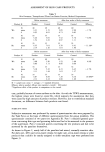
ASSESSMENT OF SKIN CARE PRODUCTS 15 water-in-oil cream, the authors expected greater differences in performance and accep- tance than with two similar creams of either emulsion type. It is common practice for subjective assessments of face creams that panelists use the products on their whole face during the test period of two or four weeks. Direct comparisons, e.g., left side of the face untreated, right side treated, are not possible because panelists would not agree to participate in such tests. Furthermore, for healthy women biophysical measurements on their faces are very uncomfortable. Therefore, almost all biophysical measurements are using one forearm untreated for control. It is assumed that results received on arms correspond to those on the faces. This assumption bears a certain risk due to different skin conditions on faces and arms in respect of sebum content, moisture, sensitivity, and exposure to the environment, especially UV rays. Another problem of performing tests over a two- or four-week period exists with the applied quantities of test products. As panelists use their creams by themselves and therefore as much as they need or want, there are certain differences that may probably influence the results. Generally, even 12 or 24 hours after application, product residues cannot be excluded. Despite all these possible problems, the authors were confident that the chosen condi- tions for these comparisons were highly realistic and highly conforming to laboratory practice and to consumer habits. The panels in this test consisted of healthy female volunteers who usually participated in subjective or biophysical tests in these laboratories, but who were not specially chosen in regard to skin type since the test products were offered as all-purpose creams for all skin types. Due to great deviations in the absolute results of the biophysical measure- ments between the centers, no correlations to age or skin type could be detected. Additionally, there were too few persons of either age or skin type in each panel of 35 to 40 women. In our study we could measure changes of skin condition after treatment with two different skin creams by means of the capacitance method, dyestuff adsorption, surfom- etry, and image analysis. The differences between the laboratories are probably due to differences in panels, equipment, and especially in the applied quantities, which re- suited in residues on skin even 12 or 24 hours after application. It seems evident that panelists in center Be used more products than in We, causing higher differences between test and control in corneometer, sebumeter, TEWL, and subjective improve- ment of skin condition. Nevertheless, the corneometer method leads in all centers to the best correlations between subjective and objective assessments. The methylene blue method seems to be more sensitive to residues, leading to poorer correlations. TEWL and skin surface lipids measurements are not suited to measure product performance under the chosen conditions because there would be neither an occlusion nor damaged barrier function, and sebum content is low on the volar aspects of the forearms. These factors lead to values with high standard deviations. The unexpected small improvements in skin conditions perceived by the panelists can be explained by the well groomed skin conditions of the female volunteers, which could hardly be improved in most cases. Higher differences can probably be anticipated with panels consisting of persons with clinically dry or poorly groomed skin, but in our opinion, this is not realistic for testing cosmetic products.

16 JOURNAL OF THE SOCIETY OF COSMETIC CHEMISTS This study showed that test periods of two weeks are sufficient for all objective tests. Usage of standard products for all performance tests is obligatory, since all results can only be assessed in comparison to standards. It should be an exciting task for future studies, perhaps on an international basis, to improve all these biophysical test methods in respect of panelists (skin condition, age), equipment, product quantities, climate, and standard products. ACKNOWLEDGMENTS The authors wish to thank their respective companies for their generous support, all the collaborators who contributed to this study, and last but not least all the volunteers who made this investigation possible. REFERENCES (1) H. Tronnier, Neuere Testmethoden zur Wirksamkeitsprfifung an der menschlichen Haut, SOFW, 115, 308-322 (1989). (2) P. Busch, K. Schumann, and H. Verbeek, Die Entwicklung der Hautkosmetik in den letzten 25 Jahren, Parfiimerie und Kosmetik, 73, 62-70 (1992). (3) L. Hartmann, Methods for studying the skin surface, J. Soc. Cosmet. Chem., 34, 407-418 (1983). (4) K. Mosler, Hautfeuchtigkeitsmessung-kein Problem mit dem Corneometer CM 420, Pa•iimerie und Kosmetik, 64, 375-379 (1983). (5) R. Marks, C. Edward, and D. Black, Non invasive assessment of stratum corneum structure and function, Int. J. Costa. Sci., 11, 59-65 (1989). (6) A.M. Kligman, Regression method for assessing the efficacy of moisturizers, Cosmet. Toilerr., 93, 278-335 (1978). (7) J. K. Prall, R. F. Theiler, P. A. Bowser, and M. Walsh, The effectiveness of cosmetic products in alleviating a range of skin dryness conditions as determined by clinical and instrumental techniques, Int. J. Cosm. Sci., 8, 159-174 (1986). (8) G. L. Grove, Design of studies to measure skin care product performance, Bioeng. Skin, 3, 359-373 (1987). (9) J. K. Prall, Instrumental evaluation of the effects of cosmetic products on skin surface with particular reference to smoothness, J. Soc. Cosmet. Chem., 24, 693-707 (1973). (10) G. L. Grove, "Techniques for Substantiating Skin Care Product Claims," in Safety and Efficacy of Topical Drugs and Cosmetics, Kligman and Leyden, Eds. (Grune & Shatton Inc., New York, 1982), pp. 157-176. (11) R. Edelberg, Relation of electrical properties of skin to structure and physiologic state, J. Invest. Dermatol., 69, 324-327 (1977). (12) K. Schrader, Untersuchungen wasser-retinierender Kosmetika auf der Haut, Pa•iimerie und Kosmetik, 62, 265-272 (1981). (13) G. P. Serban, S. H. Henry, V. F. Cotty, and A. D. Marcus, In vivo evaluation of skin lotion by electrical capacitance: I. The effect of several lotions on the progression of damage and healing after repeated insult with sodium lauryl sulfate, J. Soc. Cosmet. Chem., 32, 407-419 (1981). (14) G. P. Serban, S. M. Henry, V. F. Cotty, and A.D. Marcus, In vivo evaluation of skin lotion by electrical capacitance: II. Evaluation of moisturized skin using an improved dry electrode, J. Soc. Cosmet. Chem., 32, 421-435 (1981). (15) H. Tagami, M. Ohi, K. Iwatsuki, Y. Kanamaru, M. Yamada, and B. Ichijo, Evaluation of the skin surface hydration in vivo by electrical measurement, J. Invest. Dermatol., 75, 500-507 (1980). (16) H. Tagami, Y., Kanamaru, K. Inove, S. Suehisa, F. Inove, K. Iwatsuki, K. Yoshikuni, and M. Yamada, Water sorption-desorption test of the skin in vivo for functional assessment of the stratum corneum, J. Invest. Dermatol., 78, 425-428 (1982).
Purchased for the exclusive use of nofirst nolast (unknown)
From: SCC Media Library & Resource Center (library.scconline.org)