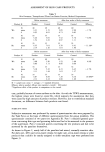
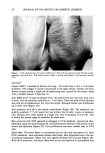
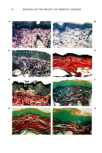
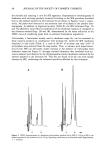
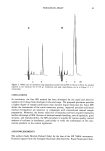
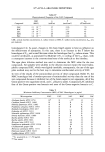
j. Soc. Cosmet. Chem., 45, 43-52 (January/February 1994) Photochemical studies on trans-3-methylbutyl 4-methoxycinnamate A. SCHRADER, J. JAKUPOVIC, and W. BALTES, Creachem GmbH, Cosmetic Industry Research Institute, Holzminden (A.S.), and Institute for Organic Chemistry (J.J.) and Institute for Food Chemistry (W.B.), Technical University of Berlin, Berlin, Germany. Received July 29, 1993. Synopsis The sunscreen filter substance trans-3-methylbutyl 4-methoxycinnamate was irradiated with a defined solar simulator. Initial in vivo irradiation under in-use conditions caused discolorations in the UV absorber. Subsequent in vitro irradiation resulted in seven degradation products, the structures of which were deter- mined by means of spectroscopic methods, especially nuclear magnetic resonance (NMR) spectroscopy. INTRODUCTION Products containing sunscreens have in recent years often been mentioned in connection with initiation of dermal photoreactions. Photochemical degradation products of the actives are frequently among the causal factors of such reactions (1). The toxic potential of UV-induced degradation products from sunscreens is growing in significance due to increasing demand by dermatologists for use of sunscreen agents, even in non-sunscreen products. MATERIALS AND METHODS IRRADIATION APPARATUS We used an optically filtered 300 W Xenon system with six emission spots with a diameter of 1 cm 2 each (Figure 1). In the method development phase, the six spots, supplied by a single light source, allow for absorption of a radiation dose gradient that facilitates determination of the dosage to be used for the irradiation object in a single procedure. Correlation of the emission spectrum of the solar simulator to natural sunlight is indispensable for the measurement procedure (3,4). Figure 2 shows the spectral curve of sunlight on a summer day in the wavelength range of 288-320 nm (5). • Taken in part from the Ph.D. thesis of A. Schrader. A part of this work has been submitted as a preliminary elsewhere. 43

44 JOURNAL OF THE SOCIETY OF COSMETIC CHEMISTS Figure I. Overall view of the solar simulator system (2). IRRADIATIONS AND ANALYSES The UV-B sunscreen agent (10%) was dissolved in propan-2-ol for purposes of irradi- ation. For specimen irradiation, 100 •I of the UV filter solution was applied to human skin limited by a silicone-fixed glass ring (02.5 cm). Following a sunscreen agent contact time of 20 minutes, the object was irradiated by a dose of 600 mJ/cm 2 according to 10 MED. The distance to the skin was 3-5 mm. The skin field was subsequently extracted with 500 •I of propan-2-ol. To obtain larger specimen volumes, six "back extracts" per test person were combined in a single solution. For in vitro irradiation a 100-ml sunscreen filter solution was placed in a quartz bowl and irradiated with direct vertical light at the same object-to-source distance as for the in viva trial. The irradiation dose was 16.4 J/cm 2. The irradiation dosages for in vitro and in viva studies are not comparable. Fractionation of the mixture was done by means of analytical TLC.
Purchased for the exclusive use of nofirst nolast (unknown)
From: SCC Media Library & Resource Center (library.scconline.org)