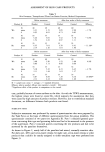
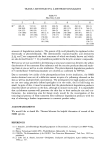
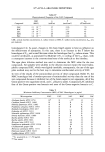
TRANS-3-METHYLBUTYL 4-METHOXYCINNAMATE 51 Table VI Mass Data of 2_-8 M + 496 (1) 512 (4) 442 (8) 496 (3) 496 (6) 496 (6) 992 (1) 248 (84) 264 (40) 424 (3) 409 (2) 409 (1.5) 409 (2.5) 744 (2) 194 (27) 248 (56) 411 (2) 380 (3) 380 (3) 381 (9) 496 (3.5) 178 (100) 194 (69) 383 (2.5) 248 (100) 248 (100) 248 (87) 494 (3) 161 (96) 178 (100) 355 (5) 178 (77) 178 (89) 178 (100) 408 (4) 161 (77) 178 (90) 161 (21) 161 (39) 161 (62) 380 (4) 176 (77) 248 (22) 161 (100) 178 (71) 161 (100) amounts of degradation products. The genesis of 8 could plausibly be explained either thermically or photochemically. The stereoisomeric truxinic/truxillic acid derivatives 5, 6, and 7_ are compounds the basic structures of which are already known and which are also derived from [2 + 2] cycloaddition parallel to the bicyclic aromatic compounds. We have as yet not succeeded in determining a structural connection between the yellow discoloration of the sunscreen filter substance and the reaction products detected result- ing from in vivo as well as in vitro irradiation. The photochemical degradation products of 3-methylbutyl 4-methoxycinnamate are colorless as confirmed by HPTLC. Due to extremely low yields of the photoproducts from in vivo irradiation, the NMR results obtained were not of a definitive nature in spite of a yellowing observed on the skin as well as multiple-field concentration. The prerequisites for high analytical yields are not met using precisely defined spotlights in in vivo trials, the lit field being too small. In spite of this, it must be assumed that the photochemical degradation products described above are present on the skin, although in minute traces only. It is improbable that cyclobutane systems will penetrate the skin due to their molecular size and con- formation. An interesting area for future study would be the investigation of the toxicological potency of these sunscreen filter substance degradation products with the aim of achieving a further improvement in cosmetic product safety. ACKNOWLEDGMENTS We would like to thank Mr. Thomas Schuster for helpful discussion of several of the NMR spectra. REFERENCES (1) S. Schauder, Lichtfilterhaltige Hautpflegepriiparate in Deutschland, in Gb'ttinger Liste (BMV-Verlag, 1991). (2) Photon Technology GmbH (PTI), Wedel/Holstein HafenstraBe 32, Germany. (3) COLIPA, The Recommendations of the COLIPA "Sun Protection Measurement" Task Force, 1992 (un- published). (4) J. Lowe and A. Shaath, Sunscreens--Development, Evaluation and Regulatory Aspects (Dekker-Verlag 1990), p. 537.

52 JOURNAL OF THE SOCIETY OF COSMETIC CHEMISTS (5) R. M. Sayre, C. Cole, W. Billhimer, J. Stanfield, and R. D. Ley, Spectral comparison of solar simulators and sunlight, Photodermatol. Photoimmunol. Photomed. 7, 159 (1990). (6) N. A1-Jalal and A. Gilbert, Substituent effects on the photocycloaddition reactions of anisoles to acrylonitriles, Travaux Chimiques des Pays-Bas, 109(1), 21 (1990). (7) G. Montaudo, S. Caccamese, and V. Librando, Photodimers of cinnamic acid and related compounds. A stereochemical study by NMR, Organ. Magnet. Reson., 6, 534 (1974). (8) A. Mustafa, Dimerisation reactions in sunlight, Chem. Rev., 1 (1951). (9) L. Paolillo, H. Ziffer, and O. Buchardt, A NMR-analysis of several photodimers containing cyclo- butane rings, J. Organ. Chem., 35(1), 39 (1968). (10) D. A. Ben-Efraim and B. S. Green, The use of mid-point or average NMR chemical shifts in stereochemical assignments, Tetrahedron, 30, 2357 (1974).
Purchased for the exclusive use of nofirst nolast (unknown)
From: SCC Media Library & Resource Center (library.scconline.org)