ASSESSMENT OF SKIN CARE PRODUCTS 19 Alwin Reng, Hoechst AG, 65926 Frankfurt am Main Dr. Hans-Joachim Schulze, Universit•its-Hautklinik K/31n, Josef-Stelzmann Str. 9, 50931 K/51n Birgit Thomaskamp, Hans Rahn GmbH, Spessartstr. 4, 63477 Maintal Dr. Klaus Tolkiehn, Schwarzkopf GmbH, Hohenzollernring 127-129, 22763 Hamburg Prof. Dr. Hagen Tronnier, Inst. f•ir experimentelle Dermatologie, Universit•it Witten- Herdecke, Stockumer Str. 10, 58453 Witten-Annen Dr. Hans-Ulrich Wekel, BASF, 67056 Ludwigshafen am Rhein Dr. Klaus-Peter Wittern, Beiersdorf AG, Unnastr. 48, 20253 Hamburg

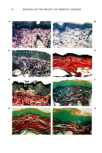
j. Soc. Cosmet. Chem., 45, 21-33 (January/February 1994) The protective effect of a broad-spectrum sunscreen against chronic UVA radiation in hairless mice' A histologic and ultrastructural assessment LORRAINE H. KLIGMAN and PEISHU ZHENG, Department of Dermatology, University of Pennsylvania School of Medicine, Philadelphia, PA 19104-6142. Received July 12, 1993. Synopsis Long-wavelength UVA (340 nm) has been shown capable of inducing dermal damage with chronic exposure. This study assesses the effect of a broad spectrum (SPF-15) sunscreen containing avobenzone (Parsol 1789) in comparison to an oxybenzone-containing sunscreen. Albino hairless mice were irradiated thrice weekly (100 J/cm2/exposure) for a cumulative dose of 8000 J/cm 2 after 32 weeks. Sunscreens were applied (2 •tl/cm 2) to two groups of mice. The third group was unprotected, and a fourth served as a normal unirradiated control. Unprotected, irradiated mice developed epidermal acanthosis and dermal elastic fiber hyperplasia with increased glycosaminoglycans. Mice protected with the avobenzone-containing sunscreen had marginal epidermal hyperplasia but no other histologic damage. By contrast, mice protected with the oxybenzone- containing sunscreen, surprisingly, had damage that exceeded what was seen in unprotected mice. Electron microscopy confirmed the histologic findings and revealed further ultrastructural differences between the treatment groups. The unexpected exacerbation of photodamage with the oxybenzone-containing sunscreen was very likely not due to the oxybenzone but rather to irritation induced by some component in the vehicle. All SPF-15 sunscreens, by definition, must protect against sunburn. The consequences of chronic exposure may be quite different and are clinically relevant. INTRODUCTION As a result of recent studies with hairless mice, the evidence is accumulating that chronic exposure to either full-spectrum (320 nm) or long-wavelength UVA (UVA I: 340 nm) induces dermal connective tissue damage (1-7). With histochemical (1-5), ultrastructural (6), and biochemical techniques (5,7), elastic fiber hyperplasia, increases in the glycosaminoglycans (GAGs) of the ground substance, and a change in the sus- ceptibility of collagen to enzymatic digestion have been described. Reports on sunscreen protection against these UVA-induced changes are beginning to appear. Broad- spectrum, oxybenzone-containing sunscreens (peak absorption: '•320 nm) (8) of sun protection factor (SPF) 15 have been shown histologically to prevent the elastic fiber hyperplasia and the increases in GAGs induced by solar-simulating radiation that in- 21
Purchased for the exclusive use of nofirst nolast (unknown)
From: SCC Media Library & Resource Center (library.scconline.org)