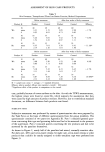
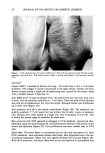
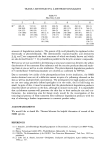
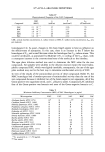
TRICLOSAN ASSAY 39 lOO ,80 o • 60 •e 40 20 5 10 15 20 25 Time (min) Figure 1. Recovery of triclosan from a deodorant stick as a function of extraction time. Other SFE conditions are as in Table I. Values are means of triplicate experiments. based on conventional liquid extraction (6). Four different stick and two soap prepara- tions, all commercially available, were analyzed (Table II). Preliminary experiments using the SFE conditions, optimized for the stick formulation, showed incomplete extraction of triclosan from the soap matrix. This problem was overcome by increasing the extraction temperature from 40 to 50øC (see Table I). The improved recovery obtained for soap preparations at a higher temperature can be traced to sample matrix modification (such as swelling) and to enhanced analyte diffusivity. The results pre- sented in Table II are in compliance with the EEC legislation (7) and indicate that the recoveries from deodorants of this bacteriostat obtained by SFE are higher than those determined with the previously adopted liquid extraction technique (6). Furthermore, sample processing by SFE is more rapid (the entire extraction cycle was completed in less than 30 min) and labor-saving than the classical methods currently used (6,10), as pretreatment of the deodorant preparation is simply reduced to loading the sample into Table II Comparison of Triclosan Levels in Deodorant Products Purified by SFE or Liquid Extraction (6) Sample SFE Concentration (% w/w)* Liquid extraction Deodorant stick A 0.154 (1.2%) 0.149 (1.3%) B 0.025 (4.0%) 0.023 (7.4%) C 0.199 (2.1%) 0.190 (6.3%) D 0.160 (3.7%) 0.157 (4.3%) Deodorant soap A 0.288 (1.5%) 0.266 (4.9%) B 0.234 (0.6%) 0.208 (1.2%) * Each value is the mean (RSD) of six determinitions.

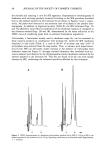
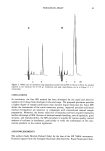
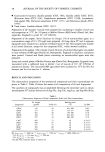
40 JOURNAL OF THE SOCIETY OF COSMETIC CHEMISTS the thimble and inserting it into the SFE apparatus. Representative chrornatograrns of deodorant stick and soap products extracted according to the SFE procedure described here or the method reported in the literature (6) are shown in Figures 2 and 3, respec- tively. No peaks were detected at the retention time of triclosan in the placebo chro- matograrns. In addition to improved accuracy (Table II), the SFE technique (Figs. 2A and 3A) afforded a more effective purification of the deodorant matrices as compared to the reference method (Figs. 2B and 3B), demonstrated by the major reduction in the HPLC traces of interfering peaks from co-extracted formulation ingredients. Triclocarban, a bacteriostat mainly used in deodorant soaps (6), can be contained in these cosmetic products in combination with triclosan (6). Under the SFE conditions described in this study (Table I), a total of 98.4% of triclosan and only 4.6% of triclocarban were removed from the soap matrix. Thus, at variance with liquid extrac- tion (6,10), SFE can selectively isolate triclosan in the presence of triclocarban from deodorant soaps (see Figure 3). Strongly retained substances that interfered with suc- cessive analyses were observed in the chromatograms of some deodorants extracted by the method reported in the literature (6). This was not found to be the case with sample cleanup by SFE, confirming the enhanced specificity afforded by this technique. A B I I I I 4 8 4 8 min Figure 2. HPLC chromatogram of a deodorant stick product purified (A) by SFE (0.110 g) or (B) by the method reported in the literature (6) (0.120 g). Operating conditions are as described under Experimental 1 = triclosan.
Purchased for the exclusive use of nofirst nolast (unknown)
From: SCC Media Library & Resource Center (library.scconline.org)