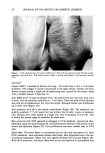
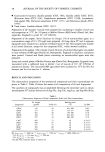
32 JOURNAL OF THE SOCIETY OF COSMETIC CHEMISTS .' .,, "\ -' , i ,A' ... ?.•.' . '-,4: .... ' . • tz ,, ,•' ). ' •.', ' ',•...• .'• -.,-"- •' :'d, ,• -.. •'• •' , ',?• ,'It '":• - .•- •2 ' .•:•,,•' •,-,." .•' ,•¾ff•"•L -' i,'.,•Z•l• .•R_ ß •' '•)• ' ,• • . ': •"' Figure 8. SS-B treated. Elastic fiber (--) hyperplasia was even greater than with UVA alone. Many cells of the inflammatory repertoire were present and eosinophils (*) were abundant. Magnification X 7,800. Bar -- 2•m. regard to chronic effects of UV radiation, is as valid as a large body of evidence suggests (I9), molecules that absorb further into UVA I may be beneficial. Aside from physical blockers of UV radiation such as thick layers of zinc oxide, all sunscreens allow small amounts of radiation to reach the skin. Whereas erythema can be completely prevented, the cumulative "breakthrough" radiation may contribute to pho- toaging. We have shown that 1/2 of a UVA-I MED added to either V4 or 1A of a UVB MED produces dermal photodamage to hairless mice that is additive (20). Over a lifetime, these small amounts of UVA can add up to thousands of Joules of exposure with detrimental photoaging effects. The argument that SPF-I5 sunscreens provide adequate protection against erythema for most people and under most conditions is valid, but acute effects are not the only reason for requiring a sunscreen. Emphasis on acute effects fails to take into consideration the consequences of chronic exposure over a lifetime. ACKNOWLEDGMENTS The authors wish to acknowledge the invaluable participation of several associates: Marilyn J. Crosby and Sally Adams, animal treatment Kermit Wharton, animal care

UVA SUNSCREEN 33 Dorothy Campbell, histology procedures William Witmer, photography Sijie Zheng, electron micrograph printing and Brenda Lacey, manuscript preparation. REFERENCES 1) (2) (3) (4) (5) (6) (7) (8) (9) (lO) (11) (12) (13) (14) (15) (16) (17) (18) (19) (20) L. H. Kligman, F. J. Aiken, and A.M. Kligman, The contributions of UVA and UVB to connective tissue damage in hairless mice, J. Invest. Dermatol., 84, 272-276 (1983). L. H. Kligman, K. H. Kaidbey, V. M. Hitchins, and S. A. Miller, Long Wavelength (340 nm) Ultraviolet-A Induced Skin Damage in Hairless Mice Is Dose Dependent," in Human Exposure to Ultraviolet Radiation.' Risks andRegulations, W. F. Passchier and B. F. M. Bosnjakovic, Eds. (Elsevier, Amsterdam, 1987), pp. 77-81. D. L. Bissett, D. P. Hannon, and T. V. Orr, An animal model of solar-aged skin: Histological, physical, and visible changes in UV-irradiated hairless mouse skin. Photochem. Photobiol., 46, 367-376 (1987). L. H. Kligman, R. M. Sayre, and K. H. Kaidbey, Dermal damage by short to long wavelengths within the UVA spectrum, ?hotochem. ?hotobiol., 45, 77s (1987). A. Fourtanier, J. Labat-Robert, and P. Kern, "Effects of Chronic Suberythemal Doses of Pure UVA Radiations--Protective Effect of a New Sunscreen Mexoryl © SX," in Biologic Responses to UVA Radi- ation, F. Urbach, Ed. (Valdenmar Publ. Co., Overland Park, KS, 1992), pp. 393-407. P. S. Zheng and L. H. Kligman, UVA induced ultrastructural changes in hairless mouse skin: A comparison to UVB-induced damage, J. Invest. Dermatol., 100, 194-199 (1993). L. H. Kligman and M. Gebre, Biochemical changes in hairless mouse skin collagen after chronic exposure to UVA radiation, ?hotochem. ?hotobiol., 54, 233-237 (1991). K. H. Kaidbey and R. W. Gange, Comparison of methods for assessing photoprotection against ultraviolet A in vivo, J. Am. Acad. Dermatol. 16, 346-353 (1987). J. A. Harrison, S. L. Walker, S. R. Plastow, M. D. Batt, J. L. M. Hawk, and A. R. Young, Sunscreens with low sun protection factor inhibit ultraviolet B and A photoaging in the skin of the hairless albino mouse. Photoimmunol. ?hotomed. 8, 12-20 (1991). L. H. Kligman, Luna's technique: A beautiful stain for elastin, Am. J. Dermatopath. 3, 199-200 (1981). R. Hirose and L. H. Kligman, An ultrastructural study of ultra-violet-induced elastic fiber damage in hairless mouse skin, J. Invest. Dermatol., 90, 697-702 (1988). L. H. Kligman, F. J. Akin, and A. M. Kligman, Prevention of ultraviolet damage to the dermis of hairless mice by sunscreens, J. Invest. Dermatol., 78, 181-189 (1982). J. R. Lowe, M. M. Mobayen, T. Bourget, and S. H. Dromgoole, UVA protection in human epi- dermis: Comparison of three sunscreen formulations, J. Invest. Dermatol., 94, 551 (1990). L. H. Kligman, Photoirritation in hairless mice: A novel UVA-dependent phenomenon, Photochem. Photobid., 53, 127s (1991). C. A. Cole and R. Van Fossen, "Testing UVA Protective Agents in Man," in Biologic Responses to UVA, F. Urbach, Ed. (Valdenmar Publ. Co., Overland Park, KS, 1992), pp. 335-345. K. H. Kaidbey and A. M. Kligman, The acute effects of long-wave ultraviolet radiation on human skin, J. Invest. Dermatol., 72, 253-256 (1979). C. Y. Ying, J. A. Parrish, and M. A. Pathak, Additive erythemogenic effects of middle (280-320 nm) and long-wave (320-400 nm) ultraviolet light, J. Invest. Dermatol., 63, 273-278 (1974). L. H. Kligman and R. M. Sayre, An action spectrum for ultraviolet induced elastosis in hairless mice: Quantification of elastosis by image analysis. Photochem. Photobid. 53, 237-242 (1991). L. H. Kligman, The hairless mouse and photoaging. Yearly Review. Photochem. Photobid., 54, 1109- 1118 (1991). L. H. Kligman, UVA enhances low dose UVB tumorigenesis, Photochem. Photobid., 47, 8s (1988).
Purchased for the exclusive use of nofirst nolast (unknown)
From: SCC Media Library & Resource Center (library.scconline.org)