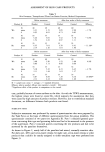
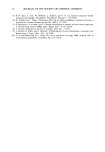
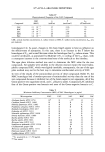
N%ACYL-L-ARGININE DIPEPTIDES 59 Table II Amino Acid Composition of the Acid-Hydrolyzed Collagen (Collagen) and Final Compounds (XAC) in Mols % AA Collagen CAC KAC LAC MAC PAC OH-PRO 10.06 4.91 4.32 6.71 9.17 7.11 ASP 5.15 3.16 2.28 2.29 1.35 2.17 THR 1.17 0.76 0.89 0.59 0.55 0.49 SER 3.64 2.07 1.64 1.44 0.93 1.17 GLU 7.44 6.36 6.79 3.81 4.02 5.17 PRO 12.11 7.11 6.89 6.49 9.58 7.23 GLY 31.43 17.07 18.32 16.07 15.11 18.21 ALA 12.56 7.49 8.28 7.58 7.42 6.17 VAL 1.19 1.01 1.13 0.72 1.17 1.01 MET 0.60 0.15 -- 0.59 -- -- ILEU 1.56 1.02 0.83 0.83 -- LEU 3.05 1.23 1.61 1.82 0.97 0.53 TYR 0.54 0.11 -- 0.18 -- -- PHE 1.25 0.96 -- 0.77 0.39 HIS 0.53 * 1.55 -- 0.24 LYS 2.31 1.38 1.47 1.28 1.50 1.44 ARG 4.83 44.18 41.93 47.67 46.71 48.37 OH-LYS 0.57 1.03 1.13 1.17 0.88 0.93 * --, Not found. coupling the corresponding long-chain N%acyl-nitroarginine (XNA) and the hydroly- sate of collagen through the well-known anhydride mixed method, a classical liquid phase methodology of peptide synthesis. Although we do not have direct experimental evidence such as EM-FAB data to document that these compounds are in fact acyl- dipeptides, results of earlier experiences in the synthesis of monodisperse N s lauroyl dipeptides of arginine (8), the relative peak integration of •H-RMN spectra (amide protons vs aliphatic protons), and amino acid analysis of these compounds (arg/amino acid ratio) support that their structures correspond to those of Formula 1. Temporary protection of the guanidine group of arginine was carried out by using the nitro group (NO 2) (11). The introduction of the strongly electronegative nitrofunction depresses the basic nature of the guanidine groups, thus facilitating the incorporation of arginine into peptides by formation of ot-peptidic bonds without guanidinium lateral competence. The coupling reaction between the alfa carboxylic group of arginine and the alfa amino groups of the amino acid mixture was achieved (yielding 54%-75%) by aminolysis of the activated nitro-arginine alfa-carboxylic group (with the isobutyl chloroformate) at - 15øC (12). The yield of the coupling reaction of PNA decreased, probably due to the structural hindrance of the long fatty acid chain (C•6). The deprotection of the NO2 was carried out by catalytic hydrogenation in the presence of acetic acid, with yields ranging between 79%-89%. The final products were oils and were obtained as hydrochloride salts. Table II indicates the amino acid composition of each of the compounds. The average molecular weight of the compounds was in the range of 481-593 g/mol. The high percentage of arginine in comparison with the rest of the amino acids is in accordance

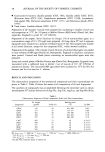
60 JOURNAL OF THE SOCIETY OF COSMETIC CHEMISTS with the structure of these compounds. The higher percentage of proline and OH- proline in the amino acid composition of MAC in comparison to the rest of the homo- 1ogues should be noted. The water solubility of these compounds was partially studied at different pH values at a constant concentration of 5% (w/v) and at room temperature. These values are indi- cated in Table III. All compounds were soluble in water in the range of pH 2-9 except the homologue of 16 carbon atoms, which showed total solubility only at pH 9. These results appear to indicate that the high hydrophobic character of the palmitoyl residue in the molecule is the reason for its water insolubility. To assess the surface-activity properties of these compounds, the following parameters were determined from the surface tension-log concentration plots: the surface tension at the CMC (•/), the CMC values, the surface excess concentration (I•), and the area per molecule (An•). All of these data are shown in Table IV. The CMC were expressed as mmolar values on the basis of the corresponding average molecular weight of each compound. The low surface-tension values of solutions of our acyldipeptides, (35-27 nM/m), and the appearance of a CMC, suggest their utility as surfactants. These values are compa- rable to the 28 and 40 nM/m obtained for miceliar solutions of two commercial sur- factants: collagen tripeptide acylated with coconut fatty acid and sodium lauryl sulfate, respectively (13). As expected, the nature of the fatty chain influences the surface- activity properties of the surfactants. As in the case of a series of conventional surfactants with the same polar group, a) the longer the alkyl chain, the lower the surface tension values, and b) the longer the alkyl chain, the lower the CMC values. From these results, we may conclude that in this series the most important factor governing micellar aggregation is the attracting forces between the hydrophobic radicals. The most hydro- phobic compound (PAC) showed the greatest ability to lower the surface tension and to form micelies. The Gibbs surface excess concentration (I TM) is defined by the concentration of surfactant at interface, and it is an indication of how much the interface has been covered by the surfactant (14). The higher the I •, the more effective the adsorption at the aqueous/air interface. On the other hand, the area per molecule (An0 at interface provides informa- tion on the packing and orientation of the adsorbed surfactant molecule. The lower the An• , the more closely packed are the molecules at interface. Table IV indicates the values 0 2 for the I TM and the A m at the interface at surface saturation in mols/nm 2 and A/molecule, respectively. In general, these values are in accordance with other series of surfactant Table III Water Solubility of XAC Homologues at Room Temperature, as a Function of pH Value* Compound pH = 2.0 pH = 5.0 pH = 7.0 pH = 9.0 CAC + + + + KAC + + + + LAC + + + + MAC + + + + PAC - - - + The compounds gave a pH of 4.0 + 0.5 at c = 5% (w/v) in water. +, soluble -, insoluble.
Purchased for the exclusive use of nofirst nolast (unknown)
From: SCC Media Library & Resource Center (library.scconline.org)