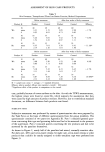
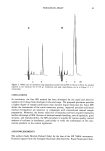
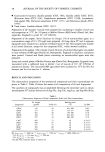
ASSESSMENT OF SKIN CARE PRODUCTS 5 areas are dabbed with cellulose tissues and air-dried for 15 minutes. 20 Ixl of solution 4 is spread on each measurement area within 30 seconds and dried for 30 seconds. In this time test glasses are fixed again. Then measurement areas are washed with 2 ml of solution 2 for 45 seconds by moving the forearms. The solution is removed and dis- carded. Remainders of methylene blue are rinsed off twice with 2 ml of solution 3. Extinction (E) of the collected dyestuff solution is measured with a photometer at 660 nm against solution 3. ß Relative product efficacy = E product - E control E control x 100 ß Testglass: Glass cup with transpierced bottom, 3.5 cm in diameter and 5 cm in height (all centers used glass cups of the same kind). ß Solution ! = 1% Nonoxynol 30 in water ß Solution 2 = 0.25% Nonoxynol 30 in water ß Solution 3 = 2% Sodium laureth sulfate in 48% water and 50% isopropyl alcohol ß Solution 4 = 20% Methylene blue (0.5%) in 80 ml solution 1. Results for four centers are presented in Table II. The last column contains efficacy values that are negative in this case because dyestuff adsorption is reduced in smoother skin. It is evident that significant improvements in skin smoothness were assessed at all centers for "K." For "N," reductions were also found in all centers, with significant values only in two centers. Surfometry (26-30). Surfometry is a method used to evaluate skin microtopography. For this, skin surface negative replicas are made with a silicone rubber (Xantopren). These replicas are then measured radially over 12 scans in 30' intervals and on a total length of 15 mm as shown in the following figure: direction of the rotation 10 I 2 12 30" ß -' 3 = mm• 4 5 7

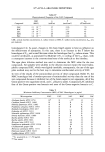
6 JOURNAL OF THE SOCIETY OF COSMETIC CHEMISTS Table II Skin Parameter: Skin Roughness Method: Methylene Blue Before treatment After four weeks of daily treatment Product K Product Control Product Control Efficacy N 31 31 31 31 Schr mean 35.8 39.7 28.0 34.2 s 11.7 11.9 7.5 8.1 N 4O 4O 4O 4O We mean 40.3 40.8 36.3 43.3 s 16.7 16.9 12.6 15.1 N 34 34 31 31 BDF mean 43.0 44.3 34.7 45.1 s 13.3 15.6 15.3 16.9 N 22 22 22 22 Schw mean 38.9 31.5 30.8 41.1 s 14.8 12.8 9.8 12.4 - 18.1%* - 16.2%* -23.1%* -25.1%* Before treatment After four weeks of daily treatment Product N Product Control Product Control Efficacy N 33 33 33 33 Schr mean 37.2 37.9 30.6 33.9 s 8.9 9.0 11.9 11.7 N 4O 4O 4O 4O We mean 41.0 39.0 37.8 43.0 s 20.4 21.0 15.0 16.0 N 33 33 33 33 BDF mean 41.7 42.7 31.5 44.8 s 15.5 15.9 11.5 19.0 N 22 22 22 22 Schw mean 40.6 40.5 31.5 39.2 s 9.3 13.4 12.8 13.9 -9.7%* - 12.1% -29.7%* - 19.6%* N = sample size mean = average s = standard deviation. Efficacy: relative product efficacy ratio (product--control) ß 100/control. ß Highly significant efficacy of the product in comparison to the control. The analyzed parameter, Rtm, the mean peak-to-valley height, is defined for each scan according to DIN 4768/1 as follows: Rtm = 1/5 (Z1 + Z2 + Z3 + Z4 + Z5) (The arithmetic average maximum peak-to-valley height-of-roughness value Z 1 to Z5 of five consecutive sampling lengths over the filtered roughness profile.) Experimental: The investigations took place in a room with a constant climate of 22øC and 55% relative humidity. The volunteers had to acclimatize in this room for 15 min before the replicas were taken at the test sites (inner side of the forearm). Only two centers were experienced with this method. Results in Table III show significant re- ductions of skin roughness after the test period for both products at both centers, but no differences between the products.
Purchased for the exclusive use of nofirst nolast (unknown)
From: SCC Media Library & Resource Center (library.scconline.org)