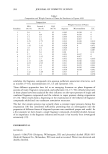
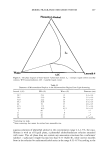
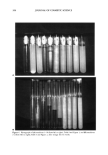
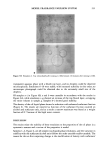
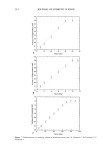
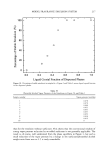
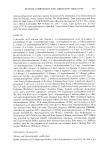
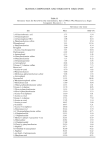
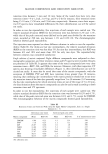
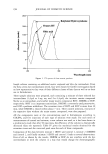
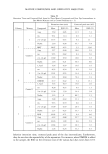
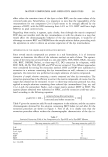
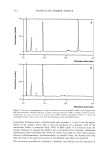
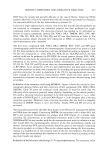
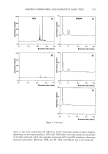
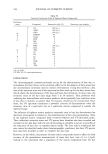
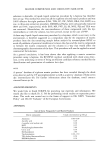
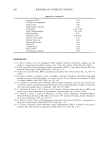
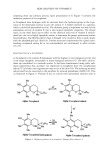
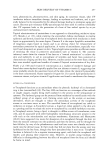
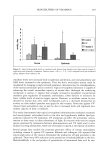
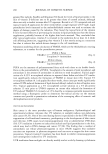
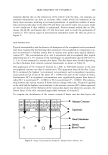
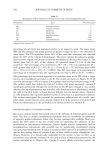
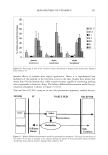
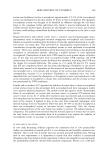
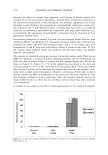
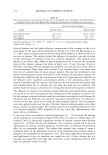
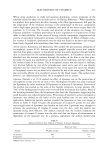
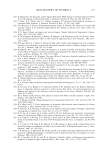
MODEL FRAGRANCE EMULSION SYSTEM 217 lOO 8o 8o 40 20 0 [] I 0.0 I ' I ' I ' I ' I ' I [] [] [] - I , I I • I , I • I 0.2 0.4 0.6 0.8 1.0 Liquid Crystal Fraction of Dispersed Phases Figure 10. Percentage of stable emulsion in samples b-i, Figure 2 and Table I, versus liquid crystal fraction in the dispersed phases. Table IV Phenethyl Alcohol Vapor Pressures of the Emulsions in Figure 5A and Table I Sample number Vapor pressure (mmHg) 1 0.078 2 0.070 3 0.060 4 0.053 5 0.053 6 0.053 7 0.052 8 0.036 9 0.012 0 0 than for the emulsion without surfactant. This shows that the conventional wisdom of strong vapor pressure reduction by an added surfactant is not generally applicable. The result is, of course, well understood from the phase equilibria in Figure 3, but such a small reduction of the vapor pressure by a change in the surfactant/phenethyl alcohol weight ratio from zero to 2.5 is truly remarkable.

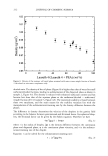
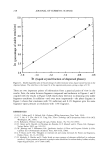
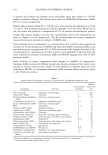
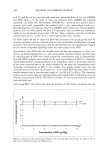
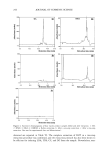
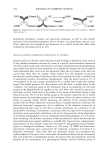
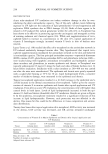
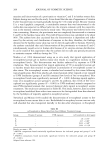
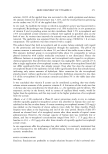
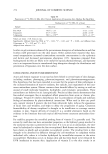
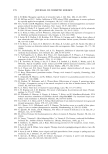
218 JOURNAL OF COSMETIC SCIENCE 5.0 4.0 3.,5 3.1:) 2.õ 2.0 ' I ' I ' ' I ' I ' -1.4 -1.2 -1.0 -0.8 In (liquid crystal fraction of dispersed phases) -0.6 Figure 11. Double-logarithm plot of the percentage of stable emulsion versus liquid crystal fraction in the dispersed phases. The solid line is the linear fit of the experimental points, giving a slope of 2.50. There are two important points of information from a practical point of view in the results. First, the ratios between fragrance compound and surfactant in Figures 1 and 2 coupled with the results in Figure 4A,B clearly show the limit to obtaining very stable fragrance emulsions. In addition--and even more importantly--the phase diagram in Figure 3 shows that emulsions with 5% surfactant and 0.1% fragrance give the same fragrance vapor pressure as emulsions with 1.5 % fragrance. REFERENCES (1) R. C. Colkin and J. S. Jellinek, Eds., Perfumery (Wiley-Interscience, New York, 1994). (2) C.T. Ho, S. T. Tan, and C. H. Tong, Eds., Flavor Technology (ACS Symposium Series 610) (ACS, Washington, DC, 1995). (3) K. Ballantyne, Perfume through the ages, Parfum. Kosmet., 76, 716-718 (1995). (4) H. Altner and J. Boeckh, in Physio/ogie des Menschen, R. F. Schmidt and G. Thews, Eds. (Springer- Verlag, Berlin, 1987), pp. 320-352. (5) W. Jennings and T. Shibamoto, Eds., Qualitative Analysis of Flavor and Fragrance Vo/atiles by G/ass Capillary Gas Chrimotography (Academic Press, New York, 1980). (6) J.P. Rozat and F. Nit, Thoughts on essential oils and aroma chemicals for flavors and fragrances, Perfum. Flavor., 21, 13-19 (1996). (7) R. Akaboski, S. Horike, and S. Noda, Study on vapor pressure of odorants solubilized in surfactant micelies. I. Vapor pressure ofgeraniol or geranyl acetate solubilized in sodium dodecyl sulfate micelies, Nippon Kagak• Kaishi, 1974-1980 (1984).
Purchased for the exclusive use of nofirst nolast (unknown)
From: SCC Media Library & Resource Center (library.scconline.org)