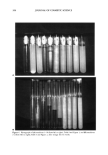
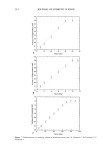
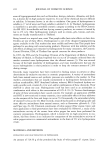
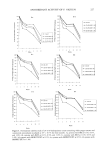
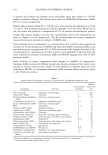
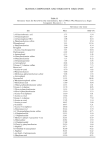
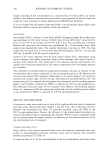
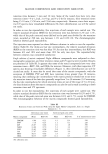
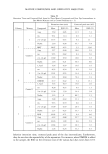
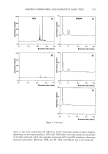
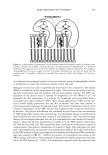
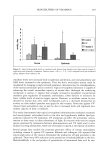
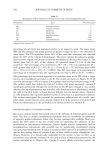
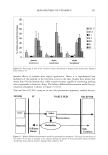
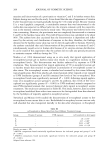
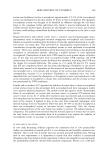
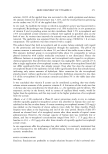
MATRIX COMPOUNDS AND OXIDATIVE HAIR DYES 243 BHT from the sample and partially effective in the case of NaAsc, before the HPLC analysis. Moreover, it has to be stressed that with this extraction procedure by n-heptane, the non-extractability of the dye intermediates is ensured (9). Extraction of single-compound matrix solutions. Due to the fact that the dye intermediates are not extracted by n-heptane, the extraction protocol was then performed on single- compound matrix solutions. The extraction protocol was applied to 16 individual so- lutions of matrix compounds, namely OA, NNO, ORA, DMDM, BHT, PVP, MP, LDA, TDS, DC, NOL, SS, LS, TEA, PQ, and CC (see their function in Table I). The resulting aqueous phases obtained were submitted to HPLC or analyzed by UV-Vis spectrophotometry when necessary. The first seven compounds (OA, NNO, ORA, DMDM, BHT, PVP, and MP) show chromatographic peaks for which the chromatographic characteristics are given in Table III. For these products, the extraction yield was calculated according to equation 1. For the last nine compounds, i.e., LDA, TDS, DC, NOL, SS, LS, TEA, PQ, and CC, the final analysis could not be performed by RP-HPLC for several reasons: because LDA, NOL, and TDS are surfactants, the submission of these compounds to RP-HPLC leads to their adsorption in the system, thus provoking further contamination, and the compounds CC, LS, SS, TEA, DC and PQ do not show any chromatographic peak when submitted to RP-HPLC. As an alternative, a UV-Vis spectrophotometer was then used to test the extraction procedure on these nine compounds, by recording the spectra obtained before and after extraction. In order to determine if the UV-Vis spectrophotometer was sen- sitive enough for the extraction measurements, BHT, which has been shown to be extracted by n-heptane (see above), was used for comparing results obtained using both procedures. Evaluation of the extraction yield using RP-HPLC. Figure 4 shows the successive chro- matograms obtained before and after extraction of four compounds (OA, NNO, ORA, DMDM). Table VI gives the extraction yield obtained. It must be noted that the efficiency of the extraction protocol varies slightly, depending on the matrix product. OA needs a two-step extraction procedure to be fully extracted (Figure 4, la-c), while the peaks of NNO (Figure 4, 2a,b) and ORA (Figure 4, 3a,b) disappear after a one-step extraction procedure. Moreover, even a two-step procedure does not lead to a complete extraction of DMDM (Figure 4, 4a-c) and NaAsc. Finally, PVP and MP are not at all extracted. The extraction protocol has therefore been shown to be efficient for isolating OA, NNO, and ORA from the sample. Concerning DMDM, the extraction yield is about 80% and MP is not extracted. Nevertheless, by analogy with EOP (Figure 2), a similar study involving the concentration as an additional parameter leads to the conclusion that DMDM and MP do not interfere with the dye intermediates or with the column in a way that would affect the chromatographic behavior of the dye intermediates (results not shown). Concerning PVP, special attention should be given to real samples containing this matrix product, as it forms a film on the column surface during the first injection, leading to a modification of the retention times of the dye intermediates. The determi- nation of the dye intermediates has therefore to be carried out mainly according to their spectrum (results not shown). Evaluation of the extraction yield using UV-Vis spectrophotometry. The extraction yields

244 JOURNAL OF COSMETIC SCIENCE 1300 900 - 600 - 3oo- -75 0.0 1300 9oo_ E • 600- ,.• 300- -75 oo 1300 900- g600- "• 300- OA la I I I 16u -25 15.0 30.0 45.0 57.0 Retention time (min) 0.0 NNO I 2a I I 15.0 30.0 45.0 57.0 Retention time (min) 15.0 30.0 44.0 Retention time (min) 160 113 I 213 .•1oo I -25 I I o.o 15.o 30 o 44.0 Retention time (rain) lc o.o 15.o 30.0 45.0 57 o Retention time (rain) Figure 4. Successive chromatograms of four matrix product samples before and after extraction. 1: OA 2: NNO 3: ORA 4: DMDM. a: Before extraction. b: After a one-step extraction. c: After a two-step extraction. (See text for experimental data and abbreviations.) obtained are reported in Table VI. The complete extraction of BHT in a two-step extraction procedure was confirmed, and the extraction protocol has also been shown to be efficient for isolating LDA, TDS, CC, and DC from the sample. Nevertheless, once
Purchased for the exclusive use of nofirst nolast (unknown)
From: SCC Media Library & Resource Center (library.scconline.org)