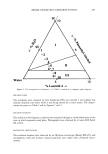
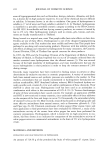
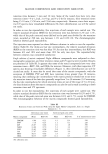
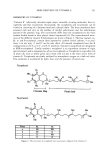
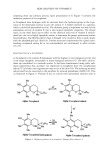
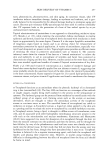
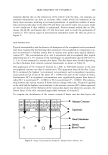
SKIN DELIVERY OF VITAMIN E 251 CHEMISTRY OF VITAMIN E "Vitamin E" collectively describes eight major, naturally occuring molecules, four to- copherols and four tocotrienols. Structurally, the tocopherols and tocotrienols can be viewed as consisting of a chroman head and a phytyl chain. The four tocopherols have saturated tails and vary in the number of methyl substituents and the substitution pattern of the phenolic ring. The tocotrienols differ from the tocopherols by the three isolated double bonds in their phytyl chains (isoprenoid) (9). The stereochemical struc- tures of the different vitamin E homologues are given in Figure 2. The four isomers, o•-, [3-, •/- and 8-tocopherol, contain three asymmetric carbons (chiral carbons, *) at posi- tions 2 on the ring, 4' and 8' on the side chain. All natural tocopherols have the R configuration at the C-2, C-4', and C-8' positions. Natural o•-tocopherols are designated as RRR-cx-tocopherol. Totally synthetic tocopherol is an equivalent mixture of eight optical isomers and is designated as a//-rac-(•-tocopherol. o•-Tocopherol is especially rich in plant oils such as wheat germ and cotton seed oil and is the most active form of vitamin E. Tocopherols are slowly oxidized by atmospheric oxygen to a dark red color. This oxidation is accelerated by light, heat, and the presence of metal ions. Tocopherol: R1 HO. 6 •'• A R2 8 e Me Me Chroman Ring Phytyl chain Tocotrienol: R1 HO 6/• Me Me Me R2 8 1 l•le 3' 7' 11' Me Me Form R• a Me Me • Me H ¾ H Me 8 H H Figure 2. The structures of tocopherols and tocotrienols. Adapted from reference 9.

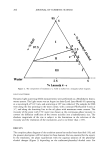
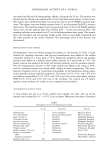
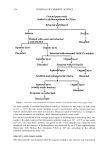
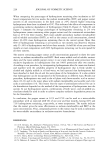
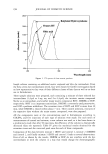
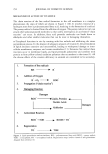
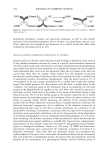
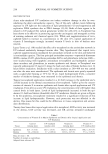
252 JOURNAL OF COSMETIC SCIENCE MECHANISM OF ACTION OF VITAMIN E The chain reaction of the free radical formation in the cell membrane is a complex phenomenon the steps of which are shown in Figure 3 (10). It involves removal of a hydrogen atom from a polyunsaturated fatty acid, resulting in the formation of a radical. The peroxy radical is formed from the addition of oxygen. The peroxy radical in turn can attack other polyunsaturated molecules so that unless interrupted, an accelerated "chain reaction" can occur. In addition, fatty acid peroxide molecules can break down to aldehydes and other smaller molecules that can be toxic or damaging themselves. tx-Tocopherol functions in vivo by reacting with free radicals and inhibiting the tissue peroxidation process. In the absence of adequate amounts of vitamin E, the peroxidation of lipids becomes extensive and uncontrolled, leading to widespread damage to intra- cellular membranes, enzymes, and certain metabolites (11). Extensive free radical chain reactions occur in membrane lipids, and lipid peroxides polymerize and combine with protein to form yellow-colored oxidation polymers that accumulate in the tissue (1). All the diverse effects of the vitamin deficiency in animals are considered to be secondary, o . Formation of free radicals RH ............................................ t• Addition of Oxygen R' + 02 ........................ • Propagation ("chain reaction") Damaging Reaction Damages RO0' Antioxidant Reaction , ROO' • Lipids, Proteins Nucleic Acids .• Aldehydes Damages . RO0' + TOH ........................ t• ROOH + TO' Regeneration TO' ß ........................................... • TOH Figure 3. Lipid peroxidation and antioxidants. RH = polyunsaturated fatty acid ROO': peroxy radical TOH = ot-tocopherol TO' = ot-tocopheryl radical. Regeneration steps involve vitamin C and glutathione. Adapted from reference 10.
Purchased for the exclusive use of nofirst nolast (unknown)
From: SCC Media Library & Resource Center (library.scconline.org)