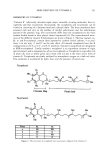
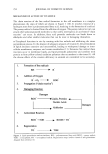
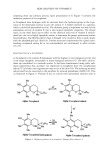
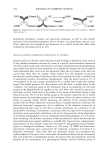
SKIN DELIVERY OF VITAMIN E 269 acetate was hydrolyzed to free tx-tocopherol approximately 4.5-5 % of the tx-tocopheryl acetate was hydrolyzed in the skin within 24 hours to free tx-tocopherol. The lipophilic tx-tocopheryl acetate was thought to be absorbed by diffusion through the cell mem- brane to the cytoplasm within individual cells, where it may be hydrolyzed by intra- cellular esterases and/or lipases. Esterases are also thought to occur in sweat, and vitamin E acetate could undergo extracellular hydrolysis before its absorption by the skin in such species. Kramer-Stickland and Liebier (106) used a sensitive gas-chromatography-mass- spectrometry assay to distinguish between endogenous tx-tocopherol and deuterium- labeled tx-tocopherol resulting from hydrolysis of topically applied deuterated tx-tocoph- eryl acetate on mouse skin. This permitted an unambiguous characterization of the contribution of topically applied o•-tocopheryl acetate to total epidermal o•-tocoperhol content. There was a modest hydrolysis of the deuterated ester prodrug to the deuterated tocopherol in unirradiated animals, reflecting a tenfold increase in total epidermal o•-tocopherol. Pretreatment of mice with UVB caused an even greater degree of hydrol- ysis. If the skin was pretreated with tx-tocopherol before UVB exposure, the UVB enhancement of o•-tocopheryl acetate hydrolysis was abolished, indicating that UVB was the trigger for increased hydrolysis. The acetate at a 5.3 pmol (50 mg of a 5% cream) dose did not completely protect the skin from photodamage. Hydrolysis in the unirra- diated mice seemed to be dependent on the amount of the acetate absorbed. Hydrolysis was saturable over a 24-h period, and increases in the acetate dose did not result in a corresponding increase in its hydrolysis. Hydrolysis in irradiated mice was time- dependent but not limited by absorption. tx-Tocopheryl acetate was hydrolyzed to the active antioxidant tx-tocopherol in mouse skin, and hydrolysis and the esterase activity was potentiated by UVB irradiation. Gensler and co-workers (107) reported the inability of mouse skin to cleave tx-tocopheryl acetate and succinate to the antioxidant form tx-tocopherol and their consequent inabil- ity to prevent photocarcinogenesis. The authors tested the capacity of the thermostable forms of tx-tocopherol, its acetate and succinate esters, to prevent UV-induced skin cancer in mice in vivo. At 17 weeks after treatment, skin was removed and concentrations of o•-tocopherol and its esters were detected chromatographically. The authors found that most of the vitamin E applied to skin in the ester form remained unchanged, with limited cleavage to free tx-tocopherol. There was only 10-30% as much tx-tocopherol as there was o•-tocopheryl acetate or succinate (wt/wt), respectively. Also, the chronic topical administration of the ester forms was unable to prevent UV-induced photocar- cinogenesis. The authors have reasoned that the limited capacity of mouse skin to cleave the ester forms to the antioxidant form of o•-tocopherol may explain the inability of o•-tocopheryl acetate or succinate to prevent photocarcinogenesis. IN VITRO AND IN VIVO STUDY In vitro study. Increasing evidence supports the contention that in vitro permeability studies can somewhat accurately predict in vivo absorption and possibly cutaneous me- tabolism. This is only true if studies take into account potential problem areas. During such in vitro experiments it is important to ensure that skin viability is maintained throughout the time duration of the experiment. Cadaver skin should be used cautiously the permeability should be checked with standard compounds. Wester et al. (108) have

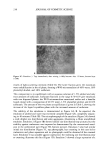
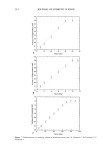
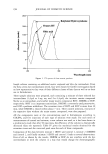
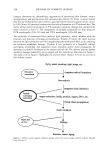
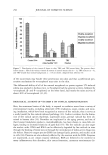
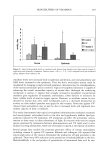
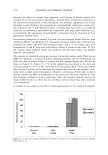
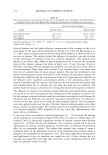
270 JOURNAL OF COSMETIC SCIENCE discussed the effects of storage, heat separation, and freezing on human cadaver skin viability for in vitro percutaneous absorption. Another factor of potential importance is the dermal microvasculature in skin absorption, and therefore, appropriate use of full- thickness or split-thickness skin preparations in permeability studies also requires fur- ther attention. Use of full-thickness human or animal skin may result in an artificial reduction in permeation, particularly for compounds with high lipid solubility (e.g., c•-tocopherol). The absorption of hydrophobic compounds must be measured with an appropriate receptor fluid. Percutaneous absorption of vitamin E acetate into and through human skin has been studied by Wester and Maibach (35). Dermatomed human cadaver skin (500 pm) was mounted into glass cells with flow-through design, with a 1-cm 2 surface area. Two formulations, A and B, were used with labeled vitamin E acetate as the active. At 24 h the receptor fluid (buffered saline) was analyzed, and the skin surface was washed, digested, and analyzed. The majority of vitamin E acetate was recovered in the skin surface wash. There was no difference, however, in vitamin E acetate absorption between the two formulations, as both were able to deliver vitamin E acetate into and through human skin. Results are shown in Figure 12. About 1.5-1.7% of the applied dose was found in the skin, and minimal quantities, 0.63-0.78%, were found in the receptor fluid. This study showed that vitamin E acetate can be delivered into human skin and into the systemic circu- lation with a simple topical formulation. However, a limitation of this study is that it did not consider the effect of metabolism of the acetate into the active vitamin E or the skin enzymes involved in such a conversion. Also, the receptor medium used in the study, buffered saline at a flow rate of 3 ml/hour, did not ensure that sink conditions were maintained. In another in vitro study on rat skin 6 h after application of a 5% vitamin E alcoholic 120 100 • 8O 60 4o 20 Receptor Skin Fluid Content Surface Wash [] Fommla A [] Formula B Figure 12. In vitro percutaneous absorption of vitamin E acetate into and through human skin. Adapted from reference 35.
Purchased for the exclusive use of nofirst nolast (unknown)
From: SCC Media Library & Resource Center (library.scconline.org)