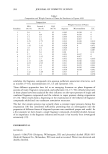
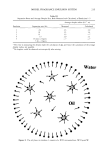
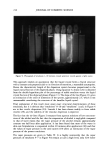
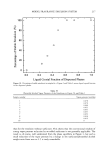
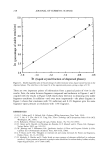
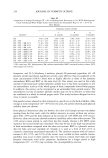
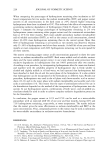
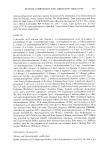
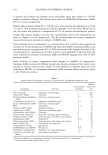
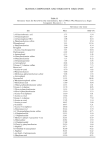
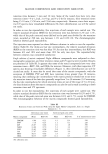
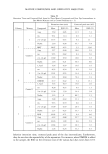
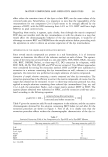
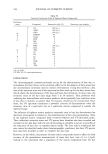
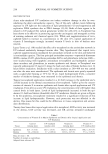
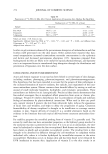
204 JOURNAL OF COSMETIC SCIENCE Table I Composition and Weight Fraction of Phases for Emulsions in Figures 4A,B Composition Weight Fraction of Phases PEA Laureth 4 H20 Emulsion (wt %) (wt %) (wt %) Aqueous Microemulsion LLC 1 5.0 0 95 0.962 0.038 0 2 4.2 0.8 95 0.961 0.039 0 3 3.4 1.6 95 0.959 0.041 0 4 2.6 2.4 95 0.933 0.067 0 5 2.25 2.75 95 0.932 0.049 0.019 6 1.8 3.2 95 0.930 0.026 0.044 7 1.45 3.55 95 0.928 0 0.072 8 1.0 4.0 95 0.920 0 0.080 9 0.5 4.5 95 0.913 0 0.087 10 0 5.0 95 0.90 0 0.10 a 2.7 2.3 95 0.953 0.047 0 b 2.55 2.45 95 0.933 0.067 0 c 2.3 2.7 95 0.932 0.052 0.016 d 2.15 2.85 95 0.932 0.046 0.022 e 2.05 2.95 95 0.931 0.040 0.029 f 2.0 3.0 95 0.931 0.035 0.034 g 1.8 3.2 95 0.930 0.026 0.044 h 1.7 3.3 95 0.930 0.018 0.052 i 1.42 3.58 95 0.927 0 0.073 j 0.8 4.2 95 0.922 0 0.078 solubilize the fragrance compounds into aqueous surfactant association structures, such as micelies (7-10), microemulsions (11,12)and liposomes (13). These different approaches have led to an emerging literature on phase diagrams of systems of water, fragrance compounds, and surfactants (14-17). The colloidal structures in these phases have been analyzed for their influence on the vapor pressure of single and combined fragrance compounds and the relation to vapor pressure during evaporation (17,18). These results form a beginning in the examination of the behavior of fragrance compounds solubilized into surfactant association structures. The fact that simple systems may actually show a constant vapor pressure during free evaporation (18) was considered sufficiently promising that an investigation into the properties of different forms of dispersed systems was considered proper and useful. As a first example we have chosen a single fragrance compound, phenethyl alcohol, because of its importance in the fragrance industry and because it has recently been investigated extensively (19). EXPERIMENTAL MATERIALS Laureth 4 (Brij©30) (Uniqema, Wilmington, DE) and phenethyl alcohol (PEA) 99% (Aldrich Chemical Co., Milwaukee, WI) were used as received. Water was deionized and doubly distilled.

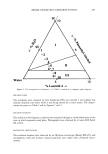
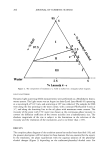
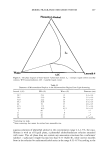
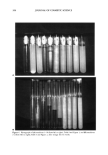
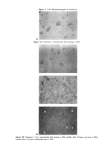
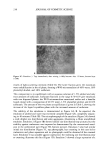
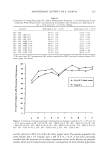
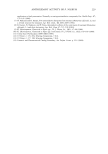
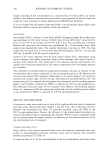
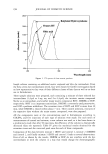
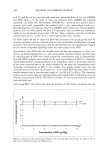
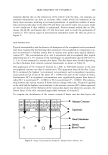
MODEL FRAGRANCE EMULSION SYSTEM 205 ! 90 ,' lO Water o o\ø 95 x2 x3 4 5 II 6 x x8 III 9x•10 5 10 % Laureth 4 Figure 1. The composition of emulsions 1-10, Table I, marked on a triangular phase diagram. EMULSIFICATION The emulsions were prepared by first dissolving PEA into laureth 4 and adding this solution dropwise into water while it was being stirred by a vortex mixer. The compo- sitions are given in Table I and in Figures 1 and 2. EMULSION STABILITY The stability of the fragrance emulsion was examined through a visual observation of the time in which separation took place. Photographs were obtained by a Canon EOS Rebel XS camera. MICROSCOPIC OBERVATIONS The emulsion droplets were observed by an Olympus microscope (Model BHA-P), and microphotos, with and without crossed polarizers, were taken with a Polaroid micro- camera.
Purchased for the exclusive use of nofirst nolast (unknown)
From: SCC Media Library & Resource Center (library.scconline.org)