j. Cosmet. Sci., 52, 355-368 (November/December 2001) A new approach to the bending properties of hair fibers F. BALTENNECK, A. FRANBOURG, F. LEROY, M. MANDON, and C. VAYSSI]•, L'Oreal Recherche, 1 Avenue Eugane Schueller, 93600 Aulnay sous Bois (F.B., F.L.) and 90 Rue Gdndral Roguet, 92583 Clichy Cedex (A.F., M.M., C.V.), France. Accepted for publication July 31, 2001. Synopsis A new test developed to characterize the bending properties of treated or virgin hair fibers is described. The device consists of a pendulum that bends a sample made up of 39 parallel hair fibers at each swinging stroke. Hair bending stiffness can be assessed by the number of strokes observed until the pendulum stops. The mechanical behavior of natural hair fibers is related to their geometric characteristics. The effects of various hair treatments can be assessed by this method. ABBREVIATIONS N '/lex 171 L b 0o k EMEAN I E.I RMEAN M(x) 8 F Initial energy of the pendulum (in N.mm) Total numbers of strokes until the pendulum stops Bending energy lost by the pendulum by bending 39 hair fibers 1 l-ram long (in N.mm) Inertia mass of the pendulum (47 g) Gravitation constant (9.81 m.s -2) Distance between the rotation axis and the center of gravity (0.185 m) Distance between the rotation axis and the bending bar (0.218 m) Initial angle of the pendulum (30 ø ) Geometric constant for the bending test (0.2149 mm -•) Mean intrinsic elastic modulus of hair fibers (in MPa or N.mm 2) Momentum of inertia in bending (in mm 4) Bending rigidity (in N.mm 2) Mean radius of all hair fibers (in •m) Momentum of applied forces on the fiber (in N.mm) Linear displacement of the bending bar (in mm) Recalculated length of bending fiber during bending test (in mm) Bending bar radius (r = 1.5 mm) Free end of hair fibers in the bending test (l = 11 mm) Number of fibers of the sample (usual sample n = 39) Relative humidity 355

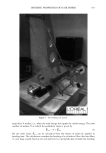
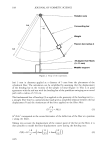
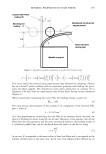
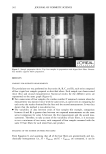
356 JOURNAL OF COSMETIC SCIENCE INTRODUCTION In the development of new hair products, the availability of relevant in vitro techniques for efficacy assessment is of paramount importance. Indeed, with the increase in inno- vative products, efficient and rapid tests are strongly needed to get an instantaneous estimation of the tested formulae. Most particularly for hair products, it is necessary to evaluate the effects of a given treatment on the mechanical properties of hair fibers. Numerous techniques addressing hair mechanical behavior have been proposed (1). They can be divided into four main domains: © Tensile properties © Bending properties © Torsion properties © Relaxation in each of the different modes However, the most direct way to evaluate the influence of cosmetic products on the mechanical rigidity of hair fibers is offered by bending tests: bending is the natural configuration of hair on the head, and most sensory evaluations regarding mechanical rigidity as well as global hair appreciation such as "body" are related to the bending properties of hair fibers. Swift reported recently (2), from atomic force microscopy data given by Parbhu et al. (3), that the cuticle makes a major contribution to the bending behavior of hair. To investigate single-fiber bending, four main methods have been developed: a cantilever loaded at one end (4), a loaded loop (5), a pendulum (6-7), and a vibrating rod (8). These methods were first developed in the field of textiles and fabrics. However, the limiting factors of single-fiber tests lie in the questionable correlation between in vitro measurements and in vivo evaluation on a full head of hair. Moreover, these tests either require sophisticated devices, or are quite complicated in their conception. In fact, these techniques are of little interest for a fast and easy evaluation of numerous cosmetic products. The interest of the method presented in this paper lies in the manner that the technique tests the bending properties of an assembly of parallel hair fibers. It is thus possible to obtain in vitro data that is more representative of in vivo observations. Since the method is simple to use and allows for fast data processing, it can be a valuable aid in screening tests. THEORY The bending test apparatus (Figure 1) is shown in more detail in the overall setup of the experiment shown in Figure 2. The pendulum consists of a bar that is weighted with a mass m fixed at a distance L• from the rotation axis. At the beginning of the test, the connecting bar is displaced from the vertical at an angle 0 o. The initial energy of the mobile system Ei,it can be calculated by considering the mechanical state of the pen- dulum at its initial position: Einit = mgL w (1 - cos(0o)) (1) The pendulum is then released and starts swinging with an initial speed of 0 (i.e., without any initial push). At each crossing of the vertical, the flexion bar (distance L b from the rotation axis) bends the sample made of 39 parallel hair fibers (11-mm long). The elastic bending of these fibers requires an energy Efle,•. Consequently, the pendulum
Purchased for the exclusive use of nofirst nolast (unknown)
From: SCC Media Library & Resource Center (library.scconline.org)