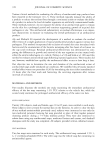
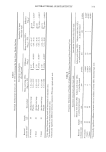
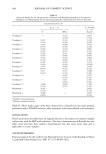
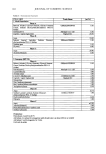
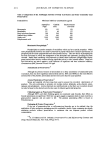
404 JOURNAL OF COSMETIC SCIENCE Table II Analytical Results for the Determination of Fluoride and Monofiuorophosphate in Commercial Toothpastes and Mouthwashes by Ion Chromatography (IC) and Fluoride-Ion Selective Electrode Concentration (w/w, %) IC (n = 5 •) F- electrode (n = 6 •) F- FPO32 Total F- Toothpaste 1 0.075 0.074 (4.3%) b (2.5%) Toothpaste 2 0.244 0.129 0.376 (1.1%) (1.4%) (5.0%) Toothpaste 3 0.245 0.386 0.632 (0.7%) (2.4%) (2.2%) Toothpaste 4 0.369 0.239 0.605 (3.3%) (4.1%) (2.3%) Toothpaste 5 0.390 0.231 0.620 (5.0%) (4.0%) (0.5%) Toothpaste 6 0.314 0.360 0.669 (3.7%) (4.4%) (4.4%) Toothpaste 7 0.245 0.239 0.474 (2.0%) (4.4%) (0.76%) Toothpaste 8 0,144 0.467 0.618 (0.9%) (5.1%) (0.7%) Toothpaste 9 0.211 0.355 0.588 (2.4%) (3.7%) (1.8%) Toothpaste 10 -- 0.667 0.675 (2.5%) (3.9%) Toothpaste 11 -- 1.09 1.055 (3.6%) (5.6%) Toothpaste 12 0.064 0.690 0.768 (5.3%) (5.5%) (1.6%) Mouthwash 1 0.021 -- 0.028 (1.2%) (1.5%) Mouthwash 2 0.068 -- 0.070 (2.8%) (2.6%) Number of determinations. Relative standard deviation. Table II. These results agree with those obtained by a fluoride-ion electrode method, performed with a TISAB II solution, after treatment with hydrochloride acid hydrolysis. CONCLUSIONS The IC procedures described here are applied directly to the analysis of cosmetic samples without the need for MFP acid hydrolysis. The direct determination of fluoride not only offers more precision than indirect determination but also saves more time and is applicable to actual samples. ACKNOWLEDGMENT Financial support for this work by the National Science Council of the Republic of China is gratefully acknowledged (no. NSC 87-2113-M-041-002).

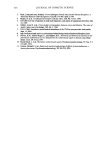
FLUORIDES IN ORAL HYGIENE PRODUCTS 405 REFERENCES (11) (12) (1) B.G. Bibby, A new approach to caries prophylaxis: A preliminary report on the use of fluoride application, Tufts Dental Outlook, 6, 4 (May 1942). (2) V. D. Cheyne, Human dental caries and topically applied fluorine: A preliminary report,J. Am. Dent. Assoc., 29, 1683 (1946). (3) M. V. Verling, "Dentifrice," in The Chemistry and Manufacture of Cosmetics, 2nd ed., M. G. aleNavarre, Ed. (Continental Press, Orlando, FL, 1975), Vol. 2, pp. 450-453. (4) M. Pader, Oral Hygiene Prod/acts and Practice (Marcel Dekker, New York, 1988), pp. 406•407. (5) E. Gocke, M. T. King, K. Eckhardt, and D. Wild, Mutagenicity of cosmetics ingredients licensed by the European Communities, Mutat. Res., 90, 91-109 (1981). (6) D.C. Wayne, An investigation of methods proposed for the analysis of the various forms of fluoride in toothpaste, Aust. Dent. J, 26, 299-303 (1981). (7) M. S. Ma and W.J. Chen, Determiantion of active fluoride content in toothpaste by gas chromatog- raphy, Riyong Huaxue Gongh. 2, 78-80 (1988). (8) S. Emil, P. Anica, K. Adolf, and P. Mirko, Quantitative determination of fluoride in toothpastes, J. High. Resoh#. Chromatogr., 16, 243-246 (1993). (9) D. Y. Liu, Determination of fluoride content in toothpaste by ion-selective electrode, Riyong Huaxue Gongh, 3, 155-158 (1992). (10) Y. Norimass, N. Sachiko, N. Tetsuya, U. Nobuyuki, K. Hiroki, and T. Akira, Determination of monofluorophosphate, orthophosphate, and polyphosphates by high-performance liquid chromatog- raphy with a photodiode array detector, Anal. Chem., 64, 1499-1501 (1992). J.P. Jeffrey, E. H Audrey, and J.B. Geoffrey, Determination of fluoride and monofluorophosphate in toothpaste by ion chromatography, J. Chromatogr., 367, 423-427 (1986). H. T. Jeseph and A. B. Thomas, Determination of potassium nitrate and sodium monofluorophosphate in the presence of phosphate and sulfate by high-resolution ion chromatography. J. Chromatogr., 410, 494-499 (1987).
Purchased for the exclusive use of nofirst nolast (unknown)
From: SCC Media Library & Resource Center (library.scconline.org)