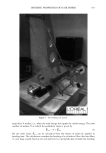
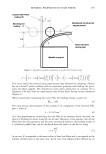
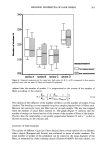
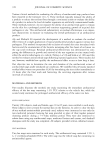
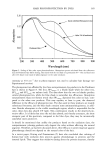
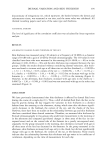
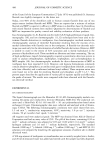
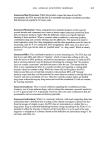
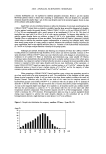
BENDING PROPERTIES OF HAIR FIBERS 357 EOREAL RECHERCHE Figure 1. The bending test system. stops after N strokes, i.e., when the total energy loss equals the initial energy. The total number of strokes N at which the pendulum stops is given by E,,,,, = N x Ezz• (2) On the other hand, Ej7e= can be calculated from the theory of elasticity applied to bending bars. The calculation considers the bending of a cylindrical fiber (the hair fiber) 1 l-ram long, rigidly fixed at one end and bent by a perpendicular cylinder (the bending

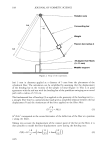
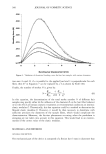
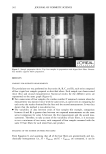
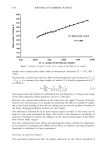
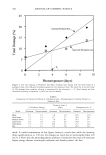
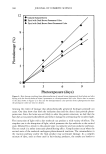
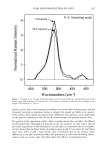
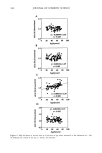
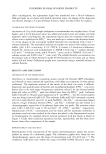
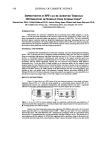
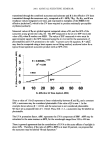
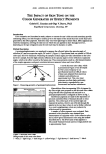
358 JOURNAL OF COSMETIC SCIENCE Rotation axis Connecting bar Weight Flexion bar (radius r) 39 aligned hair fibers (I = 11 mm) Metallic support Figure 2. Setup of the experiment. bar) 3 mm in diameter applied at a distance of 5 mm from the placement of the cylindrical fiber. The calculation can be simplified by assuming that the displacement of the bending bar in the vicinity of the sample is linear (Figure 3). This is in good agreement with the real test with the bending bar of the pendulum swinging on a curved path with a radius of 21.8 cm. The fundamental law of bending (9) as applied to the geometry of the bending test (i.e., a straight fiber bent by a perpendicular load) gives a simplified relation between the bar displacement 8 and the momentum of the force applied on the fiber M(x): d28 -= MOO (3) dx 2 (a '2 8/dx 2 corresponds to the second derivative of the deflection of the fiber at a position x along the fiber). Taking into account the displacement of the contact point of the bar on the fiber, it is then possible to model the force-displacement curve during the bending test: F(8) = E1 • cos Atan +Atan (4) with
Purchased for the exclusive use of nofirst nolast (unknown)
From: SCC Media Library & Resource Center (library.scconline.org)