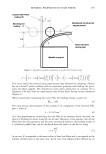
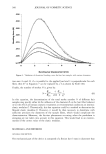
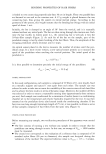
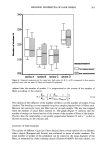
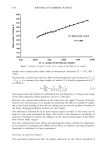
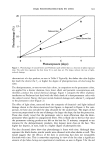
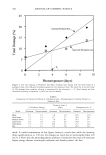
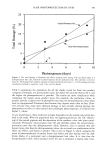
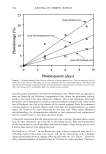
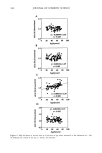
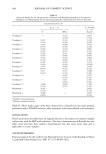
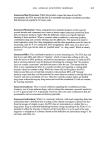
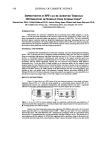
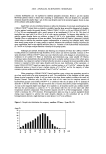
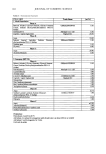
BENDING PROPERTIES OF HAIR FIBERS 363 24O 23O 220, 210 200 . . seriesA series B seriesC series D measurement F•l st measurement •-'] 2rid measurement Figure 6. Repeated measurements for virgin hair. Each series (A, B, C, or D) corresponds in four samples prepared once with the same 39 fibers (see Sample Preparation). inferred that the number of strokes N is proportional to the inverse of the number of fibers according to the relation (11) The validity of the influence of the number of fibers n on the number of strokes N was checked. The bending test was repeated using four samples prepared with 39 fibers each. Between two successive tests, one fiber was cut on each sample. The test was stopped when the number of intact fibers reached 23. The graph (Figure 7) confirms that the number of swings is a linear function of the inverse of the number of fibers of the sample. The fact that the relationship is not purely proportional between N and n-t is due to friction occurring on the rotation axis. INFLUENCE OF FIBER DIAMETER The rigidity of different virgin hair fibers obtained from several subjects of two different ethnic origins (European and Asiatic) was evaluated in terms of stroke numbers. The mean number of strokes of the pendulum can be related to the mean diameter of the fibers, as measured by a laser scanning system (Zimmer Gmbh©). For each subject, ten

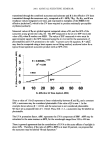
364 JOURNAL OF COSMETIC SCIENCE 350 330 310 290 270 250 230 210 190 t70 150 0,02 0.985 0,025 0,03 0,035 0,04 1In (n: number of hair fibres per sample) Figure 7. Number of strokes N versus 1/n (n: number of hair fibers in the sample). ! 0,045 samples were characterized under stable environmental conditions (T -- 25øC RH = 45%). Theoretically, considering virgin hair fibers with homogeneous elastic properties (i.e., E = E•,, N is a constant), the mean number of strokes N is directly proportional to R -4 according to Ei•,i , 4 Ez•,i , 1 = = (12) N Efle:• 39 q-r k E•4e3 N R 4 The experimental data (Figure 8) confirmed quite well Equation 12, using a large range of hair fiber diameters (mean diameters: 60 pm to 100 pm). However, the experimental ordinate at the origin does not equal 0 because of friction forces at the rotational axis. It is possible to recalculate the effective number of strokes due to the elastic bending of the fibers by taking into account the number of strokes of the freely swinging pendulum without any hair sample. The mechanical behavior for hairs from various origins recorded in this study can be related to the work performed by Swift (10). From a fully theoretical calculation of cantilever bending, he showed the influence of the cross-sectional shape of hair fibers from various ethnic origins. The close correlation between theory and experimental results confirms the importance of our method in evaluating the stiffness of hair fibers. In addition, the elastic behavior hypothesis is confirmed by these experiments. INFLUENCE OF RELATIVE HUMIDITY The mechanical properties of hair are greatly dependent on the relative humidity of
Purchased for the exclusive use of nofirst nolast (unknown)
From: SCC Media Library & Resource Center (library.scconline.org)