378 JOURNAL OF COSMETIC SCIENCE The above discussion clearly shows that the natural hair-coloring pigments, which are located in the cortex, protect hair against sun damage as judged by the above criteria. It is, therefore, tempting to expect that hair-coloring products would perform even better, since they also color the cuticles. However, dye molecules may not be passive optical filters and, instead, accentuate light-induced damage by initiating additional photochemical reactions. Here, we have investigated the effect of hair dyes on the photodegradation of hair. We have found that hair colors, in general, provide protection against sun damage. This protective effect is immediately realized with direct or semipermanent colors. Hair dyed with products utilizing oxidation dyes, although initially weakened due to chemical damage, also shows net protection upon prolonged photo-exposure. These data also reveal, not surprisingly, that the darker shades that deposit more color on hair also provide better photoprotection. EXPERIMENTAL Different methods were employed to measure the efficacy of products using oxidation dyes and those using direct or semipermanent dyes. The efficacy of the former was evaluated using tensile measurements. This method was not suitable for evaluating the semipermanent products because a significant amount of color would bleed during measurements. It has been shown that the mechanical strength of hair fibers in the wet state correlates very well with the amount of disulfide bonds in hair (11). A Raman spectroscopic method, which measures the integrity of the disulfide bonds in hair, was, therefore, used for these products. This method, however, is not suitable for testing hair colored with oxidation dye products because of thermal heating associated with absorp- tion of the near-infrared probe beam. PERMANENT AND DEMIPERMANENT PRODUCTS Piedmont or medium brown hair supplied by DeMeo Brothers (New York) was used. The hair was cleaned prior to testing using a sodium lauryl sulfate (SLS) solution (10%, w/w). Tensile measurements. Tensile measurements were performed on single fibers in the wet state. To reduce the data scatter due to differences between fibers, the effects of dyeing and photoirradiation were measured individually for each fiber. Hair fibers, 30-ram in length, were used in a Dia-Stron MTT 600 tensile tester (Dia- Stroh Ltd) to obtain the F•5 (force needed to extend the fiber by 15%) in deionized water. The fibers were extended at a rate of 20 mm per minute up to 20% extension and then released. Upon completion of the tensile measurements, the fibers were immersed in deionized water for two hours at room temperature (ca. 20øC) and then air dried. Although an "overnight" soak is typically used in this type of experiment (1,12), we have found that a two-hour soak, under our experimental conditions, was sufficient to restore the original tensile properties of the fibers. Sets of 25 fibers, which had undergone initial tensile testing, were dyed using various shades of a representative permanent and a demipermanent or tone-on-tone color for 25

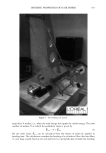
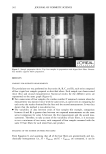
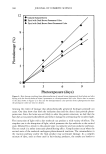
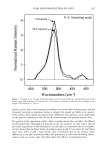
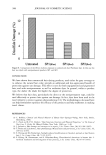
HAIR PHOTOPROTECTION BY DYES 379 and ten minutes, respectively, according to package instructions. Due to obvious busi- ness reasons we have chosen not to identify the products by brand names. These products contain combinations of typical dye ingredients such as phenylenediamines, aminophe- nols, resorcinols, and naphthols (1). A set of undyed fibers was used as the control. Tensile measurements (as described above) were performed on the dyed fibers to deter- mine the damage resulting from the oxidative coloring process. Tensile measurements were repeated after these fibers were exposed to simulated sunlight in the Atlas Fad- ometer Ci35A, maintained at 50øC and 50% RH, [br three, six, and nine days, which is equivalent to cumulative irradiation of 10.4, 20.8, and 31.2 kj/cm 2 respectively. , In general, the total damage was calculated according to the following equation: %Total damage = [(F•5(o ) - F•5(o)/F•5(o))] x 100 (1) where F•5(o ) and F•5(o represent, respectively, the force required for 15% extension at zero time (before dyeing and with no photoirradiation) and after dyeing and photoir- radiation for time t. For oxidatively colored hair, there was an initial damage upon dyeing, which can be represented as: % Chemical damage = [(F15(undyed ) - F15(after dyeing))/F15(undyed) ) 100 (2) Photodamage was calculated by removing the contribution of chemical damage (equa- tion 2) from the total damage measured at any given irradiation time (equation 1), as follows: % Photodamage = [(F15(afterdyeing ) - F15(t))/F15(afterdyeing)] x 100 (3) Photoprotection was then calculated as follows: % Photoprotection = [(slopeu,•dyed - slOpedyed)/SlOpeu,•dycd] X 100 (4) where the slopes were obtained from the plots of photodamage vs time. SEMIPERMANENT PRODUCTS Piedmont hair from DeMeo Brothers (New York) was used in these experiments. Hair tresses typically weighed 2 g and were -6 inches long. Hair dyeing was performed according to the instructions on the product packages. Two shades, the flame (red) and indigo (blue-black) of product 1 and the auburn shade of product 2 were tested as representatives of semipermanent dyes. Semipermanent dye products typically contain a combination of dyes, such as nitrophenylenediamines, nitroaminophenols, and amino- anthraquinones (1). Two tresses were dyed with each shade, according to product in- structions. Two undyed tresses were used as controls. All tresses were mounted in covers, exposing the middle 2 inches of each tress, and irradiated in the Fadometer (Atlas Ci35A) at 50øC and 50% RH. After 12 hours the tresses were flipped and irradiated for another 12 hours. The tresses were then shampooed and dyed again. This whole pro- cedure was repeated three more times. This amounted to a total of 96 hours of irradiation (13.9 kj/cm2), with three dyeings in between. This protocol is somewhat different from that used for the products based on oxidation dyes, and better reflects the in-use conditions associated with this product category.
Purchased for the exclusive use of nofirst nolast (unknown)
From: SCC Media Library & Resource Center (library.scconline.org)