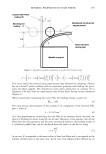
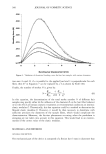
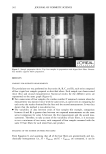
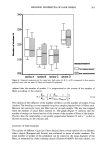
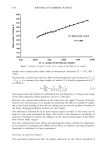
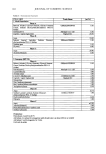
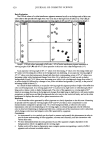
BENDING PROPERTIES OF HAIR FIBERS 367 midity levels, the bending stiffness of these hair fibers is similar. Bleached hair appears more rigid and more affected by humidity than virgin hair. At high humidity levels, it becomes as stiff as virgin hair. Permanent waving following bleaching leads to hair fibers even more sensitive to water. At 100% RH, the number of strokes of the pendulum is greater than for bleached or virgin hair (13). CONCLUSION The pendulum bending test developed in our laboratories is a simple and powerful test for quickly evaluating the bending behavior of hair in various conditions and following different cosmetic treatments. The first experimental data presented in this study are in good agreement with theo- retical calculations, considering the bending elastic properties of hair. Moreover, the technique allowed us an evaluation of the influence of different experimental conditions (relative humidity, cosmetic treatments), in good accordance with the structural modi- fications induced by these conditions. The validation of the test confirmed its relevance and its usefulness for the assessment of hair products. Since it corresponds to a bending test in the elastic domain of hair fibers, the test is not destructive. Evaluating the effect of additional, or superimposed, treatments on the same samples can therefore be undertaken. APPENDIX BLEACHING TREATMENT CONDITIONS Material: virgin hair Washing: 0.3% ammonium dodecylsulfate solution Rinsing: running tap water Bleaching: peroxide solution (hydrogen peroxide 15 vol and sodium peroxodisulfhte 22% and ammonia 2.9%) for 50 minutes at 30øC Rinsing: running tap water Neutralization: 0.22% sodium thiosulfate solution for 30 minutes at 30øC Rinsing: running tap water PERMANENT-WAVING TREATMENT CONDITIONS Material: bleached hair Reduction: 5% ammonium thioglycolate solution adjusted at pH 7.3 --+ 0.1 at 30øC for 15 minutes Rinsing: running tap water for 45 min Neutralization: hydrogen peroxide solution (6 vol) adjusted at pH 2.9-3.0 with an appropriate amount of concentrated HC1 solution for 10 minutes Rinsing: running tap water for 45 minutes

368 JOURNAL OF COSMETIC SCIENCE ACKNOWLEDGMENTS The authors wish to thank L. Gauchet for her efforts in the realization of the tests, and D. Saint-L•ger, C. Bouillon, D. Good, and B. Hibon for reviewing the manuscript. The authors wish to express their thanks to J. Scot for the restoration of the device system and to J. C. Garson and S. Vicic for their large contribution to the preliminary tests. REFERENCES (1) C. R. Robbins, Chemical and Physical Behavior of Human Hair (Van Nostrand Reinhold, New York, 1979), pp. 153-207. (2) J. A. Swift, The cuticle controls bending stiffness of hair, J. Cosmet. Sci., 51, 37-38 (2000). (3) A. N. Parbhu, W. G. Bryson, and R. Lal, Disulphide bonds in the outer layer of keratin fibers confer higher mechanical rigidity: Correlative nano-indentation and elasticity measurements with an AFM, Biochemistry, 38, 11755-11761 (1999). (4) R.M. Khayatt, and N.H. Chamberlain, The bending modulus of animal fibers, J. Text. Imt., 39, 185-197 (1948). (5) H. M. Elder, The tensile, compresslye and bending moduli of some monofilament materials,J. Text. Inst. 57, T8-14 (1966). (6) G.V. Scott, and C. R. Robbins, Stiffness of human hair fiber, J. Soc. Cosmet. Chem., 29, 469-485 (1978). (7) J. D. Owen, The application of Searle's single and double pendulum method to single fiber rigidity measurements, J. Text. Inst., 56, 329-339 (1965). (8) J.-C. Garson, M. Vidalis, P. Roussopoulos and J.-L. Ldv&que, Les propri6tds vibratoires transversales des fibres de kdratine. Influence de l'eau et d'autres agents, Int. J. Cosmet. So, 2, 231-241 (1980). (9) S. P. Timoshenko and J. N. Goodier, Theory of Elasticity, Third Edition (McGraw Hill International Editions, 1970), pp. 284-288. (10) J. A. Swift, Some simple theoretical considerations on the bending stiffness of human hair, J. Cosmet. Sci., 17,245-253 (1995). (11) B. M. Chapman, The bending stress-strain properties of single fibers and the effect of temperature and relative humidity, J. Text. Inst., 64, 312-327 (1973). (12) C. Zviak, Science des traitements capillaires (Edition Masson, 1988), pp. 40-44. (13) F.J. Wortmann, Bending relaxation properties of human hair and permanent-waving performance,J. Cosmet. Chem., 41, 123-139 (1990).
Purchased for the exclusive use of nofirst nolast (unknown)
From: SCC Media Library & Resource Center (library.scconline.org)