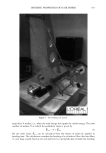
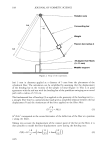
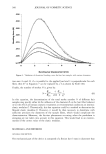
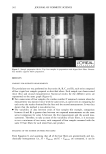
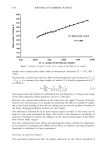
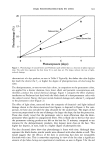
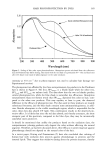
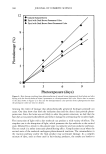
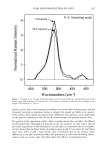
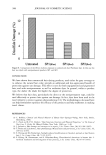
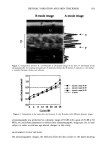
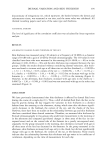
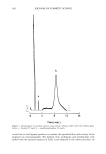
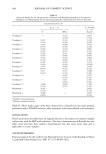
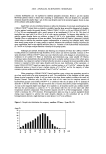
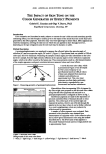
2001 ANNUAL SCIENTIFIC SEMINAR 419 THE IMPACT OF SKIN TONE ON THE COLOR GENERATED BY EFFECT PIGMENTS Gabriel E. Uzunian and O!ga V. Dueva, Ph.D Engelhard Corporation, Ossining, NY Introduction Color cosmetics are formulated to mask, enhance or correct the user's skin tone and sometimes provide contrasting effects, but little thought is usually given to the impact of the actual skin tone on the t'mal color generated by the effect pigments. Skin tones may vary from light beige to almost black. Effect pigments are relatively transparent, allowing the skin tone on which they are applied to show through however, depending on the type of pigment used, the end result may be dramatic or subtle. Method Description A goniospectrophotometer was employed to measure the reflected light at the specular angle of reflection (0 ø) and two aspecular angles, 20 ø and 45 ø (Figure 1). Experimental data was plotted in CIELab color space for D-65 illuminant. Measuring the samples at these angles provides information on the color travel of a sample, from the high intensity reflection at the specular angle to lower reflection at aspecular angles, which is the effect viewed by the human eye. These measurements result in a full characterization of the sample appearance and good correlation between measured values and visual effects. 45 ø Sa• • 450 20 ø 0 ø Figure 1. Measuring geometry of goniospectrophotometer A novel skin tone color chart, which is presented on Figure 2 was developed by The Leneta Company to our specifications based on CIELab values of skin tones obtained from numerous volunteers and utilized as an experimental tool. This color chart possesses excellent shade uniformity, color density, reproducibility, non- fluorescence and surface smoothness. Nitrocellulose films incorporating 22% of pigment by dry film weight were prepared on the skin tone color charts using selected effect pigments and analyzed on a goniospectrophotometer configured as shown in Fig. 1. Interference pigments are made by the deposition of precisely controlled films of titanium dioxide on mica platelets. They reflect part of the incident light and transmit the portion, which is not reflected through the platelet to the next layer where it can be further reflected. As a result complimentary colors are produced, by reflection and by transmission. A number of effect pigments were evaluated. Data presented in this discussion were obtained from measurements of a pigment with a violet reflection color and a yellow-green transmission color using the method described above. The INCI name of this pigment is Mica (and) Titanium Dioxide and its average particle size is approximately 25pm. Figure 2. Skin tone color chart Backgrounds of skin tone color chart: 1- white 2 - light beige 3 - dark beige 4 - yellow-beige . 5 - light brown 6 - dark brown 7 - black.

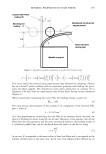
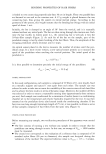
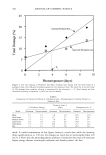
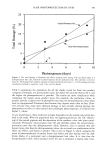
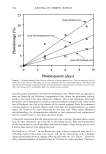
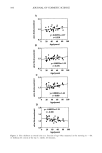
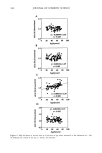
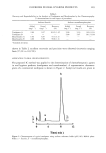
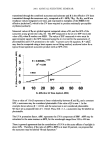
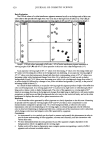
420 JOURNAL OF COSMETIC SCIENCE Data Evaluation The CIELab values of a violet interference pigment measured on all seven backgrounds of skin tone color chart at the specular (0 ø) angle were very close due to the high level of reflectivity. The CIELab valttes of this pigment measured at aspecular viewin• an•les of 20 ø and 45 ø are presented in Graph 1. Graph 1. CIELab values (presented at full scale = 45) of violet interference pigment measured at viewing angles of 20 ø (0) and 45 ø (O) from specular on skin tone color chart backgrounds (1-7) At an aspecular viewing angle of 20 ø, L* values were decreasing, a* values were becoming redder and b* values were becoming less yellow as the background was darkening. At an aspecular viewing angle of 45% L* values were decreasing more dramatically then their corresponding values at 20ø a* values were becoming redder with a background change from white (1) to light brown (5), and less red on darker backgrounds (6) and (7) b* values were becoming more yellow with a background change from white (1) to yellow-beige (4) followed by a change to less yellow on darker backgrounds (5) and (6), to the point of becoming bluish on black (7). As a result of these tendencies, at a specular viewing angle this pigment produces bright violet reflection color on all backgrounds. At a viewing angle of 20 ø it is perceived as light violet on white through yellow- beige and as intense violet on darker backgrounds. The color of this pigment at a viewing angle of 45 ø travels in an orange direction as the background changes from light beige to light brown, with some notable exceptions: on dark brown and black backgrounds the color stays in the violet-red family, and on the white background it displays the actual yellow-green transmission color. Discussion It was found that colors generated by effect pigments are clearly dependent on the skin tone. Measuring at specular and two aspecular viewing angles of 20 ø and 45 ø provides a more comprehensive color characterization compared to specular only. On a white background both, a reflection color and a transmission color are seen depending on the viewing angle on a black background only the reflection color is observed. Depending on background skin tone, a certain part of the transmission color is absorbed, which changes color travel and impacts color effect generated by a pigment. Conclusions ß An instrumental in-vitro method was developed to measure and quantify this phenomenon in order to provide better understanding of effect pigments, colorants and cosmetics, and their interaction with various skin tones. ß We have demonstrated that the color generated by an effect pigment is highly dependent on the background on which it is applied and the viewing angle. ß Further work will be done to characterize more complex systems incorporating a variety of effect pigments and colorants in suitable vehicles.
Purchased for the exclusive use of nofirst nolast (unknown)
From: SCC Media Library & Resource Center (library.scconline.org)