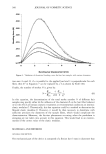
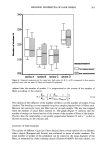
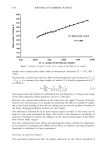
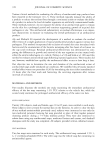
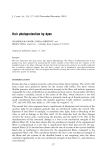
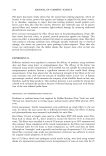
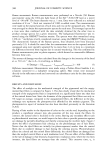
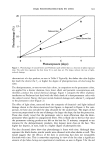
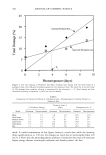
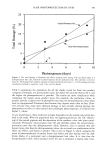
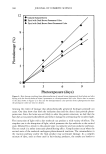
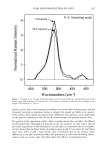
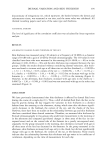
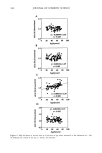
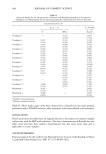
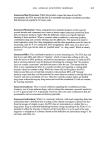
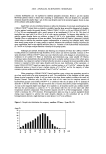
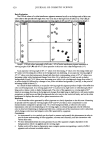
384 JOURNAL OF COSMETIC SCIENCE 25 20 o 10 ¸ 5 Undyed Piedmont Hair... Dyed with Demipermanent color o Dyed with Permanent color I I I I 0 2 4 6 8 10 Photoexposure (days) Figure 4. The photodamage of hair fibers as a function of photo-exposure time. The lines represent the best linear fits to the data sets. The slopes of the lines represent the rate of photodegradation. The data reveal that dyeing of Piedmont (unpigmented) hair with the permanent coloring product provides more protection than does dyeing with a comparable shade of a demipermanent product. provides greater photoprotection than the permanent color. These results are opposite to what we found for the Piedmont (unpigmented) hair, where the permanent coloring product was found to be more efficacious (Table I). This is not surprising, since both permanent and demipermanent products essentially behave as deposit-only colors in the case of Piedmont hair due to the absence of the natural pigment. Since the permanent coloring products, in general, deposit more color than the demipermanents, we would expect the former to be more efficacious for this hair type. These subtle differences notwithstanding, the photoprotection afforded to both pigmented and unpigmented hair by oxidation dyes is clear from the above results. It should be mentioned that the photoprotection due to dyeing, discussed above, results from the dyes themselves and is not due to the dyeing process. This was demonstrated by the experiments in which hair fibers that had undergone a sham dyeing process with a dyeless base showed little photoprotection. The band at ca. 510 cm -• in the Raman spectrum of hair is associated with the S--S stretching mode of the amino acid cystine, and can be conveniently used to monitor chemical and photochemical changes affecting this molecule (13). Figure 7 shows the effect of photoirradiation of Piedmont hair for 96 hours in a solar simulator. The loss in

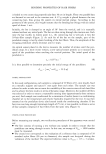
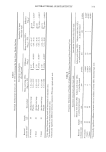
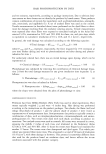
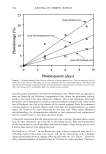
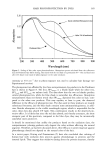
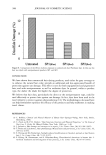
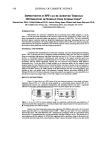
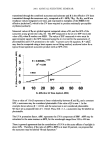
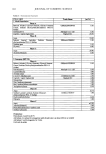
HAIR PHOTOPROTECTION BY DYES 385 1.6 1.2 Dyed with Red Permanent Color 216 h Irradiation Piedmont Hair • • 200 300 400 500 600 700 800 900 Wavelength (nm) Figure 5. Fading of hair color upon photoirradiation. Absorption spectra calculated from the reflectance data for Piedmont hair before dyeing. Hair dyed with the red shade of a permanent ha • -lor and dyed tress after 216 hours (nine days) of photo-exposure in the solar simulator. intensity at 510 cm -• due to photo-exposure was used to calculate hair damage (see Experimental section). The photoprotection afforded by the three semipermanent dye products to the Piedmont hair is shown in Figure 8. The first, SPl(b•ue), is a bluish shade while the other two, SPl(red ) and SP2(r•d), are auburn (red). The data show that the two red shades produce similar photoprotection, while the blue shade is somewhat less efficacious. Absorption measurements (data not shown) reveal that SPl(b•u o deposited less color on hair, com- pared to the other two products. This may explain, at least in part, the observed difference in the efficacy of photoprotection. The dyes used in these products are mainly substituted benzenes, and the blue shade contains some aminoanthraquinones, in addi- tion. Besides absorption in the visible wavelength region, which is responsible for the color, these dyes also absorb UV light. This combination results in the observed pro- tective effect. It is likely that since the red dyes absorb, and thereby attenuate, the more energetic part of the spectrum, compared to the blue dyes, they may be intrinsically somewhat more protective. It should be mentioned that unlike the products based on the oxidation dyes, the semipermanent coloring products only deposit the color without affecting the natural pigment. Therefore, as has been discussed above, their efficacy in protecting hair against photodamage should not depend on the natural color of the hair. In a recent paper, Hoting and Zimmerman (5) have also concluded that coloring of human hair with oxidation dyes protects against photodamage to proteins and the internal lipids. They suggest that oxidative dyeing alters the protein structure, thereby
Purchased for the exclusive use of nofirst nolast (unknown)
From: SCC Media Library & Resource Center (library.scconline.org)