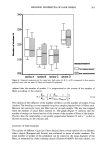
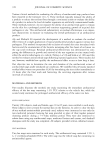
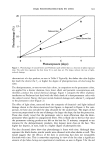
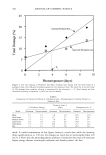
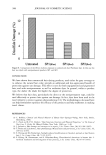
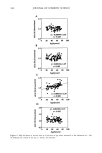
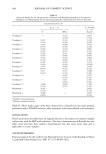
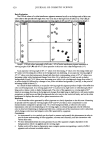
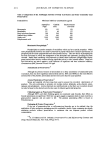
388 JOURNAL OF COSMETIC SCIENCE 12 Untreated SP 1 (mue) SP 1 (Red) SP2(Red) Figure 8. Comparison of the effects of photo-exposure on undyed and dyed Piedmont hair. In this case the hair was dyed with semipermanent products SP1 and SP2. CONCLUSION We have shown that commercial hair-dyeing products, used either for gray coverage or to enhance the natural hair color, provide an additional and less-appreciated benefit of protection against sun damage. This effect is seen for both unpigmented and pigmented hair, and with semipermanent as well as oxidation dyes. In general, within a product type, the darker the shade the higher the degree of protection. We believe that hair dyes, particularly the direct or the semipermanent type, could be used effectively to protect hair against sun damage. In fact, dyes have been used in the wool industry to protect against phototendering (14). The methodologies discussed here can help formulators optimize the efficacy of the products and help marketers in making novel claims. REFERENCES (1) C. Robbins, Chemical and Physical Behavior of Human Hair (Springer-Verlag, New York, Berlin, Heidelberg, 1988). (2) C. Zviek and R. P. R. Dowber, "Hair Structure, Function and Physical Properties," in The Science of Hair Care, C. Zviek, Ed. (Marcel Dekker, New York, 1986), pp. 1-48. (3) J. Jachowicz, Hair damage and attempts at its repair, J. Soc. Cosmet. Chem., 38, 263-286 (1987). (4) C. Pande and J. Jachowicz, Hair photodamage: Measurement and prevention,J. Soc. Cosmet. Chem., 44, 109-122 (1993). (5) E. Hoting and M. Zimmerman, Sunlight-induced modifications in bleached, perreed, or dyed human hair,•/. Soc. Cosmet. Chem., 48, 79-91 (1997). (6) E. Hoting, M. Zimmerman, and S. Hilterhaus-Bong, Photochemical alterations in human hair. I. Artificial irradiation and investigation of hair proteins, d. Soc. Cosmet. Chem., 46, 85-99 (1995).

HAIR PHOTOPROTECTION BY DYES 389 (7) (8) (9) (10) (11) (12) (13) (14) C. Dubief, Experiments with hair degradation, Cosmet. Toilerr., 107, 95-102 (1992). R. Beyek, G. S. Kass, and C. F. Meyer, Elasticity and tensile properties of human hair. II. Light radiation effects,J. Soc. Cosmet. Chem., 22, 667-678 (1971). E. Tolgyesi, Weathering of hair, Cosmet. Toilerr., 98, 29-33 (1983). L. Wolfram "The Reactivity of Human Hair--A Review," in Hair Research, C. E. Orfanos et•/., Eds. (Springer-Verlag, New York, 1981), pp. 479-500. P. Alexander, M. Fox, and R. F. Hudson, The reaction of oxidizing agents with wool, Biochem. J., 49, 129 (1951). J.B. Speakman, Mechano-chemical methods for use with animal fibers, J. Textile Inst,, 37T, 102 (1947). C. Pande, FT-Raman spectroscopy: Applications in hair research, J. Soc Cosmet. Chem., 45, 257-268 (1994). I.J. Miller and G.J. Smith, Protection against phototendering of wool by metal salts and mordanted dyes, J.S.D.C., 111, 103-106 (1995).
Purchased for the exclusive use of nofirst nolast (unknown)
From: SCC Media Library & Resource Center (library.scconline.org)