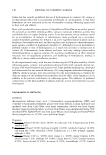
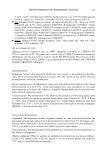
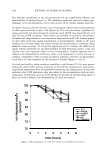
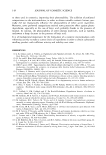
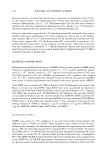
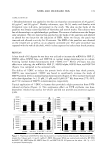
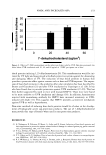
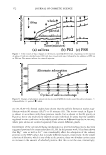
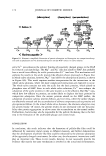
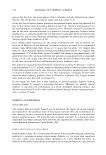
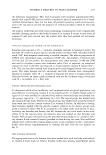
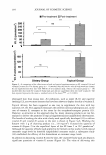
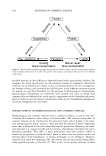
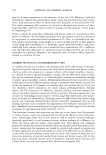
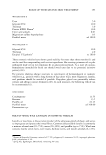
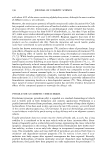
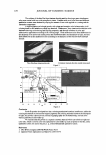
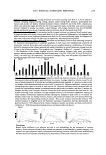
172 ct! � 00 00 ct! 0 JOURNAL OF COSMETIC SCIENCE llOOng 5 _10 15 0 Time(minutes) (a) salivas (b) PEI 5 0 5 (c) PSS Figure 7. Time courses of mass changes on the mucin-coated QCM electrode, responding to the injection of salivas (5 ml) into distilled water (500 ml), then rinsed with water followed by the addition of PEI ion or PSS ion. The arrows indicate the time of injection. Figure 8. Changes of adsorption amount on mucin-coated QCM electrodes caused by saliva exchanges. 6: submandibular D: parotid e: whole. ers (10, 16,30-34). Several studies have shown that the pellicle formation reaches equi librium within 90 minutes (10,17) or 45 minutes (33). The in vitro result in Figure 4 is almost in accordance with those previous results, but as shown in the IR spectra in Figure 2, the in situ results fairly depend on each individual. It seems that the carefully regulated in vitro conditions in the whole mixed saliva are different from the in situ ones, where pure salivas are secreted separately from several different glands. Involvement of the calcium-bridging mechanism in a protein-binding process has been suggested previously by some researchers (31,36). In the present work, it has been shown that Mg2+ ions as well as Ca2 + ions considerably affect the adsorption of the salivary proteins on the HAP surface, but in totally different manners, respectively. In the simple solutions of albumin, which is one of the acidic proteins, these two divalent cations cause an increase in the amount of adsorbed proteins. But this is not the case, interestingly,

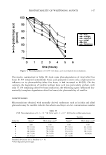
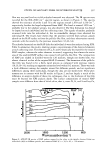
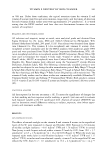
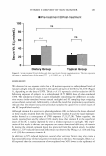
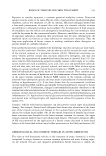
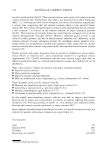
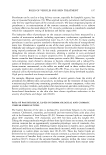
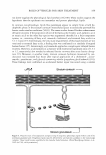
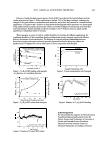
STUDY OF SALIVARY FILMS ON HYDROXYAPATITE 173 for the behavior in the whole saliva solutions: Mg2 + ions inhibit the protein adsorption. Divalent cations such as Mg2+ and Ca2 + ions are supposed to react equally with nega tively charged ionic species in saliva to form cation-anion complexes. The difference in the effects of these cations on the complex formation was then exam ined, as shown in Figure 9. The concentration of the cations added to saliva was 200 mmol/1. Absorbance at 500 nm was monitored while stirring the solution for 240 minutes. The linear increase in absorbance was observed for the Ca2 + -added saliva solution, but no significant changes were observed in the Mg2+-added solution. These phenomena are probably attributed to the difference in the affinities of these cations for the salivary proteins, or to the difference in the solubilities of cation-protein complexes. The point is whether these Ca2 + complexes adsorb directly on the HAP surface to form pellicle. As shown in Figure 6, however, the adsorption of proteins does not increase linearly after reaching the maximum value, despite the further addition of Ca2 + ions. Judging from the results shown in Figures 6 and 9, it is unlikely that the aggregation of the complex formed by the added Ca2 + ions in saliva solution contributes directly to the increase of adsorbed proteins on the HAP surface. The added Ca2+ ions probably increase the available Ca2 + sites on the HAP surface for the adsorption of acidic proteins and also enhance the calcium bridging between these adsorbed proteins. An attempt to assemble the protein films on the QCM electrode has been made by several researchers (37-40). We tried to make use of the QCM to investigate the mechanism of pellicle accumulation. Mandel et al. (41) reported that the parotid gly coproteins are mostly cationic and that the submandibular glycoproteins are anionic. The present QCM studies demonstrate that the surface charges of the films deposited from parotid and submandibular saliva are cationic and anionic, respectively, and that the charged proteins adsorb electrostatically on the oppositely charged surface. Thus, QCM, the first-utilized methodology for the study of salivary film, has rationalized the accu mulation mechanism. An adsorption and accumulation model based on the present results is illustrated in Figure 10. The Ca2+ and PO/- sites on the HAP surface are supposed to be the major binding sites for the acidic and the basic proteins, respectively. Negatively charged groups like the carboxyl group interact directly with the Ca2 + sites, and the addition of ,-.. 0 0 .,,_.. cd 0. 1 0.08 0.06 0.04 0.02 0 0 H-8-t::::::::::___:W ��H=�H���H 50 100 150 200 Time(minutes) 250 Figure 9. The effect of added divalent metal ions on complex formation with negatively charged salivary species. 0: Ca 6: Mg D: blank.
Purchased for the exclusive use of nofirst nolast (unknown)
From: SCC Media Library & Resource Center (library.scconline.org)