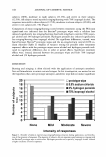
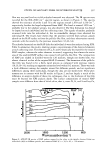
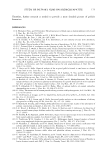
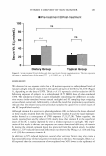
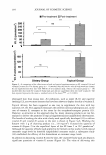
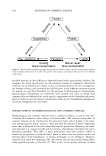
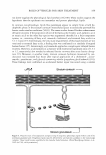
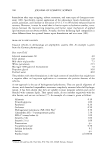
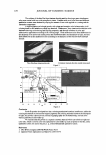
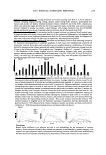
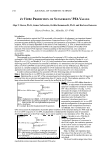
174 JOURNAL OF COSMETIC SCIENCE (adsorption) (desorption) (accumulation) Saliva Figure 10. Schematic simplified illustration of protein adsorption and desorption via competitive adsorp tion and accumulation and via alternate adsorption on the HAP surface in saliva solution. extra Ca2 + ions enhances the indirect binding of negatively charged groups to the HAP by virtue of a calcium bridge. The Mg2 + and Na+ ions also adsorb to HAP, but probably have a much lower affinity for acidic proteins than Ca2 + ions have. This mechanism well explains the results in the acidic protein-like albumin shown previously in Figure 6(a). In whole saliva solutions, however, Mg2 + ions inhibit the adsorption of protein, as shown in Figure 6(6). This result requires another interpretation for the interactions in the whole saliva solutions, where the more complicated interactions are expected to occur. The whole saliva contains not only the acidic but the basic proteins, which adsorb to phosphate sites of HAP. Even in such whole saliva solutions, Ca2 + ions enhance the adsorption of the acidic proteins in the same manner as in the albumin. But Mg2 + ions, which have low affinity to proteins, are rather likely to displace the basic proteins by competitive adsorption. Once the anionic proteins adsorb on the HAP surface, the adsorption of cationic salivary proteins follows, and vice versa, where the surface charges are effectively reversed and the accumulation of salivary components such as proteins and glycoproteins follows. In the mixed whole saliva, however, the alternate adsorption may not proceed easily. Of course, the present results do not necessarily rule out the possi bility that protein aggregation in saliva causes the accumulation on the enamel surface. Furthermore, bacteria may also be responsible for the pellicle thickening that is the first step in the formation of the undesirable plaque and colored stain. CONCLUSION In conclusion, this study indicates that the formation of pellicle-like film could be influenced by coexistent metal cations in different manners, and further demonstrates that the development of pellicle-like film could be enhanced by the alternate adsorption of the oppositely charged constituents. In either case, the electrostatic interactions could play an important role. These in vitro results, however, do not necessarily provide the evidence that exactly the same mechanism is involved in the actual oral environments.

STUDY OF SALIVARY FILMS ON HYDROXYAPATITE 175 Therefore, further research 1s needed to provide a more detailed picture of pellicle formation. REFERENCES (1) J. Theilade,J. Slots, and 0. Fejerskov, The ultrastructure of black stain on human primary teeth, Scand. ]. Dent. Res., 81, 528-553 (1973). (2) M. Addy, J. Moran, A. Griffiths, and N. J. Wills-Wood, Extrinsic tooth discoloration by metal and chlorhexidine, Br. Dent.]., 159, 281-285 (1985). (3) G. K. Stookey, T. A. Burkhard, and B. R. Schemehorn, In vitro removal of stain with dentifrices, ]. Dent. Res., 61, 1236-1239 (1982). (4) R. L. Ralph, Clinical studies of the cleaning function of dencrifrices,j.A.D.A., 105, 798-802 (1982). (5) G. C. Forward, Role of toothpastes in the cleaning of teeth, Int. Dent.]., 41, 164-170 (1991). (6) P. L. Dawson,]. E. Walsh, T. Morrison, and]. Grigor, Dental stain prevention by abrasive toothpastes: A new in vitro test and its correlation with clinical observations,]. Cosmet. Sci., 49, 275-283 (1998). (7) H. M. Eriksen, H. Nordbo, H. Kantanen, and J. M. Ellingsen, Chemical plaque control and extrinsic tooth discoloration: A review of possible mechanisms,]. Clin. Periodont., 12, 345-350 (1985). (8) C. Dawes, G. N. Jenkins, and C.H. Tonge, The nomenclature of the integuments of the enamel surface of the teeth, Br. Dent.]., 115, 65-68 (1963). (9) Y. Yao, M. S. Lamkin, and F. G. Oppenheim, Pellicle precursor proteins: Acidic praline-rich proteins, statherin, and histatins, and their crosslinking reaction by oral ansglutaminase, ]. Dent. Res., 78, 1696-1703 (1999). (10) T. Sonju and G. Rolla. Chemical analysis of the acquired pellicle formed in two hours on cleaned human teeth in vivo, Caries Res., 7, 30-38 (1973). (11) P. Schupbach, F. G. Oppenheim, U. Lendenmann, M. S. Lamkin, Y. Yao, and B. Guggenheim, Electron-microscopic demonstration of praline-rich proteins, statherin and histatins in acquired enamel pellicles in vitro, Eur.]. Oral Sci., 109, 60-68 (2001). (12) A. Bennick, G. Chau, R. Goodlin, S. Abrams, D. Tustian, and G. Madapallimattam, The role of human salivary acidic praline-rich proteins in the formation of acquired dental pellicle in vivo and their fate after adsorption to the human enamel surface, Arch. Oral Biol., 28, 19-27 (1983). (13) R. T. Zahradnik, E. C. Moreno, and E. J. Burke, Effect of salivary pellicle on enamel subsurface demineralization in vitro,]. Dent. Res., 55, 664-670 (1976). (14) D. I. Hay, The interaction of human parotid salivary proteins with hydroxyapatite, Arch. Oral Biol., 18, 1517-1529 (1973). (15) U. Lendenmann, J. Grogan, and F. G. Oppenheim, Saliva and dental pellicle-A review, Adv. Dent. Res., 14, 22-28 (2000). (16) G. Embery, D. R. J. Green, and G. Rolla, Structural probe analysis on the attachment of salivary glycoproteins to HAp using FT-IR, Caries Res., 23, 247-251 (1989). (17) Y. Kuboki, K. Teraoka, and S. Okada, X-Ray photoelectron spectroscopic studies of the adsorption of salivary constituents on enamel,]. Dent. Res., 66, 1016-1019 (1987). (18) S. R. Wood, J. Kirkham, P. D. Marsh, R. C. Shore, B. Nattress, and C. Robinson, Architecture of intact natural human plaque biofilms studied by confocal laser scanning microscopy,]. Dent. Res., 78, 21-27 (2000). (19) H. Nordbp, K. K. Skjprland, and H. M. Eriksen, Auger electron spectroscopy of iron in dental pellicle from stainers and non-stainers, Acta Odontol. Scand., 42, 37-40 (1984). (20) D. Tantbirojn, W. H. Douglas, C. C. Ko, and P. L. McSwiggen, Spatial chemical analysis of dental stain using wavelength dispersive spectrometry, Eur.]. Oral Sci., 106, 971-976 (1998). (21) N. Vassilakos, T. Arneb rant, and P. 0. Glantz, Interaction of anionic and cationic surfactants with salivary pellicles formed at solids surfaces in vitro, Biofouling, 6, 277-288 (1992). (22) J. L. Jensen, M. S. Lamkin, and F. G. Oppenheim, Adsorption of human salivary proteins to hydroxy apatite: A comparison between whole saliva and glandular salivary secretions, ]. Dent. Res., 71, 1569-1576 (1992). (23) Y. Tanizawa, H. Tsuchikane, K. Sawamura, and T. Suzuki, Reaction characteristics of hydroxyapatite with F- and P03F2- ions,]. Chem. Soc. (Faraday Trans), 87, 2235-2240 (1991). (24) Y. Tanizawa and T. Suzuki, X-Ray photoelectron spectroscopy study on chemical states of fluoride in bovine dentine treated with NaF,J. Chem. Soc. (Faraday Trans), 89, 2901-2906 (1993).
Purchased for the exclusive use of nofirst nolast (unknown)
From: SCC Media Library & Resource Center (library.scconline.org)