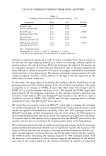
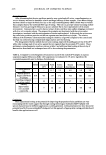
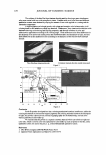
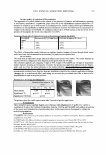
218 JOURNAL OF COSMETIC SCIENCE Comeofungimetry After determining that the zinc pyrithione particles were coated and still active, comeofungimetry, an ex-vivo bioassay was used to determine relative antifungal efficacy of these samples. Since these coatings had been chosen to target the Malassezia sp. on the scalp comeofungimetry offers a better way to evaluate these samples than by the traditional MIC type of testing. This test is a good pre-clinical screening method because it involves growing the Malassezia sp on a substrate that is more representative of its natural environment. Cyanoacrylate is used to harvest a layer of skin, and these skin surface strippings are treated with olive oil to simulate sebum. The prepared skin samples are then treated with the actives under investigation, inoculated with the microorganism of interest and incubated. In this study the actives were the coated zinc pyrithione particles and the test organism used was Malassezia furfur . The relative efficacy of the treatments is determined by looking for inhibition of growth compared to the controls and this data was collected using computerized image analysis and vital staining. The data generated by this method showed some coatings improved the antifungal activity of the ZPT while other coatings made it less active against the test organism than the uncoated ZPT control. These preliminary comeofungimetry results are shown in table 2 and additional data looking at the activity of t.liese actives formulated into a shampoo base will be shown during the presentation. Table 2. Comparative comeofungimetry bioassay test results for the coated ZPT samples in aqueous suspensions against Malassezia furfur. (All suspensions were adjusted to 1 % active ingredient, the concentration generally used in shampoo formulations) Saline Uncoated Palm Amino Stearyl Lethicin Siliconyl ZPT oil silicone dimethicone beeswax Coating material - - 11.7 7.5 4.0 3.0 3.0 (%) Median positive fungal cells# from 810 451 339 372 433 585 515 20 samples % killing compared - 44 58 54 47 28 36 to saline control Efficacy improvement. - 0 32 23 7 -36 -18 over uncoated control(%) Conclusion These experiments looking at the potential for improving the properties of zinc pyrithione are very encouraging and the results suggest that through coating technology a multitude of ZPT variants with special characteristics for different applications could be generated. In this presentation we have shown the potential benefits from an antidandruff standpoint but this approach of appropriatly coating particles should benefit other applications as well.

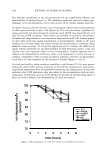
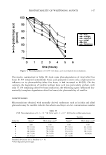
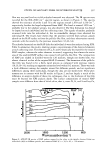
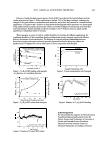
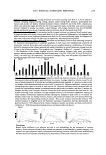
2003 ANNUAL SCIENTIFIC MEETING 219 OPTICAL CHARACTERISTICS OF TITANIUM OXIDE INTERFERENCE FILM AND THE FILM LAMINATED WITH OXIDES AND THEIR APPLICATIONS FOR COSMETICS Takahiro Kaida, Kota Kobayashi, Maoya Adachi and Fukuji Suzuki Nihon Koken Kogyo Company, LTD, 6-1-2 Ichiban-cho, Tachikawa-shi, Tokyo, Japan Introduction An infinite number of colors can be produced by mixing colored light. The colors required in color make-up must meet various demands, ranging not only from colorless to vivid new color tones, but also from ex1remely matte finishes to novel qualitative textures that shine in the light. Using current techniques, however, only colors and qualitative textures limited by the range of coloring materials whose use is permitted by safety considerations can be provided. Currently, color make-up products such as lipstick, eye shadow and the like show characteristics that are demanded by the combined use of organic pigments that show brilliant colors, or inorganic pigments such as iron oxide or the like. However, these make-up products are limited to color regions that are far removed from the color mixing of colored light. Furthem10re, in current coloring materials, various problems remain in terms of safety, light resistance, dispersibility, low coloring and the like. We have succeeded in developing, for the first time in the world, a method for synthesizing thin film form titanium dioxide whose optical thickness can be freely controlled. We discovered that this single-layer thin film form titanium dioxide emits color through interference phenomenon. Furthennore, by laminating various types of metal oxides as thin films, we developed a powder which shows coloring and brilliance that cannot be obtained in the case of conventional inorganic powders. We applied this developed interference color thin film form iron oxide coated titanium dioxide to color make-up, and discovered that new color tone variations and a different qualitative texture can be obtained. Materials and Methods Synthesis of Interference Color Thin Film Form Titanium Dioxide Titanyl sulfate (40 g) and ion exchange water (750 ml) were added to the 0.2 to 0.8 mm particle sized natural mica ( 15 g), and hydrated titanium oxide was deposited on the surfaces of the mica particles by heating and hydrolysis under agitation, and was then aged. This product showed a green interference color. Following rinsing with water, filtration and drying, the product was immersed in an alkaline aqueous solution (pH 12). The powder liberated in the supernatant was separated by decantation, and the titanium oxide layer was peeled from the surface of the substrate-form mica. In this way, a green interference color thin film form titanium dioxide was synthesized. Coating of Surface of Interference Color Thin Film Form Titanium Dioxide with Iron Oxide The interference color thin film form titanium dioxide was dispersed in ion exchange water then, an aqueous solution of ferric nitrate and an aqueous solution of caustic soda were added, and the surfaces of the interference color thin film form titanium dioxide particles were coated with iron oxide by a neutralization process. Powder Characteristics of Interference Color Thin Film Form Titanium Dioxide TI1e configuration of the powder was observed using a scanning electron microscope (SEM). The color tone of the powder was measured as follows: specifically, the powder was dispersed in a clear lacquer, and was applied to a black and white hiding-chart using an applicator. Then, tl1e color was measured at an incident angle of -45° and a light-receiving angle of -30° to 70° using a three dimensional variable-angle gloss meter. Results and Discussion Fig. 1 shows the results of SEM observation of the green interference color thin film form titanium dioxide. As is seen from this figure, the green interference color thin film form titanium dioxide is thinner plate-form powder than a conventional titanium dioxide coated mica pearl. Fig. 2 shows the color measurement results obtained using a three-dimensional variable-angle gloss meter. For purposes of comparison, color measurements were also performed for conventional titanium dioxide coated mica pearls (green interference mica pearl, blue interference mica pearl and violet interference mica pearl). As is seen from tl1is figure, tl1e green interference thin film form titanium dioxide showed a color variation from green to blue-green, blue and violet-blue according to differences in the light-receiving angle, and was an interference color thin film form titanium dioxide with a high flip-flop effect.
Purchased for the exclusive use of nofirst nolast (unknown)
From: SCC Media Library & Resource Center (library.scconline.org)