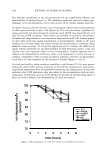
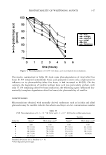
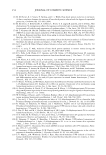
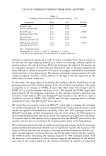
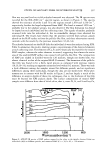
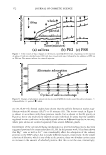
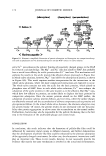
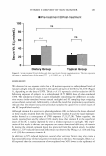
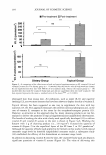
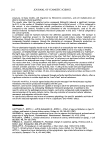
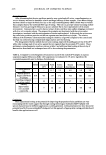
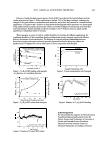
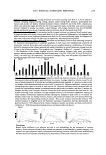
PHOTOSTABILITY OF WHITENING AGENTS 147 100 "'C 95 ·u n:J .2 90 "o' .-. �1: -X-m.e. "'C Q,) Q,) 0 85 "'C L... n:J a. C- 80 ---...-orange ---.-coconut --violet ---tea ---&-fragrance "'C C 75 C 70 o 1 2 3 4 5 6 time (hours) Figure 4. Photodegradation of 0.25% w/w kojic acid in perfumed microemulsions. The results, summarized in Table IV, show some photodegradation of citral (after five hours 61.4% remained unmodified). Kojic acid appeared to exert only a slight positive influence on its photostability (after five hours it had increased to 64.9% ). On the contrary, the degradation of vanillin without kojic acid was particularly evident, with only 25 .1 % remaining after five-hour irradiation the whitening agent influenced dra matically (complete degradation after five hours) the photostability of vanillin. CONCLUSIONS Microemulsions obtained with naturally derived surfactants such as lecithin and alkyl glucosides may be suitable vehicles for arbutin and kojic acid at concentrations similar Table IV UVB Photodegradation of 2.3 x 10- 5 M Citral and 1.3 x 10- 5 M Vanillin in Microemulsions Citral Time (h) Alone* With kojic acid* 0 100 89.2 (2.4) 2 74.9 (3.3) 3 68.1 (0.4) 4 66.7 (1.4) 5 61.4 (2.2) Standard deviations are in brackets (n = 4). * Non-degraded percentages. 100 94.9 (3.6) 79.8 (1.9) 78.2 (2.0) 70.2 (2.2) 64.9 (2.5) Alone* 100 87.5(2.1) 67.8 (3.1) 51.0 (2.5) 34.3 (1.8) 25.1 (2.0) Vanillin With kojic acid* 100 42.1 (3.2) 12.7 (1.3) 10.3 (1.1) 6.8 (0.6)

148 JOURNAL OF COSMETIC SCIENCE to those used in cosmetics, improving their photostability. The addition of perfumed compositions to the microemulsion, in order to obtain suitable cosmetic lotions, gen erally did not dramatically influence the photostability of either active ingredient. Moreover, some perfumed compositions exerted some protective effect against photo degradation, especially in the case of kojic acid, probably thanks to the presence of linalool. In contrast, the photostability of other odorous molecules, such as vanillin, underwent a sharp decrease in the presence of kojic acid. It is of fundamental importance for the formulator of a cosmetic microemulsion with whitening activity to make a correct choice of ingredients in order to obtain a pleasantly smelling product with sufficient activity and stability over time. REFERENCES (1) J. K. Salmon and I. J. Frieden, in Pigmentation and Pigmentary Disorders, N. Levine, Ed. (CRC Press, Boca Raton, FL, 1993), pp. 149-208. (2) 0. Lee and E. Kim, Skin lightening, Cosmet. Toiletr., 110, 51-56 (1995). (3) J. L. Bolognia, S. A. Sodi, M. P. Osber, and J.M.Pawelek, Enhancement of the depigmentry effect of hydroquinone by cystamine and butionine sulfoximine, Br. J. Dermatol., 133, 349-357 (1995). (4) DM 17 agosto 2000-Aggiornamento degli elenchi allegati alla legge 11 ottobre 1986, n. 713, sulla produzione e la vendita dei cosmetici, in attuazione delle direttive della Commissione dell'Unione Europea 2000/6/CE e 2000/11 CE. (5) J. Cabanes, S. Chazarra, and F. Garcia-Carmona, Kojic acid, a cosmetic skin whitening agent, is a slow-binding inhibitor of catecholase activity of tyrosinase,J. Pharm. Pharmacol., 46, 982-985 (1993). (6) Y. Shih and Z. Jyh-Myng, Voltammetric determination of kojic acid in cosmetic bleaching products using a disposable screen-printed carbon electrode, Electroanalysis, 11, 229-233 (1998). (7) K. Maeda and M. Fukuda, Arbutin: Mechanism of its depigmenting action in human melanocyte culture, Exp. Ther., 276, 765-769 (1996). (8) S. Akiu, T. Suzuk, T. Asahara, Y. Fujinuma, and M. Fukuda, Inhibitory effect of arbutin on mela nogenesis-Biochemical study using cultured B16 melanoma cells,Jpn. J. Dermatol., 101, 609-613 (1991). (9) C. Coiffard, L. J.M. Coiffard, and Y. De Roeck-Holtzhauer, Degradation kinetics of arbutin in solution, Pharm. Ind, 61, 574-576 (1999). (10) M. Gallarate, M. E. Carlotti, I. Cagliani, and D. Negri, Formulation and characterization of disperse systems as topical vehicles for odorous molecules, J. Cosmet. Sci., 51, 209-226 (2000). (11) M. Gallarate, M. E. Carlotti, M. Trotta, and A. E. Grande, Cosmetic microemulsions containing naturally occurring whitening agents, Proceedings of the 4th World Meeting on Pharmaceutics, Biopharma ceutics, Pharmaceutical Technology, Florence, April 2002. (12) M. Trotta, M. R. Gasco, and S. Morel, Behaviour of oil/water microemulsions upon dilution with water,]. Dispersion Sci. Tech., 12, 239-255 (1991). (13) M. E. Carlotti, V. Rossatto, and M. Gallarate, Vitamin A and vitamin A palmitate stability over time and under UVA and UVB radiation, Int. J. Pharm., 240, 85-94 (2002). (14) C. Couteau and L. J.M. Coiffard, Photostability determination of arbutin, a vegetable whitening agent, Il Farmaco, 55, 410-413 (2000). (15) J.M. Blakeway, M. L. Frey, S. Lacroix, and M. S. Salerno, Chemical reactions in perfume aging, Int. j. Cosmet. Sci., 9, 203-214 (1987). (16) K. Kimura, H. Nishimura, I. Iwata, and J. Mizutani, Deterioration mechanism of lemon flavor. 2. Formation mechanism of off-odor substances arising from citral, J. Agric. Food Chem., 31, 801-804 (1983).
Purchased for the exclusive use of nofirst nolast (unknown)
From: SCC Media Library & Resource Center (library.scconline.org)