142 JOURNAL OF COSMETIC SCI ENC E UVB PHOTODEGRADATION STUDIES Experimental conditions. Photodegradation experiments were performed using a UVB lamp with a 290-320 nm range. Samples were introduced in Pyrex glass containers placed at 10 cm from the light source and maintained under continuous stirring. In such conditions the radiation power per surface unit was 5.97 x 10⁻⁴ W cm- 2 , with a maximum radiation dose of 7.165 J cm- 2 (13). At prefixed times, samples were with drawn and opportunely diluted for HPLC analysis. Whitening agents: Formulations • Arbutin Aqueous solutions: 5.0 x 10- 3 Mat pH 3.0, 5.0, 7.0, 8.0 9.2 x 10- 3 Mat pH 7.0 9.2 x 10- 3 Mat pH 7.0 in the presence of 5.0% w/w hexylene glycol, 2.0% w/w decylpolyglucose, and 0.25% w/w lecithin (sol. a). O/W microemulsions: 9.2 x 10- 3 M (0.25% w/w) alone 9.2 x 10- 3 M (0.25% w/w) in the presence of 2.3 x 10- 5 M citral or 4.0 x 10- 5 M linalool 9.2 x 10- 3 M (0.25% w/w) in the presence of 0.03% w/w of the following perfume formulations: orange, coconut, violet, tea, and fragrance. • Kojic acid Aqueous solutions: 5.0 x 10- 3 Mat pH 3.0, 5.0, 7.0, 8.0 1.7 x 10- 2 Mat pH 5.0 1.7 x 10- 2 M at pH 5.0 in the presence of 5.0% w/w hexylene glycol, 2.0% w/w decylpolyglucose, and 0.25% w/w lecithin (sol. a). O/W microemulsions: 1.7 x 10- 2 M (0.25% w/w) alone 1.7 x 10- 2 M (0.25% w/w) in the presence of 2.3 x 10- 5 M citral or 4.0 x 10- 5 M linalool 1.7 x 10- 2 M (0.25% w/w) in the presence of 0.03% w/w of the following perfume formulations: orange, coconut, violet, tea, and fragrance. Analytical conditions were as follows: Column: Spherisorb C18 5 µ x 15 cm. Mobile phase: CH3OH:5.0 x 10- 3 M dodecylamine pH 5.2 (40:60). Flow: 0.8 ml min- 1 . t r : 2.1 min (arbutin), 2.3 min (kojic acid). Uv max: 282 nm (arbutin), 268 nm (kojic acid). Odorous molecules. The photodegradation of 2.3 x 10- 5 M citral and 1.3 x 10- 5 M vanillin in the microemulsion was determined in the presence and absence of kojic acid in two separate series of experiments, following the experimental conditions described above. Analytical conditions were as follows: Column: Spherisorb C18 5 µ x 15 cm. Mobile phase (citral): CH 3 OH:H2O 80:20. Flow: 1.0 ml min- 1 . Uv max: 254 nm. tr: 4.0 min. Mobile phase (vanillin): CH 3 OH:H2O 30:70. Flow: 1.0 ml mil- 1 . Uv max: 280 nm. tr: 8.6 min. RES UL TS AND DISCUSSION MICROEMULSIONS Several microemulsions were obtained: the composition of the most stable one, which was chosen to dissolve kojic acid, arbutin, and the odorous molecules, was: IPP = 5.0% w/w lecithin = 3.3% w/w decyl polyglucose = 6.7% w/w ethanol 2.0% w/w hexylene glycol = 3.8% w/w and water = 79.2% w/w.

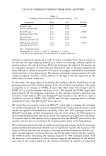
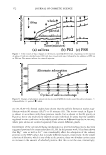
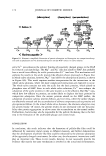
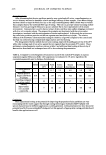
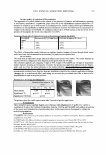
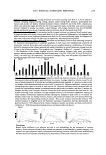
PHOTOSTABILITY OF WHITENING AGENTS 143 The mean diameters of all microemulsions were in the 25-30-nm range, and remained unmodified even after repeated freeze-thaw cycles (Table I), indicating a satisfactory stability, even in the presence of whitening agents and odorous molecules. PERFUMED MICROEMULSIONS All fragrances added to the microemulsion, both in the absence and in the presence of whitening agents, were compatible with it, as neither opalescence nor phase separation occurred. The mean diameters of microemulsions containing 0.05% w/w of each fra grance composition did not substantially vary after warming at 40°C and after one week of freeze-thaw cycles. Table II gives the results obtained with the micro'emulsion without kojic acid or arbutin similar values were obtained in the presence of whitening agents. Olfactory evaluation. Olfactory analysis aimed to identify the precise quantity of fragrance to be introduced in the microemulsion in order to obtain a pleasant fragrance, i.e., sufficient to mask the typical smell of surfactants, persistent over time and not too intense. The optimal concentrations were obviously not the same for all flavors, as their inten sities differ. Orange and coconut were added to the microemulsion over a 0.01-0.05% w/w range the weaker fragrances (fragrance, tea, and violet) were added to the micro emulsion over a 0.02-0.10% w/w range. The results of the addition of the chosen perfumed mixtures to the microemulsion led to the consideration that it was possible to cover the unpleasant smell of surfactants and IPP effectively, obtaining different results, depending on the type of fragrance used and on its intensity. PHOTODEGRADATION For both arbutin and kojic acid, photostability was maximum in those aqueous solutions whose pH was uncorrected (7 .0 for arbutin and 5 .0 for kojic acid). In the experimental conditions, at lower concentration (5.0 x 10- 3 M), arbutin was quite photostable, as has already been shown (14), while kojic acid underwent marked photodegradation, no kojic Table I Mean Diameters of Microemulsions After Repeated Freeze-Thaw Cycles Microemulsion Alone With arbutin With kojic acid With arbutin and citral With kojic acid and citral With arbutin and linalool With kojic acid and linalool Standard deviations are in brackets. Just prepared 27 .3 (8.2) 27.5 (4.4) 25.5 (8.2) 27.9(7.2) 28.5 (9.3) 24.9 (2.9) 25.5 (4.7) Mean diameter (nm) One-week freeze-thaw cycles 25.2 (7 .5) 25.4 (7.7) 25.7 (8.0) 30.0 (5.6) 28.4 (7.0) 25.7 (8.8) 26.7 (3.2)
Purchased for the exclusive use of nofirst nolast (unknown)
From: SCC Media Library & Resource Center (library.scconline.org)