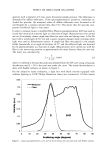
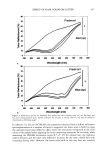
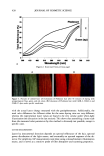
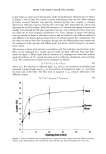
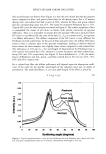
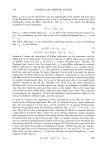
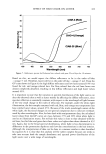
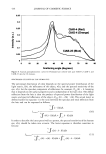
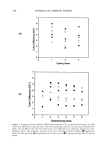
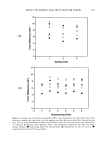
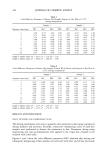
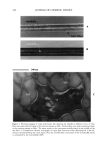
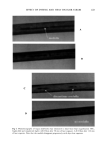
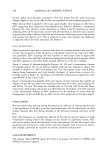
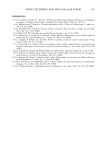
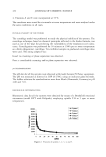
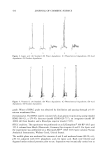
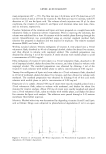
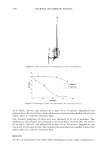
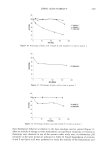
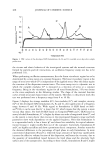
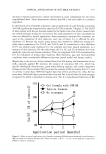
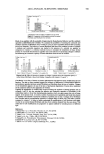
434 JOURNAL OF COSMETIC SCIENCE 0.36 0.3 0.26 ß :::l 0.2 '• 0.16 "• 0.1 0.06 i i i 0 10 20 30 CIAR-4 (Red) ClAO-4 (OranGe) CIAB-2$ (Blue) 40 50 60 70 80 9O Scattering angle (degrees) Figure 8. Typical goniophotometric curves for Piedmont hair colored with pure CIAO-4, CIAR-4, and CIAB-25 dyes for 30 minutes. PERCEPTION OF LUSTER BY THE HUMAN EYE The perceptual description of color depends on the spectral power distribution of the light source,/0•), the reflectance of the object, r0•), and the spectral sensitivity of the eye, s0•). Let the specular component of reflectance be constant, Rspec0•) = k, knowing that it depends on the surface properties and is independent of the hair color. The diffuse reflection from the hair is then the product of spectral power distribution of the light source and spectral reflectance of the object, Rdif/0•) = /0•) ' r0•). The actual luster as defined earlier by equation 1 is the ratio between the specular and total reflection from the hair and can be expressed as follows: • •'/(X)• L•t•/= (10) In order to describe the luster perceived by a person, the spectral sensitivity of the human eye, s0•), should be taken into account. The luster equation is therefore rewritten to become 4x). Lp .... ired x2foo f-•oo (11)

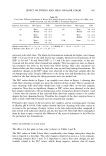
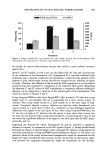
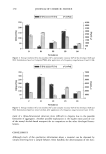
EFFECT OF HAIR COLOR ON LUSTER 435 For blue, green, and red hair with the same color strength and saturation, the maximum in the spectral reflectance curve occurs at a different wavelength but with the same energy. For simplicity, let us assume that the spectral power distribution of the light source is homogeneously distributed over a wide wavelength range. Correspondingly, the location of the maximum in the product I(X) ß r(X) occurs at different wavelengths, but the total area under the two reflected energy curves will be the same. The difference in perceived luster of hair with different colors arises from the s(X). The human visual system can detect the range of light from around 400 nm to 700 nm. However, the eye of a person with normal vision is not equally sensitive over this wavelength range. The sensitivity has a maximum in spectral response at 550 nm, i.e., in the yellow-green region, and lower responses in the blue and the red region. Therefore, the denominator of equation 11 for different colors will be in the order of blue red green. Conse- quently, perceived luster will be in the order of blue red green. Thus, under these conditions, the human eye would perceive blue-colored hair as shinier than green- colored hair. This could explain why a small amount of blue dye added to various hair care products makes hair appear more lustrous. From similar theoretical considerations, it is obvious that for truly achromatic colors, absorbing a constant fraction of light in the visible region, the white color has always the lowest luster whereas the black color has the highest. For the panel evaluating the color effects of perceived luster, the chromatic colors indeed appeared with different shine. Seventy-eight percent of the evaluators thought that the Piedmont hair colored with blue dye was shiniest, whereas the remaining 22% thought the Piedmont hair colored red was the shiniest. The red color seemed to have a higher or the same luster compared to the green color for 55% and 30% of the evaluators, respectively. These results show that the panel perceived blue to be the shiniest hair and that 55% of the panel perceived red hair to be shinier than green. The smallest number perceived red and green to have the same shine. This outcome is approximately in the expected order. CONCLUSIONS In conclusion, the luster values of hair colored with different dyes arise from variations in dye concentration and its penetration depth into the fiber. The luster of hair is controlled by diffuse reflectance depending upon the extinction coefficient of the dye, the penetration depth into the fiber, and the wavelength of the light source. According to the derived equation, diffuse reflectance is reduced by dyes with higher extinction coefficients and that are capable of penetrating the fiber completely. Such hair colors will increase luster. Ideally, under illumination with a broad homogeneous spectral power distribution light source, luster by instrumental detection should not depend on hair color as long as the dyeing level (pigmentation of colorant concentration) and dye distribution within the fiber are the same. Taking into account the color sensitivity of the human eye over the entire visible spectrum, the derived expression for perceived luster shows that the luster of hair of different colors is perceived differently. In general, hair with blue shades gives the highest luster, followed by red. The shades in the middle of the visible spectrum give the lowest luster.
Purchased for the exclusive use of nofirst nolast (unknown)
From: SCC Media Library & Resource Center (library.scconline.org)