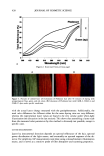
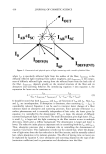
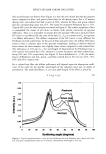
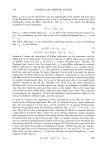
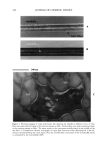
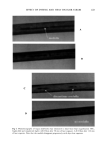
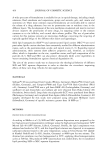
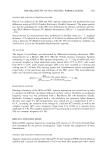
432 JOURNAL OF COSMETIC SCIENCE Here, ap and ad are the absorbances per unit pathlength of the undyed and dyed parts of the Piedmont hair, respectively, and lp and ld are fractions of the undyed and dyed pathlengths within the fiber, respectively. Since lp = 1-1•t, we obtain the following expression for total absorbance: A - % - 1,•(% - a,•) (6) Since a_v is always smaller than ad, a• - ad 0, and A will increase with an increase in ld (i.e., dye penetration), we note that in the case of undyed Piedmont hair, ld = 0 and A = a•. The diffuse reflectance can be expressed by combining equations 2 and 6 and knowing that IAB -- IoA , as follows: I,e = Io(1 - A) - Isc - Io• T (7) Equation 8 shows the dependence of diffuse reflectance on dye absorbance and the pathlength of the dyed region. AccoMing to equation 8, diffuse reflectance I R will have its highest value if ld and ad are zero (i.e., undyed Piedmont hair). Therefore, for Piedmont hair, luster is low. For colored hair, ld 0 and diffuse reflectance is reduced. Diffuse reflectance is reduced especially by dyes having higher ad, i.e., a higher extinc- tion coefficient, and higher ld, i.e., the capability of penetrating the fiber completely. Such hair colors will increase the luster. Equation 8 can be used to interpret the relative magnitudes of diffuse reflectances observed in Figure 6: examination of cross sections of hair fibers dyed for 45 minutes by microscope reveals the variation in penetration depths for studied semipermanent dyes. In the case of blue and green dyes, ld was significantly smaller compared to the red dye. Therefore, the values of IR are lower compared to Piedmont hair. In the case of red-colored hair, though its absorbance is slightly lower than that dyed with the green and blue colors, ld was higher. This is the reason that red-colored hair gave a lower diffuse reflectance and a higher luster value. Thus, equation 8 demonstrates the importance of both dye absorbance and penetration depth on the amount of diffusely reflected light, and thus on luster. In order to illustrate the importance of dye distribution in the fiber on luster, we conducted the following experiment. We used 1% solutions of pure, single-component dyes, CI acid orange-4, CI acid red-4, and CI acid blue-25, to saturate Piedmont hair fibers by dyeing them under the following conditions: pH = 4.5, T -- 55øC, and t = 30 min. These dyes are ionic anthraquinone dyes consisting of sulfonic acid groups and have a high affinity to protein fibers. Under the given dyeing conditions, strong coloration with homogeneous dye distribution throughout the hair fiber was achieved, as confirmed by examination with an optical microscope. This is in marked contrast to the basic dyes used in commercial semipermanent products. The actual coloration of the Piedmont hair after dyeing with CI acid dyes is shown in Figure 3B. The reflectance spectra for hair tresses colored with CI acid dyes are displayed in Figure 7. Reflectances for red-, orange-, and blue-dyed hair at the illumination wavelength of 632 nm are 63%, 57% and 4%, respectively. For this system a• = 0, and since the fibers are dyed throughout ld = const, equation 8 will reduce to I• = Io(1 - l•za•z ) - Isc- Io• r (9)

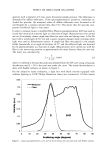
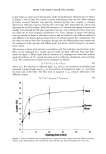
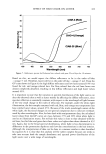
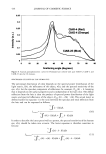
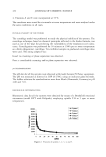
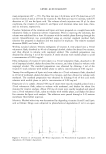
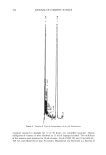
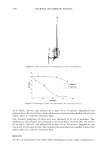
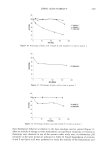
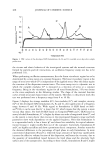
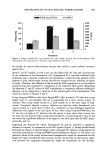
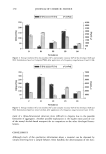
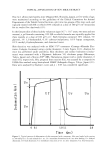
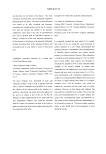
EFFECT OF HAIR COLOR ON LUSTER 433 80 70 • 60 • 5o 3o 20 10 C I.a.q,-4 (Red) CIAO-4 (Orange) CIAB-25 (Blue)/ 400 450 500 550 600 650 700 750 Wavelength (nm) Figure 7. Reflectance spectra for Piedmont hair colored with pure CI acid dyes for 30 minutes. Based on this, we would expect the diffuse reflectance to be in the order of blue orange -- red. Therefore, luster will be in the order of blue orange -- red. From the GP scans shown in Figure 8, the high diffuse reflectance and low luster around 19% was found for red- and orange-colored hair. For blue-colored hair the red laser beam was almost completely absorbed, resulting in low diffuse reflectance and high luster values around 45%. It is important to note that the variation in spectral distribution of the light source can alter the observed color as well as luster mainly by affecting the diffuse reflectance, since specular reflection is essentially constant with respect to the wavelength of light because of the very small change in the index of refraction. For example, under the white-light illumination, the hair samples saturated with red, blue, and orange one-component dyes have similar luster values, around 47%. Because of the multi-wavelength nature of the white light, the fractional changes in one spectral component due to color are overshad- owed by other wavelengths. Also, for hair dyed with semipermanent dyes, the calculated luster values from the GP curves are close, between 27% and 29% when white light is used as an illumination source. For red hair this value is close to that obtained with the red laser, but for blue and green hair these values are higher than those obtained at 632 nm. Again, due to the broad spectral distribution, white light is less discriminative to differences in dye penetration depths at such low dye concentrations in the hair interior. Although the interpretation of data can be done in a manner similar to that described by equation 8, it is clear that this analysis will be rather complex because one needs to take into account both the sample absorbance and spectral power distribution of the light source over a wide range of wavelengths.
Purchased for the exclusive use of nofirst nolast (unknown)
From: SCC Media Library & Resource Center (library.scconline.org)