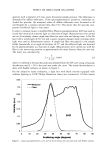
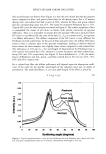
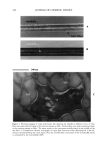
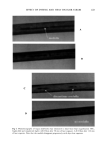
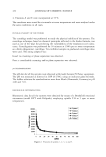
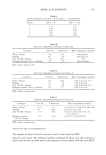
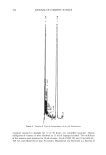
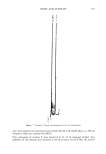
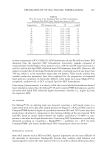
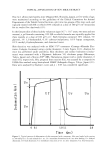
TOPICAL APPLICATION OF SOY MILK EXTRACT 475 Hos: hr-1 albino male hairless mice (Nippon SLC, Shizuoka, Japan), at five weeks of age, were maintained according to the guidelines of the Ethical Committee for Animal Experiments of the Yakult Central Institute, split into two groups of five mice each, and topically treated with BE or vehicle (50% ethanol) at a dose of 100 pl/5 cm2/mouse/day for six weeks (five days/week) (11). In the forearm skin of three healthy volunteers (ages 36.7 + 10.7 years, two men and one woman), a gel formula containing 10% BE or vehicle formula was topically applied for three months at a dose of 100 pl/5 cm 2. Both formulas contained 10% ethanol, 5% glycerol, 3% 1,3-buthanediol, 0.1% carboxyvinylpolymer, 0.1% kappa carrageenan, 0.1% methyl p-hydroxybenzoate, and deionized water. Skin elasticity was analyzed with an SEM 575 © cutometer (Courage+Khazaka Elec- tronic, Cologne, Germany) using a probe (diameter, 2 mm Figure 2) (1). Analysis for mice was performed under anesthesia. Skin thickness and surface hydration (conduc- tance) were measured with a Digimatic Indicator 543 thickness gauge (Mitsutoyo, Tokyo, Japan) and a Skicon-200 © (lBS, Hamamatsu, Japan) with a probe (diameter, 6 mm) (16), respectively. HA, prepared from murine skin, was assayed by a competitive ELISA-like method using biotinylated HABP (Seikagaku Kogyo, Tokyo, Japan) (11). Data were analyzed by Student's t-test and p 0.05 was considered significant. Uf Ua Ue 0 0.1 1.0 1.1 2.0 Tine {e½) Figure 2. Typical pattern of deformation of skin measured with cutometer. Skin was loaded with suction at 300 mHp for 1 sec and relaxed for 1 sec. Ue: immediate distension for 0.1 sec after loading. Uv: delayed distension. Uf.' final distension. Ur: immediate retraction at 0.1 sec after relaxation. Ua: final retraction.

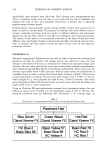
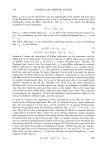
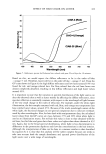
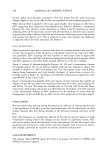
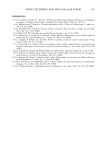
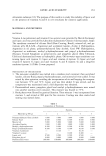
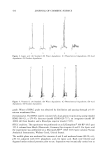
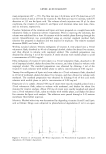
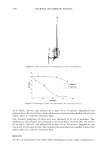
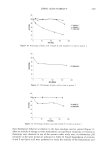
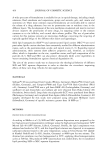
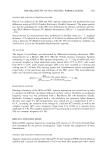
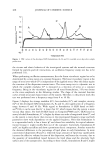
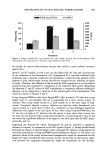
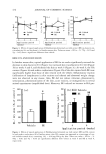
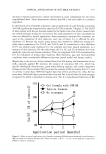
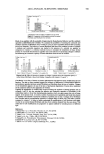
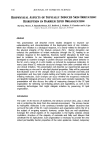
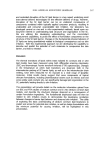
476 JOURNAL OF COSMETIC SCIENCE 0.4 I (a) 0'2 f 0.1 0 • 0 ** -0- V ehJele -•- BE 40 0.6 30 -O- Vehicle ß •- BE ' ' '6 0 ' ' ' 0 ' ' ' 2 4 0 2 4 6 0 2 4 6 Application period [Application period [Application period (weeks) (weeks) (weeks) Figure 3. Effbcts of topical application of Bifidobacteri•-fermented soy milk extract (BE) on elasticity (a), viscoelasticity (b), and thickness (c) of hairless mouse skin. Values are mean _+ SD (n = 5). **(p 0.01) and *(p 0.05) show a significant diffbrence from vehicle. RESULTS AND DISCUSSION In hairless mouse skin, topical application of BE for six weeks significantly restored the decrease in skin elasticity (Ur) (Figure 3a), increased skin viscoelasticity (Uv/Ue) (Figure 3b) at weeks 4 and 6, and thickened the skin at week 6 (Figure 3c). At week 6, the HA content (Figure 4a) and surface conductance (Figure 4b) of the skin treated with BE were significantly higher than those of skin treated with the vehicle. Inflammatory reaction (infiltration of lymphocytes in skin sections and edema) and abnormal weight change were not observed in any mouse. Also, BE did not induce irritation, phototoxicity, sensitization, photosensitization of the skin, acute toxicity, or mutagenicity in several animal experiments (unpublished data). Moreover, BE induced an increase in HA pro- 140 130 120 110 100 90 80 (a) o 6O 50 4O 3O 2O 10 Vehicle BE Vehicle BE 0 6 Application period (weeks) Figure 4. Effbcts of topical application of Bifidobacteri•-fermented soy milk extract (BE) on HA content (a) and surface conductance (b) of hairless mouse skin. HA content was expressed as a percentage of con- trol (vehicle-treated skin), containing 1.03 _+ 0.04 mg HA/g dry skin. Values are mean _+ SD (n = 5). ##(p 0.01) and *(p 0.05) are significantly diffbrent from vehicle at week 6 and BE at week 0, respectively.
Purchased for the exclusive use of nofirst nolast (unknown)
From: SCC Media Library & Resource Center (library.scconline.org)