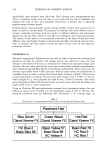
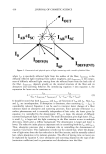
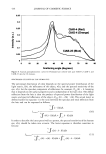
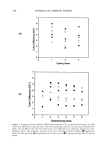
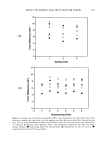
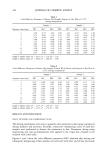
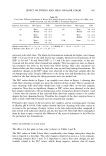
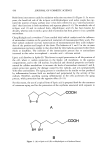
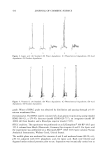
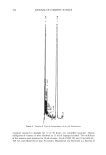
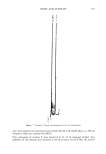
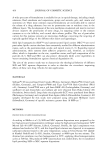
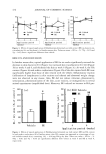
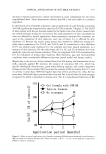
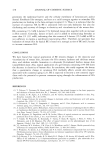
430 JOURNAL OF COSMETIC SCIENCE lOUT IAa+Isc Iolvv(s) Isp IDIFF(INT) IAs+Isc Figure 5. Geometrical and physical optics of light interacting with a model cylindrical fiber. where Isp is specularly reflected light from the surface of the fiber, ID•FF(SR) is the diffusely reflected light resulting from surface roughness, and ID•Fm•NT) is the compo- nent of diffusely reflected light coming from the reflected beam from the back side of the fiber. Io•m•NT) depends greatly on the internal structure of the fiber and its absorptive and scattering behavior. By introducing equation 3 into equation 2, the expression for luster can be rewritten as: Isp Isp L = (isv + IDWV(SR) + iDWV(,NT)) = I0 _[AB -- ([SC .qu [OUT) (4) It should be noted that both IDWV(•N•) and Iou • are functions of lAB and Isc. Also, lAB and Isc are interdependent. If absorption is dominant, then scattering Isc + Iou • is considerably reduced. Equation 4 can be used to interpret luster changes of a fiber substrate based on absorptive and scattering processes. Since specular reflectance is a surface phenomenon and is essentially independent of hair color, the luster given by equation 4 is controlled by the denominator. If lAB is large, the amount of diffusely scattered background light is very small. The small denominator gives high luster. IflAB is small, Isc is larger and the light scattering in the fiber interior occurs in multiple directions, which gives a diffuse background. The denominator is larger and luster is lower. The refractive index plays an important role in controlling both the Isc and Iou •. Thus, absorptive processes play a dominant role in controlling the denominator of equation 4 and luster. This explanation is both true for colored hair, where the absorp- tion of light arises from the dye molecules in the fiber interior, and for naturally colored hair, where absorption is by melanin granules. The effect of dyeing time on luster can be explained by equation 4, since absorption and scattering depend on the type of dye (extinction coefficient) and its penetration and distribution into the fiber.

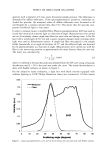
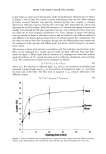
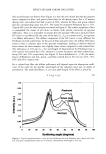
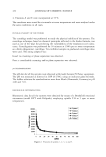
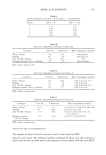
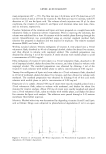
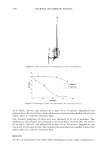
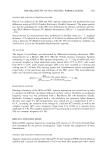
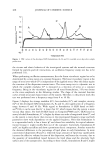
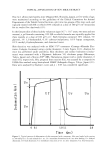
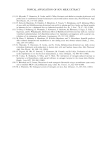
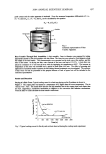
EFFECT OF HAIR COLOR ON LUSTER 431 The second feature we observe from Figure 4 is that the red-colored hair has the greatest luster compared to blue- and green-colored hair for all dyeing times. For a 45-minute dyeing time, red-colored hair had a luster of 28%, whereas for blue- and green-colored hair the corresponding value was 21%. The luster for untreated Piedmont hair is 15 %. Typical GP curves for these samples are shown in Figure 6. The surface roughness of hair is comparable for tresses of all colors, as shown with similar intensities of specular reflectance. Thus, it is reasonable to assume that the specular reflectance measured from GP curves is not affected by the color of the hair (i.e., Isv is constant and I R in equation 3 is diffuse reflectance). The diffuse component of the GP curves is very different for Piedmont and red-colored hair. In the case of blue and green hair, the diffuse reflectance seems to have a constant ratio to the specular component, leading to almost identical luster values for these samples, but slightly lower values compared to red-colored hair. The reflectance at 632 nm (i.e., the wavelength of illumination) for Piedmont hair is 56% and for red-colored hair 25%, whereas it is lower for green- and blue-colored hair, being 18% and 15%, respectively (see Figure 2). Since absorbance is -(I-R), the absor- bances of Piedmont and red-, green-, and blue-colored hair at 632 nm are 44%, 75%, 82% and 85%, respectively. For a colored hair fiber the diffuse reflectance will depend upon the absorption coeffi- cient of the color for the specific wavelength of the radiation used and its depth of penetration. The total absorbance, A, per unit path length of the fiber is given by A = a?l? + a•l• (5) 0.4 0.36 0.3 0.1 0.05 Piedmont (sp Red (sp) (sp) i i i i i i i i i 0 10 20 30 40 $0 60 70 80 90 100 Scattering angle (degrees) Figure 6. Typical goniophotometric curves for bare Piedmont hair and Piedmont hair colored with blue, red, and green semipermanent dyes for 45 minutes. Illumination wavelength is 632 nm.
Purchased for the exclusive use of nofirst nolast (unknown)
From: SCC Media Library & Resource Center (library.scconline.org)