280 JOURNAL OF COSMETIC SCIENCE lular matrix (ECM), composed of collagen, laminin, fibronectin, and proteoglycan, in skin cells (2). Especially, ROS do not only directly destroy interstitial collagen, but also inactivate tissue inhibitors of metalloproteinases (TIMPs) and induce the synthesis and activation of matrix-degrading enzymes called matrix metalloproteinases (MMPs) (1). MMPs are a family of zinc-dependent endoproteinases that are capable of degrading almost all of the components of the ECM and are classified in more than 20 species (3 ). MMPs can be divided into four categories based on substrate specificity: collagenases, gelatinases, stromelysins, and membrane-associated MMPs (4). The expression of MMPs in UV-irradiated fibroblasts is known to be initiated by reactive oxygen species (ROS) and by activation of a cell-surface growth factor and cytokine receptors (5 ). With increasing age, collagen synthesis becomes lower and MMP-1 levels become higher in sun-protected human skin in vivo (6). UV irradiation and ROS induce the synthesis of MMPs in skin fibroblasts in vitro, and MMP-mediated collagen destruction accounts, in large part, for the connective tissue damage that occurs in photoaging (7). Melothria heterophylla (Lour.) belongs to the family Cucurbitaceae and has been traditionally used for the treatment of conjunctivitis, orchitis, skin eczema, and the tubercle of a lymphatic gland (8). Free-radical scavenging activities and photoprotective activities of compounds from M. heterophylla extracts on MMP-1 mRNA and protein level have not been studied so far. The present paper deals with the isolation and structure identification of com pounds from the roots of M. heterophylla, as well as the evaluation of the antioxidant effect and inhibitory effects of these compounds on MMP-1 expression in UVA irradiated human dermal fibroblasts. MATERIALS AND METHODS GENERAL NMR spectra were measured on a Bruker Avance 500 spectrometer (Bruker, Germany, 500 MHz for 1 H) in a solution with TMS as the internal reference, and chemical shifts were expressed in B (ppm). The FAB-MS was recorded on a Jeol JMS-700 mass spec trometer Qeol, Japan). The UV spectra were obtained with a Cary lE spectrophotometer (Varian, Australia). Analytical HPLC was performed on a Waters HPLC system (Waters, USA) equipped with a 996 photodiode array detector, an alliance 2690 separation module, and a X-Terra RP-C 18 column (5 µm, 250 x 4.6 mm). Column chromatog raphy (CC) was carried out with a Sephadex LH-20 (Sigma Chemical Co., USA). TLC was conducted on precoated Kieselgel 60 F254 (art. 1.0554 and 1.13895) and RP-18 F2545 (art. 1.05559) plates (Merck, Germany). The organic solvents and chemicals were purchased from Sigma-Aldrich Co., Bio Whittaker (USA), and Gibco BRL (USA), and purified by the appropriate methods before use. EXTRACTION AND ISOLATION M. heterophylla was purchased at a herbal market in Korea. The dried roots (466 g) were refluxed with 70% aqueous ethanol, and the extract was evaporated. The extract (84.4 g) was suspended in water, and the suspension was partitioned with hexane (5 .8 g), CH 2 Cl 2 (0.8 g), EtOAc (2.7 g), and butanol (16.3 g), consecutively. The EtOAc extract was subjected to a Sephadex LH-20 CC (55 x 4.5 cm) with a gradient of MeOH and H 2 0

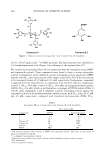
M. HETEROPHYLLA AND INHIBITION OF MMP-1 281 (40:60, 50:50, 60:40, 80:20, 100:0, v/v) to give 20 fractions (1-20). Compound 1 (370 mg) was obtained by recrystallization in EtOAc from fraction 15. Fraction 12 was further separated by a Sephadex LH-20 CC (35 x 2.3 cm) eluted with hexane-EtOAc MeOH (7:3:1, 5:5:2, 5:5:3, 4:6:4) to yield nine subfractions (I-IX). Compound 2 (105 mg) was obtained from subfraction VIII. 1,2,4,6-tetra-O-galloyl-13-0-glucopyranose (1): Amorphous pale brown powder FeC13 positive FAB-MS m/z: 789 [M+ +1} UV (MeOH) "-max: 217, 277 nm 1 H-NMR (500 MHz, acetone-d6) 3: 7.32, 7.30, 7.28, 7.26 (each 2H, s, H-2', 6'), 6.10 (lH, d,]=9.3 Hz, H-1), 5.45-5.52 (2H, m, H-2, 4), 4.62-4.67 (lH, m, H-6), 4.41-4.47 (3H, m, H-3, 5, 6) 13C-NMR (125 MHz, acetone-d 6 ) 3: 167.32 (lC), 167.13 (2C), 166.94 (lC) of galloyl carbonyl carbon atoms, 146.27-146.37 (8C, C-3', 5'), 139.29, 139.15, 139.07, 139.00 (each lC, C-4'), 122.34, 122.18, 121.95, 121.77 (each lC, C-1'), 110.26-110.42 (8C, C-2', 6'), 102.93 (lC, C-1), 74.02, 73.80, 73.30, 71.68 (each lC, C-2, 3, 4, 5), 63.08 (lC, C-6). 3,4,5-trihydroxybenzoic acid (2:) Amorphous white powder FeC1 3 positive FAB-MS m/z: 171 [M+ + 1} UV (MeOH) "-max: 220, 272 nm 1 H-NMR (500 MHz, acetone-d6) 3: 7.15 (2H, s, H-2, 6) 13C-NMR (125 MHz, acetone-d6) 3: 167.86 (lC, carbonyl carbon atom), 146.07 (2C, C-3, 5), 138.72 (lC, C-4), 122.13 (lC, C-1), 110.31 (2C, C-2, 6). MEASUREMENT OF DPPH RADICAL SCAVENGING ACTIVITY The DPPH radical scavenging effect was evaluated according to the method of Hatano et al. (9) with minor modification. DPPH solution (0.1 mM) was added to the same volume of sample solution and allowed to react for 10 min at room temperature. The optical density was measured at 565 nm using an automated microplate reader (ELx800, Bio-Tek Instruments, USA). MEASUREMENT OF SUPEROXIDE RADICAL SCAVENGING ACTIVITY The scavenging activity on the ROS was measured by monitoring the reduction of nitroblue terazolium (NBT) (10). Briefly, the samples, 0.05 M Na2CO 3 buffer (pH 10.2), 3 mM xanthine, 3 mM ethylene diamine tetraacetic acid (EDTA), 0.75 mM NBT, and bovine serum albumin (BSA) solution were mixed, and the reactant was incubated at 25°C for 10 min. Xanthine oxidase (0.25 U/ml) enzyme solution was then added, and further incubation was conducted at 25°C for 25 min. The reaction was quenched with 6 mM CuC1 2 . The scavenging activity was calculated by comparing the optical density at 565 nm of the control with that of the samples. COLLAGENASE (MMP-1) INHIBITION ASSAY The in vitro collagenase inhibition assay, which is based upon fluorescence measurement of collagen fragments upon cleavage by MMP-1, was performed using EnzChek colla genase/ gelatinase kits (Molecular Probes Inc., USA) according to the supplier's instruc tion. The enzymes were mixed with quenched fluorescent substrates (250 µg/ml) in a final volume of 200-µl reaction buffer in 96-well microplates. Digested products from
Purchased for the exclusive use of nofirst nolast (unknown)
From: SCC Media Library & Resource Center (library.scconline.org)