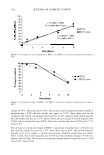
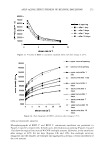
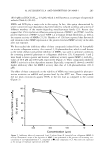
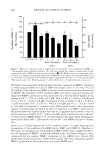
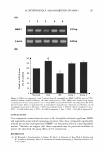
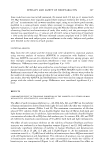
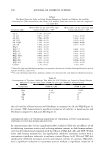
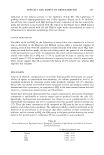
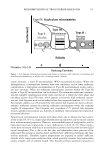
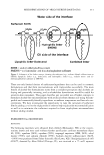
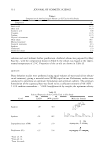
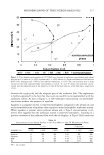
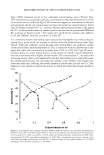
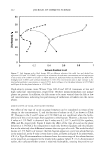
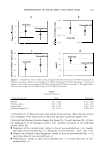
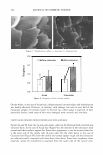
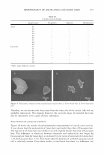
MICROEMULSIONS OF TRIGLYCERIDE-BASED OILS 317 � � C ca C, � Cl) ...... 60 50 IV 40 I I b. , , , 30 "C" ':' , , , A , , , 20 , , , , , ·� I , II , , , 10 , , , , nonmicroemulsion "F" phase 0 0 0.2 0.4 0.6 0.8 Sebum fraction in oil ♦ I/IV � IV/I .::c IV/Ill 1/111 o 111/11 A IVIII () N/11 - nonmicroemulsion 1 Figure 3. Fish diagram with sgualene at 0.5% NaCl as a function of surfactant concentration and sebum fraction in oil (a value of 0 is 100% sgualene and 1 is 100% sebum oil). Surfactant/linkers studied here are AOT (4%), hexylglucoside (5.06%), and sorbitan monooleate (5.13%). The concentration ratio is kept constant as the total surfactant/linker concentration is varied. "C" and "F" denote the surfactant concen tration and the sebum fraction of the mixed oil at which the body and tail of the fish meet, respectively (25°c). between the triglyceride and the nonpolar part of the surfactant film. The explanation is further supported by the fact that the co-oil can readily be microemulsified with the surfactant system. As seen in Figure 3, at low surfactant concentration, no microemul sion forms without the presence of squalene. Squalene is a nonpolar oil that is relatively hydrophobic compared to the sebum oil, and so microemulsification of squalene alone requires a more hydrophobic surfactant system. When squalene is present alone (without sebum oil), a Type I microemulsion is ob served. This suggests that the surfactant system is relatively hydrophilic, resulting in a positive curvature of the surfactant film with the oil droplets. A Type I-III-II transition Table IV Concentration (C) and Sebum Fraction in Oil (F) at Which a Type IV Microemulsion Forms C (%) F (fraction) Oil/NaCl (%) 0.50% 1.50% 3.00% 0.50% 1.50% 3.00% Sgualene 25 NS NS 0.42 NS NS Sgualane 25 35 42 0.35 0.20 0.15 1PM 25 38 NS 0.50 0.18 NS EL 25 38 NS 0.40 0.02 NS NS = not studied.

318 JOURNAL OF COSMETIC SCIENCE can be achieved in two ways: increasing the hydrophobicity of the surfactant system (aqueous phase) or increasing the hydrophilicity of the oil. Increasing the hydrophobicity of the surfactant system helps to move the surfactant system to the aqueous phase-oil phase interface, whereas increasing the hydrophilicity of the oil phase helps match the hydrophobicity of the surfactant system with the oil phase. The hydrophobicity/ hydrophilicity matching leads to an increase in penetration of the surfactant film into the oil phase, a decrease in the curvature from positive values (Type I) to negative values (Type II), and an increase in the flexibility of the film. As seen in these results, the Type I-III-II transition is obtained when the fraction of sebum in the oil increases (oil hydrophilicity increases). It is evident that the addition of sebum oil to the system induces a change in the microstructure of the microemulsion from an O/W type (Type I) to an W/O type (Type II). This suggests that the interaction between the surfactant film and the sebum oil is increased as the hydrophilicity of the oil mixture increases. From Figure 3, it is worth mentioning that less than 30 wt% surfactant is necessary to microemulsify triglyceride-based oil at room temperature. This is much less than in previous reports that required up to 50% surfactants and co-surfactants for triglyceride microemulsification (6,34). The required temperature in the microemulsification of sebum oil is also much lower than the temperatures that were reported in studies with triolein (ranging from 25° to 60°C in the presence and absence of alcohols, respectively (5 ,43 ). This is attributed to the presence of fatty acids in the sebum, which facilitate the oil solubilization (34, 11). Fish diagrams for the systems with squalane, isopropyl myristate, and ethyl laurate as co-oil at 0.5% NaCl are similar to the results shown in Figure 3 therefore, detailed description of these systems is not provided. Von Corswant et al. (5,7) found that adding isopropyl myristate to microemulsions based on triglycerides decreased the spontaneous curvature of the surfactant film and increased flexibility of the surfactant monolayer. The change in spontaneous curvature was manifested by a gradual change in the microstruc ture of the microemulsion, as revealed by NMR self-diffusion data. Interestingly, a Type I-III-II transition for a long-chain triglyceride was observed when the amount of IPM increased, whereas an opposite trend is observed here that is, a Type I-III-II transition occurs when the sebum fraction in oil increases or when the fraction of IPM in the oil mixture decreases. This might be due to the fact that the surfactant that Von Corswant et al. used, which is soybean phosphatidylcholine (SbPC), is relatively hydrophobic thus when the oil mixture is relatively hydrophobic, the degree of surfactant-oil interaction increases. This is known to decrease the curvature and increase the flexibility of the film, inducing a Type I-III-II transition. This is also supported by the findings of Von Corswant et al. the water/1-propanol/SbPC/IPM microemulsion system forms a W/O or Type II microemulsion (that is, the spontaneous curvature of the SbPC film is negative). In the system reported here, the increased hydrophilicity of the sebum and co-oil mixture enhances the surfactant-oil interaction, leading to a Type I-III-II transition as well when the amount of IPM present is reduced. In other words, the spontaneous curvature for the surfactant film investigated here is positive when co-oil is present alone. Surfactant partitioning at the excess water/middle phase and the middle phase/excess oil interfaces. When surfactant concentration (y-axis) is plotted as a function of a tuning parameter such as salinities or hydrophobicity (x-axis), a fish diagram typically appears to be vertical in both fish body and fish tail. This suggests an insignificant partitioning of lipophilic and hydrophilic compounds from a bicontinuous middle phase into an excess
Purchased for the exclusive use of nofirst nolast (unknown)
From: SCC Media Library & Resource Center (library.scconline.org)