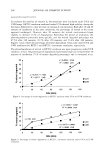
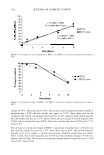
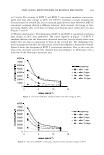
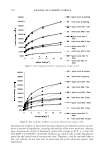
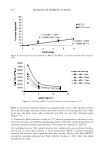
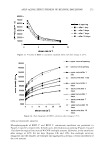
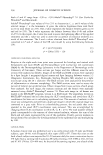
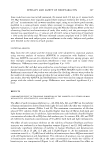
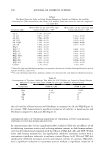
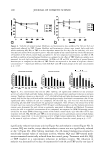
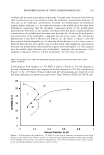
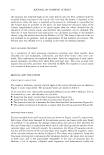
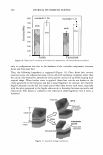
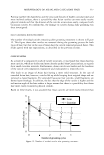
MORPHOLOGY OF ASIAN AND CAUCASIAN HAIR 337 Putting together this hypothesis and the structural features of higher cuticular edges and more inclined surfaces, there is a possibility that Asian cuticles can more easily receive physical stimuli and that the abrasion of the cuticles occurs more easily, compared with Caucasian cuticles. To confirm this, the damage to cuticles during daily grooming was then investigated. DAILY-GROOMING MODEL TREATMENT The number of residual cuticles remaining after grooming treatment is shown in Figure 12. This figure shows that cuticles are removed during the grooming process for both types of hair, but that in the case of Asian hair the cuticle removal proceeds faster. This result agreed with our expectations, as described in the previous section. CONCLUSIONS As a result of a comparative study of cuticle structures, it was found that Asian hair has more cuticles, which are thicker and more densely packed than Caucasian hair, as regards their small cuticular intervals. Furthermore, Asian cuticles are harder and the hardness of the cuticle cell components (exocuticle and endocuticle) is relatively even. This leads to an image of Asian hair having a more solid structure. In the case of extended Asian hair, however, cuticles lift up while keeping their original shape and are removed as large fragments. For extended Caucasian hair cuticles, small fragments are formed upon breakage. In addition, the fact that the edge of the cuticle is higher and the inclination angle of the hair surface is larger means that there is a possibility that Asian hair more easily encounters physical stimuli. Based on these results, it was assumed that Asian cuticles are more easily removed than 6 ---Asian 5 · - · Caucasian 4 (I) 3 "§ 4-- 2 0 -.._·.. f- - - - - -l-- (I) 0 0 2 3 4 Number of grooming cycles Figure 12. Number of residual cuticles after grooming treatment.

338 JOURNAL OF COSMETIC SCIENCE Caucasian cuticles. The progress of cuticle abrasion during daily grooming processes endorses this assumption. It is assumed that that there is a racial difference in the component that absorbs stress first. In the case of Asian hair, the cohesion between cuticle cells seems to be affected by the stress first, while in the case of Caucasian hair, the cuticle cell structures themselves seem to be damaged first. REFERENCES (1) H. Otsuka and T. Nemoto, Study on Japanese hair, Koshokaishi, 12, 192-197 (1988). (2) B. M. Das. A study of cross sections of head hair from some Caucasoid and mongoloid populations of Assam, India, Z. Morph. Anthrop., 65, 324-328 (1974). (3) A. Franbourg, P. Hallegot, F. Baltenneck, C. Toutain, and F. Leroy. Current research on ethnic hair, J. Am. Acad. Dermatol., 48, 115-119 (2003). (4) S. Hayashi, T. Okumura, and A. Ishida, "Preliminary Study on Racial Difference in Scalp Hair," Biology and Disease of the Hair, T. Kobori et al., Eds. (University of Tokyo Press, Tokyo 1976), pp. 555-561. (5) B. M. Das, Medullary structure of head hair in some Caucasoid and mongoloid populations of Assam, India, Z. Morph. Anthrop., 63, 102-109 (1971). (6) A. N. Parbhu, W. G. Bryson, and R. Lal. Disulfide bonds in the outer layer of keratin fibers confer higher mechanical rigidity: Correlative nano-indentation and elasticity measurement with an AFM, Biochemistry, 38, 11755-11761 (1999). (7) J.P.Cleveland, S. Manne, D. Bocek, and P. K. Hansma. A nondestructive method for determining the spring constant of cantilevers for scanning force microscopy, Rev. Sci. Instrum., 64, 403--405 (1993). (8) J. A. Swift. Fine details on the surface of human hair, Int. J. Cosmet. Sci., 13, 143-159 (1991). (9) S. B. Ruetsch and H.-D. Weigmann. Mechanism of tensile stress release in the keratin fiber cuticle. I.,]. Soc. Cosmet. Chem., 47, 13-26 (1996).
Purchased for the exclusive use of nofirst nolast (unknown)
From: SCC Media Library & Resource Center (library.scconline.org)