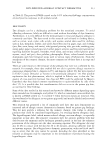
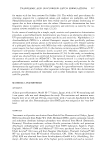
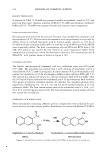
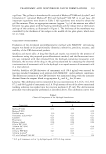
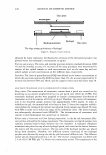
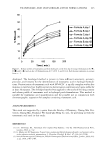
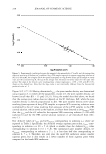
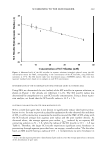
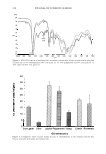
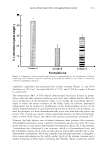
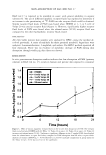
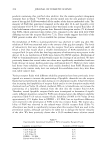
60 50 40 G) G) 30 &! -::.e.. 20 10 0 TRANEXAMIC ACID IN HYDROGEL PATCH FORMULATIONS 225 0 50 100 150 Time (min) 200 -+- Formula A,day1 --- Formula B,day1 __,._ Formula C,day1 --◊- Formula A,day120 ----a- Formula B,day120 ---tr- Formula C,day120 Figure 7. Release profiles of tranexamic ai;:id from hydrogels on the first day of storage (formulations A ( ♦ ), B (■) and C (..6.)) and on day 120 (formulations A ( ◊ ), B (D), and C (6)). Each datum represents an average from n = 3. developed. The developed method is proven to have sufficient sens1t1v1ty, accuracy, precision, and linearity for the determination of tranexamic acid in hydrogel formula tions. Derivatization of tranexamic acid with NDA/CN- is rapidly complete within five minutes in mild and not highly restrictive derivatization conditions and quite stable for at least 30 minutes. The developed method was applied to the study of the drug content and release profile of tranexamic acid in hydrogel patch formulations. This method is suitable for tranexamic acid quantification and for possible use in conjunction with chromatographic separation for samples containing tranexamic acid. ACKNOWLEDGMENTS This work was supported by a grant from the Faculty of Pharmacy, Chiang Mai Uni versity, Chiang Mai, Thailand. We thank Qui Heng Co. Ltd., for providing us with the tranexamic acid used in this study. REFERENCES (1) S. C. Sweetman, Ed., Martindale: The Complete Drug Reference, 33rd Ed. (The Pharmaceutical Press, London, 2002), p. 742. (2) K. Maeda and M. Naganuma, Topical trans-4-aminomethylcyclohexanecarboxylic acid prevents ultra violet radiation-induced pigmentation,]. Photochem. Photobiol. B: Biol., 47, 136-141 (1998). (3) British Pharmacopoeia! Commission, British Pharmacopoeia (The Stationary Office, London, 2004), Vol. 1, pp. 1960, 2783-2784.

226 JOURNAL OF COSMETIC SCIENCE (4) E. I. Lerner, V. Rosenberger, and M. Flasher, Pharmaceutical oral patch for controlled release of pharmaceutical agents in the oral cavity, U.S. Pat 6,197,331 (March 6, 2001). (5) A. Tibbelin, R. Aust, M. Bende, M. Holgersson, B. Petruson, H. Rundcrantz, and U. Alander, Effect of local tranexamic acid gel in treatment of epistaxis, ORL]. Otorhinolaryngol Relat. Spec., 57, 207-209 (1995). (6) A. Manosroi, K. Podjanasoonthon, and J. Manosroi, Development of novel topical tranexamic acid liposome formulations, Int.]. Pharm., 235, 61-70 (2002). (7) A. M. Wahbi, E. A. Lotf1, and H. Y. Aboul-Enein, Spectrophotometric determination of tranexamic acid with chloranil, Talanta, 31, 77-78 (1984). (8) M. E. Mohamed and H. Y. Aboul-Enein, Colorimetric determination of tranexamic acid with p dimethylaminobenzaldehyde, Int.]. Env. Anal. Chem., 19, 19-25 (1984). (9) N. Buyuktimkin and S. Buyuktimkin, Spectrophotometric determination of tranexamic acid with l-fluoro-2,4-dinitrobenzene in pharmaceutical dosage forms, Acta Pharmaceutica Turcica, 27, 78-81 (1985). (10) S. Atmaca, Spectrophotometric determination of tranexamic acid with 2,4,6-trinitrobenzenesulfonic acid, Acta Pharm. Turcica, 31, 115-118 (1989). (11) T. M. Ansari, A. Raza, and A. Rehman, Spectrophotometric determination of tranexamic acid in pharmaceutical bulk and dosage forms, Anal. Sci., 21, 1133-1135 (2005). (12) A. Raza, Utility of certain 'TT-Acceptors for the spectrophotometric determination of tranexamic acid in commercial dosage forms, Anal. Lett., 39, 2217-2226 (2006). (13) G. Iskender and S. Atmaca. Spectrofluorometric determination of tranexamic acid in pharmaceutical dosage forms, Pharmazie, 43, 290 (1988). (14) S. Uehara, T. Hagiwara, M. Takahashi, K. Kamara, K. Nakayama, K. Akiyama, and S. Nishigaki, High performance liquid chromatographic method for the determination of tranexamic acid (III), Iyakuhin Kenkyu, 19, 98-102 (1988). (15) K. Matsubayashi, C. Kojima, and H. Tachizawa, Determination of tranexamic acid in human serum by high-performance liquid chromatography using selective pre-column derivatization with phenyl isothiocyanate,j. Chromatogr., 433, 225-234 (1988). (16) S. Nojiri, S. Uehara, T. Hagiwara, and M. Nishijima, High-performance liquid chromatographic determination of aspartic acid, taurine, and tranexamic acid by precolumn derivatization using sodium picrylsulfonate, Tokyo-toritsu Eisei Kenkyusho Kenkyu Nenpo, 46, 58-61 (1995). (17) M. Y. Khuhawar and F. M.A. Rind, HPLC determination of tranexamic acid in pharmaceutical preparations and blood, Chromatographia, 53, 709-711 (2001). (18) C. Lacroix, P. Levert, G. Laine, and J. P. Gaulle, Microdetermination of two antifibrinolytics (e aminocaproic acid and tranexamic acid) by liquid chromatography and fluorimetric detection, ]. Chromatogr., 309, 183-186 (1984). (19) M. Elworthy, Determination of plasma tranexamic acid using cation-exchange high-performance liquid chromatography with fluorescence detection,]. Chromatogr., 343, 109-117 (1985). (20) P. Froehlich and E. L. Wehry, "Fluorescence Detection in Liquid and Gas Chromatography," in Modern Flttorescence Spectroscopy, Vol. 3, E. L. Wehry, Ed. (Plenum Press, New York, 1981). (21) K. Inui, S. Doi, Y. Nakai, and K. Yamada, Determination of tranexamic acid in pharmaceutical preparations by high-performance liquid chromatography, Iyakuhin Kenkyu, 26, 398-403 (1995). (22) J. Vessman and S. Stromberg, Determination of tranexamic acid in biological material by electron capture gas chromatography after direct derivatization in an aqueous medium, Anal. Chem., 49, 369-373 (1977). (23) S. Uehara, T. Hagiwara, M. Takahashi, K. Kamara, K. Nakayama, K. Akiyama, and Y. Naoi, Determination of tranexamic acid by gas chromatography (II), Iyakuhin Kenkytt, 18, 142-145 (1987). (24) D. Fekkes, State-of-the-art of high- performance liquid chromatographic analysis of amino acids in physiological samples.]. Chromatogr. B, 682, 3-22 (1996). (25) T. Fukushima, N. Usui, T. Santa, and K. Imai, Recent progress in derivatization methods for LC and CE analysis,]. Pharm. Biomed Anal., 15, 1655-1687 (2003). (26) R. W. Peace and G. S. Gilani, Chromatographic determination of amino acids in foods,]. AOAC Int., 88, 877-887 (2005). (27) P. de Montigny, J. F. Stobaugh, R. S. Givens, R. G. Carlson, K. Srinivasachar, L.A. Sternson, and T. Higuchi, Naphthalene-2,3-dicarboxyaldehyde/cyanide ion: A rationally designed fluorogenic reagent for primary amines, Anal. Chem., 59, 1096-1101 (1987). (28) Y. Cho, H. Yoo, J. Min, E. Lee, S. Hong, Y. Chung, and Y. Lee, Comparative study of naphthalene-
Purchased for the exclusive use of nofirst nolast (unknown)
From: SCC Media Library & Resource Center (library.scconline.org)