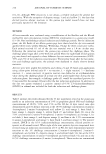
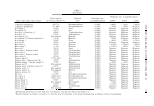
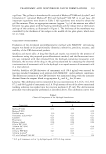
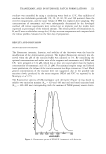
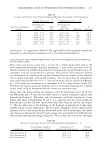
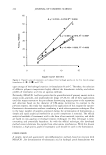
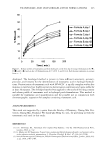
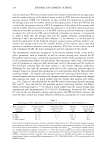
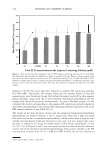
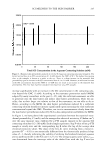
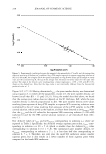
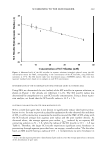
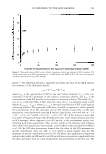
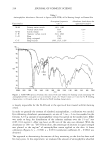
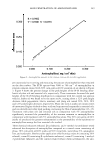
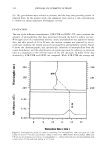
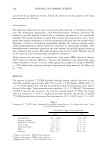
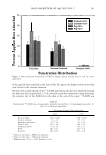
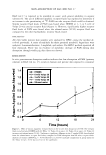
252 JOURNAL OF COSMETIC SCIENCE (16-18), pyrrolidones were utilized as solvents, and the drug was generally present in solution form. In the present study, the enhancers were used at a low concentration (5%w/w) to obtain maximum therdynamic activity. EVALUATION The aim of the different measurements, ATR-FTIR and HPLC-UV, was to evaluate the amounts of aminophylline that have penetrated through the skin by surface recovery. With application of a transdermal delivery cream, aminophylline was applied to human skin, and after periods of 30 or 60 min, the stratum corneum was removed by succes sively tape stripping the treated area and was assayed for aminophylline content. Figure 6 shows the chromatographic and spectroscopic behaviors of aminophylline from the cream formulation, and the identification of a peak was made by reference to retention time at a maximum in the 270-nm region of the UV spectrum. In Table II the data obtained by ATR-FTIR and HPLC are compared. With ATR-FTIR the average and .-.. i 30tJ . ._.. t � RI zc,n ..-.. � 0.02 � � 0.01 � � a.oo 8 9 / Z7D ( }, ," / .. •· \. 10 11 ' ' Retention time ( min ) '30CI wo C&I ""': ... 12 13 Figure 6. Aminophylline profile of cream C (containing 5% aminophylline, 30% corn germ oil, 10% jojoba oil, and 5% l-methyl-2-pyrrolidone enhancer). Detection: HPLC-DAD. Reversed-phase HPLC and UV spectra of a methanol-water extract of aminophylline. (---) Dotted line indicates the aminophylline peak is detected at 270 nm and peak eluting at 11.76 min.

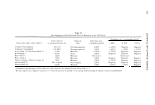
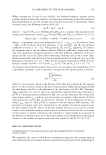
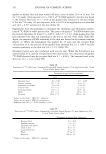
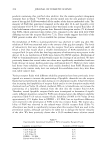
SKIN PENETRATION OF AMINOPHYLLINE 253 Table II Determination of Aminophylline after 60-min Treatment with Cream C by Stripping Method Analytical methods LC-UV ATR-FTIR % Decrease Determinations 19.70, 19.20, 20.90, 20.56, 19.93, 19.69 22.48, 20.98, 22.47, 18.87, 22.4, 22.82, 23.5 Average 20.01 ± 0.69 21.92 ± 1.52 % Decrease in peak height or peak area = {(peak height or peak area due to treatment-peak height or peak area due to control)/peak height or peak area due to control} x 100. Cream C contains l-methyl-2-pyrrolidone enhancer. standard deviations are slightly higher than with HPLC because FTIR detection is not as sensitive as UV and the samples were not pretreated and run on the ZnSe crystal. The reproducibility of the peak area of aminophylline is poor. However, the data in a sample are obtained by both LC-UV and FTIR. Thus LC-UV can be used for quantitation and FTIR for qualitative detection and spectroscopic identification of aminophylline in a mixture. CONCLUSIONS In vivo findings on skin with an ATR crystal or a stripping method, in which the decrease in the peak height of the permeating aminophylline is determined in the cream receiving phase, can be evaluated and considered in preformulation studies. The results of this study suggest that the choice of the proper combination of oil phase lipids may allow achieving drug-controlled delivery from a topical o/w microemulsion, and may be employed with limited success when formulated into a matrix-type transdermal patch or in a gel. ACKNOWLEDGMENTS Financial support of this work by the Chia Nan University of Pharmacy and Science is gratefully acknowledged (CNAC-92-06). REFERENCES (1) J. S. Artz, and M. I. Dinner, Can.]. Plast. Surg., 3, 190 (1995). (2) J. W. Petrozzi and R. N. Shore, Arch. Dermatol. 112, 525 (1976). (3) M. Baan, J. Madarasz, G. Pokol, and S. Gal, Solid State Ionics, 172, 587 (2004). (4) L.-H. Wang and C.-C. Wang, Microchimica Acta, 153, 95 (2006). (5) J.-E. Haky, W. M. Foss, and B. L. Marks,]. Liq. Chromatogr. Rel. Technol., 20, 2399 (1997). (6) B. L. Marks, L. M. Katz, J.E. Haky, W. M. Foss, and D. J. Torok, Int.]. Obesity, 23, 198 (1999). (7) J.P. Liu and N. Zhou, Chinese Pharm. ]., 36(8), 534 (2001). (8) R. L. Bronaugh and J. J. Yourick, C&T, 115, 47 (2000). (9) M. Hori, S Satoh, and H. I. Maibach, "Classification of Percutaneous Penetration Enhancers: A Con ceptual Diagram," in Percutaneous Absorption, R. L. Bronaugh and H. I. Maibach, Eds. (Marcel Dekker, New York, 1989), p. 197. (10) D. Abdullah, 0. N. Ping, and J. G. Liu, Yaoxue Xuebao, 31, 214 (1996). (11) D. Monti, P. Chetoni, S. Burgalassi, M. Najarro, M. F. Saettone, and E. Boldrini. Int.]. Pharm., 237, 209 (2002).
Purchased for the exclusive use of nofirst nolast (unknown)
From: SCC Media Library & Resource Center (library.scconline.org)