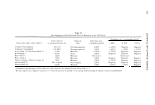
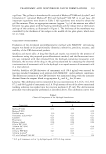
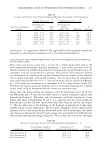
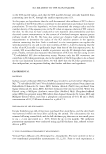
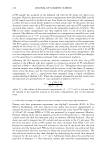
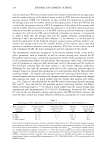
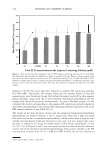
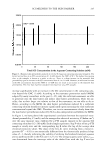
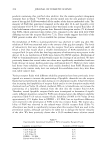
234 JOURNAL OF COSMETIC SCIENCE such as ultrasound. We have recently utilized this model to determine the average radius and the number density of the aqueous pores in skin (p-FTS) that was contacted by an aqueous solution of SDS (13). Similarly, we have utilized this model here to determine the average radius and the number density of the aqueous pores in skin (p-FTS) that was contacted by an aqueous solution of SCI. A comparison of the values of the average radii and the number densities resulting from skin exposure to (i) the SCI contacting solution (referred to hereafter as solution a), (ii) the SDS contacting solution (referred to hereafter as solution b), and (iii) the PBS control (referred to hereafter as solution c) is presented in Table I. Note that the average radii and the number densities corresponding to solutions b and c are reproduced from reference 13. In reference 13, we discussed in detail the application of the hindered-transport aqueous porous pathway model to de termine the average radius and the number density of the aqueous pores upon skin exposure to surfactant aqueous contacting solutions. With this in mind, here, we will only summarize briefly the main assumptions and key equations of this model. The fundamental underlying assumption of the porous pathway model is that hydro philic permeants, such as mannitol, as well as current-carrying ions, traverse the SC through the same tortuous, cylindrical aqueous pores·. Other model assumptions include: (i) the permeants/ions behave as hard spheres that experience solely steric, hard-sphere particle (permeant or ion)-pore wall interactions, and (ii) the anions and the cations in the electrolyte solution have the same valence, z, and similar diffusion coefficients. Although the ions (and the permeant molecules) in the contacting solutions may be charged, Tang et al. showed that assumption (i) is valid provided that the Debye-Hiickel screening length-the length scale associated with the screening of electrostatic inter actions between the ions (or between the charged permeants) and the negatively charged skin aqueous pore walls-is much smaller than the average skin aqueous pore radius, r p ore (31). Tang et al. also showed that for the PBS control contacting solution containing Na+ and Cl- ions, and also for the mannitol aqueous contacting solution, the Debye Hiickel screening length is -s:.7 A, which is much smaller than the typical average skin aqueous pore radii (approximately 15-25 A) (31). Furthermore, because the Na + and the Cl- ions are the two dominant current-carrying ions in the PBS electrolyte solution, and have the same valence and similar diffusion coefficients, assumption (ii) is also satisfied. Table I Skin Aqueous Pore Characteristics Resulting From Skin Exposure to Three Solutions (a-c) Type of aqueous Average aqueous Normalized pore Micelle Critical micelle contacting pore radius, number density, radius, concentration, solution r p orc CA) (slT)norrnal (A.) CMC (mM) (a) SCI 29 ± 5 2 ± 1 33.5 ± 1 1.0 (b) SDS 33 ± 5 7 ± 1 19.5 ± 1 8.7 (c) PBS Control 20 ± 3 1 NIA NIA Note that the results for solutions a and b are reproduced from reference 13. The hindered-transport aqueous porous pathway model was used, along with the in vitro mannitol transdermal permeability and average skin electrical resistivity measurements, to determine the average pore radius, r p or c' and the pore number density, s!T, resulting from skin exposure to solutions a - Note that we have reported sl'f values resulting from the exposure of p-FTS to contacting solutions a-c normalized by the s/T value resulting from the exposure of p-FTS to contacting solution c, which we have denoted as (sl'f)normal· The SCI micelle radius was determined using dynamic light-scattering (DLS) measurements at 3 5 °C. The CMC of SCI at 3 5 °C was provided by the BASF Company.

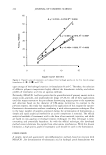
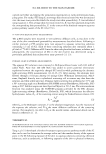
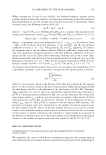
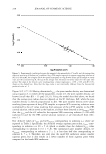
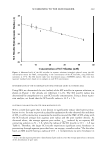
SCI MILDNESS TO THE SKIN BARRIER 235 When assumptions (i) and (ii) are satisfied, the hindered-transport aqueous porous pathway model indicates the existence of a linear-log relationship between the mannitol skin permeability, P, and the average skin electrical resistivity, R. Specifically, within statistical error, the following relation holds (31): log P = log C - log R (3) where C = [kBTl2z2Fc i one0] * [D H(A. p )ID:nH(A.ion)] is a constant that depends on the average skin aqueous pore radius, r po w through H(A. p ) and H(A.i01 ,), as follows (24,27 ,31): H(AJ = cpi(l - 2.1044Ai + 2.089Af - 0.948A[), for A i 0.4 (4) where i = p (permeant, in our case, mannitol) or ion, Ai = r/r por e' ri is the radius of solute i, H(A) is the hindrance factor for permeant or ion transport, and qi (the partition coefficient of solute i) = (1 - A/. The quantities, v and v: n , appearing in C refer to the permeant and to the ion infinite-dilution diffusion coefficients, respectively (note that these quantities correspond typically to the bulk diffusion coefficients of the per meant and the ion in the dilute donor contacting solutions used in the in vitro trans dermal permeability and electrical resistivity measurements). In addition, in C, kB is the Boltzmann constant (1.38 x 10⁻²³ J/K), Tis the absolute temperature (298 K), Fis the Faraday constant (9.6485 x 10⁴ C/mol), cion is 0.13 7 M, and e0 is 1.6 x 10- 19 C. According to the hindered-transport theory (26), one can express the permeability, P, of a hydrophilic permeant, such as mannitol, through the skin aqueous pores as follows: ( � )v H(- p ) P=---- LiX (5) where B is the porosity, which is the fraction of the skin area occupied by the aqueous pores, T is the tortuosity, which is the ratio of the permeant diffusion path length within the skin barrier (the SC) to the thickness of the skin barrier (the SC), LiX. Therefore, using equations 3-5, once P and R are determined experimentally upon exposure of p-FTS to contacting aqueous solutions of SCI, one can also determine the average skin aqueous pore radius, r por e' and the ratio of porosity-to-tortuosity, defined as e/T, if all the other parameters, such as LiX, are known (see reference 13 for an illustration of how to deduce r pore and BIT when p-FTS is contacted with an aqueous SDS solution). The porosity-to-tortuosity ratio, eh, corresponds to the number of tortuous aqueous pores per unit volume of the SC, that is, to the pore number density (13,24,27,31,32). In the context of the hindered-transport aqueous porous pathway model of the SC, an increase in the porosity, e, and/or a decrease in the tortuosity, T, which results in an increase in the porosity-to-tortuosity ratio, e/rr, of the aqueous pores, can be interpreted as indicating an increase in the number of aqueous pores per unit volume of the SC (13,24,27 ,31). RES UL TS AND DISCUSSION DETERMINATION OF THE AVERAGE RADIUS AND THE NUMBER DENSITY OF THE SKIN AQUEOUS PORES We quantified the extent of skin barrier perturbation using the skin average aqueous pore radius and the pore number density as quantitative descriptors of the morphological
Purchased for the exclusive use of nofirst nolast (unknown)
From: SCC Media Library & Resource Center (library.scconline.org)