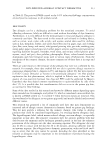
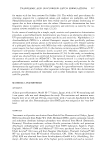
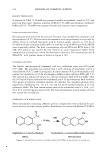
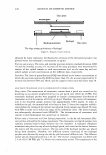
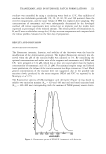
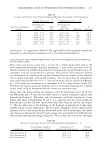
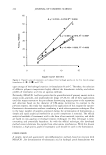
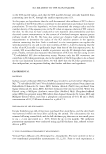
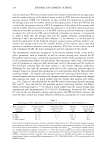
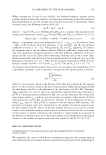
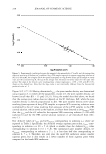
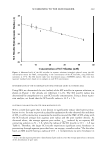
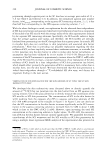
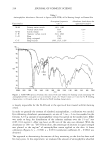
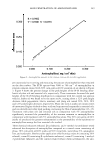
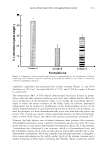
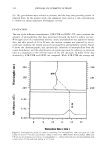
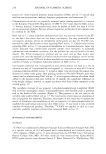
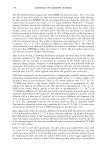
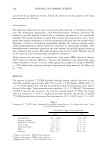
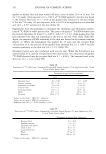
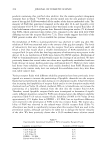
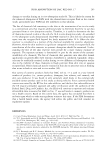
248 JOURNAL OF COSMETIC SCIENCE Table I Aminophylline Absorbances Observed in Spectra (ATR-FTIR) of Fat-Burning Sample on Human Skin Functionality N-H 0-H C-H C==O 95.1 90 80 70 60 50 %T 40 30 20 10 4.0 2000.0 1900 Primary amine stretch Primary amine bend Stretch (broad) Aliphatic carbon stretch Ring Ring conjugated Ring benzene Absorption frequencies (cm- 1 ) 3493, 3380 1557 3398 2921, 2849 1701 1649 1605, 1525, 1495 Absorbance band chosen for quantitative analysis 1557 1800 1700 1600 1500 1400 1300 1200 1100 1000 900 800 700.0 cm-I Figure 1. ATR-FTIR spectra of human skin treated with and without fat-burning cream containing 5% aminophylline/30% corn germ oil. (a) Untreated cream. (b) Treated cream at O min for N-H bending characteristic. (c) Treated cream at 60 min for N-H bending characteristic. is largely responsible for the N-H bond in the spectra of skin treated with fat-burning cream. In order to quantify the amount of adsorbed aminophylline, a calibration was needed. For calibrating absorbance measurements, an area of 7 cm x 2 cm was marked on the forearm. A 0.3-g amount of aminophylline cream was spread on the marked area. Effort was made to keep the distribution of the solution uniform over the 14 cm2 area (0.05-0.64 mg/cm2 ). After one hour, an IR scan of the area was obtained. With the absorbance at 15 5 7 cm - 1 (N-H from skin), the percentage of decrease in signal strength was plotted vs the mg/cm2 of aminophylline cream applied to the skin. A linear calibration (Figure 2), y = 0.8901 x + 0.0538 (correlation coefficient, R = 0.9902) was obtained. The approach to determining the amount of drug remaining on the skin has been used for many years. In this experiment, we evaluated the amount of aminophylline absorbed

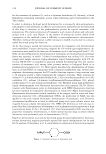
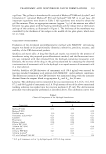
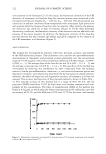
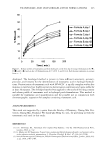
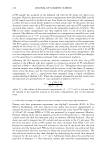
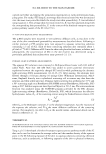
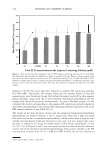
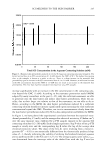
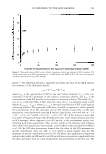
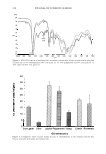
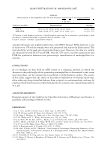
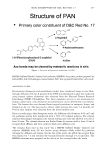
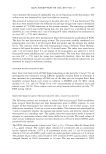
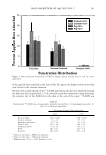
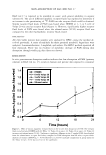
SKIN PENETRATION OF AMINOPHYLLINE 249 R= 0.9902 0.300 Y = 0.8901 X + 0.0538 0 0.000 --------------------- 0.000 0.100 0.200 0.300 Aminophylline (mg/ cm2 skin) Figure 2. Aminophylline amounts in the stratum corneum 60 min after application. percutaneously by recovering and measuring the amount of aminophylline that remained on the skin surface. The FTIR spectra from 2000 to 700 cm- 1 of aminophylline in stratum corneum treated with 30% corn germ oil/10% essential oil are shown in Figure 3. Figure 4 shows the percent change in the peak heights of the N-H bending absor bances of plant oils and essential oils, respectively. These treatments decreased the peak heights of the N-H bending absorbances in comparison with the control (an aqueous vehicle). Jojoba oil was found to be the most active, causing about a 32% peak height decrease, while peppermint, lilacin, rosemary, and ylang oils caused 28%, 24%, 18% and 12% peak height decreases, respectively. Plant oils such as jojoba oil contain esters of unsaturated higher alcohols as fatty acids and terpenes and terpenoids in essential oils, and can disturb intercellar lipid packing, increasing the flux of aminophylline (13-15). Treatment with plant oils and essential oils in comparison with 5 % aminophylline significantly increased the permeability of the stratum corneum to aminophylline in comparison with treatment with 5% aminophylline alone. The 30% corn germ oil/10% jojoba oil produced the greatest enhancement in the permeability of the epidermis to aminophylline among the four essential oils studied. Three chemical enhancers (ethanol, 13-cyclodextrin, and l-methyl-2-pyrrolidone) tested enhanced the absorption of aminophylline compared to a control cream containing oil phase, 30% corn germ oil/10% jojoba oil/10% tricaprylin, water phase 5%, aminophyl line, and surfactants. One hour after application of fat-burning cream A (containing 50% ethanol), cream B (containing 13-cyclodextrin enhancer), cream C (containing l-methyl- 2-pyrrolidone enhancer), and the control cream (without chemical enhancers), the ami-
Purchased for the exclusive use of nofirst nolast (unknown)
From: SCC Media Library & Resource Center (library.scconline.org)