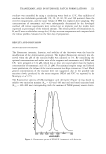
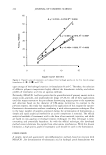
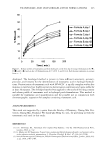
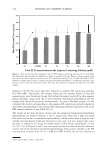
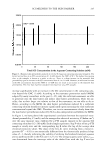
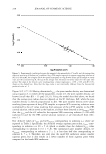
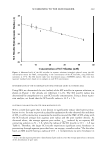
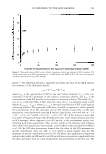
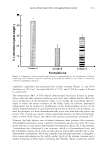
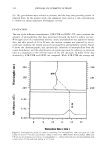
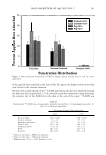
242 JOURNAL OF COSMETIC SCIENCE amount of SCI that penetrates into the skin barrier in vitro from aqueous contacting solutions was found to be approximately tenfold lower than that of SDS (11,13), which provides further evidence that the SCI micelles, unlike the SDS micelles (11,13), do not contribute significantly to skin penetration. In summary, the results in Figure 5, as well as our MLR analysis, clearly show that SCI in micellar form does not contribute significantly to SCI skin penetration, which in turn, leads to the observed dose independence of SCI skin penetration. This observation is consistent with our explanation of the skin mildness of SCI proposed above. 4 The SCI skin radioactivity results reported here are also consistent with recent studies (1,42). For example, Ananthapadmanabhan et al. (1) found that SCI binds to human SC to a lower extent than SDS, and also that SCI binding, unlike SDS binding, does not increase above the CMC of SCI. CONCLUSIONS Using mannitol transdermal permeability and skin electrical resistivity measurements in the context of a hindered-transport aqueous porous pathway model of the SC, we determined that the average aqueous pore radius resulting from skin exposure to an aqueous SCI contacting solution is 29 ± 5 A. Using dynamic light-scattering measure ments, we found that the SCI micelle radius is 33 ± 1 A. These results provide a plausible explanation for the well-documented skin mildness of SCI. Indeed, since the SCI micelles are larger in size than the average skin aqueous pores, they are sterically hindered from penetrating into the SC through the smaller skin aqueous pores. It is noteworthy that the arguments presented in this manuscript to explain the skin mild ness of SCI are valid for an intact skin barrier. If the skin barrier is compromised prior to skin exposure to SCI (for example, in the case of burn patients, where the protective SC layer is absent), then the biological effects of SCI on the skin barrier need to be accounted for to explain the skin mildness of SCI. A natural manifestation of our explanation for the skin mildness of SCI is that the SCI skin penetration should also be dose-independent. Using 14 C-radiolabeled SCI and in vitro skin radioactivity measurements, we demonstrated that SCI penetrates into the SC in a dose-independent manner. Furthermore, through in vitro skin electrical current and mannitol transdermal permeability measurements, we demonstrated that SCI induces skin barrier perturbation in a dose-independent manner. On the other hand, we have observed in previous studies that the harsh skin agent SDS, which is also an anionic surfactant like SCI, penetrates into the SC and induces skin barrier perturbation in a dose-dependent manner because the SDS micelle, being smaller in size than the average skin aqueous pores, can penetrate into the SC through these pores (11, 13 ). Furthermore, the amount of SCI that penetrates into the skin barrier in vitro from an aqueous con tacting solution was found to be significantly lower than that of SDS (11,13), which may be related to earlier in vitro and in vivo observations that SCI is mild, while SDS is harsh, to the skin barrier (1,10-17,23,42). Finally, an aqueous SCI contacting solution results in a 60% lower aqueous pore number density in vitro than an aqueous SDS contacting 4 In fact, Moore et al. have shown that micelle kinetics and micelle disintegration upon impinging on the SC and subsequent absorption by the SC do not affect surfactant skin penetration (11).

SCI MILDNESS TO THE SKIN BARRIER 243 solution, which is also consistent with the fact that SCI is known to be mild to the skin barrier and is also known to induce low skin barrier perturbation in vivo. ACKNOWLEDGMENTS We thank Dr. Peter Moore at RohMax USA for very illuminating discussions on surfactant skin penetration. In addition, we thank Dr. K. P. Ananthapadmanabhan from Unilever Corporation for providing the SCI surfactant, as well as for pointing us to several useful SCI-related skin barrier perturbation literature references. REFERENCES (1.) K. P. Ananthapadmanabhan, K. K. Yu, C. L. Meyers, and M. P. Aronson, Binding of surfactants to stratum corneum,J. Soc. Cosmet. Chem., 47, 185-200 (1996). (2) D. D. Strube, S. W. Koontz, R. I. Murahata, and R. F. Theiler, The flex wash test: A test method for evaluating the mildness of personal washing products,]. Soc. Cosmet. Chem., 40, 297-306 (1989). (3) G. lmokawa, "Surfactant Mildness," in Surfactants in Cosmetics, M. M. Rieger and L. D. Rhein, Eds. (Marcel Dekker, New York, 1997), pp. 427-471. (4) R. Scheuplein, and I. Blank, Permeability of the skin, Physiol. Rev., 51, 702-747 (1971). (5) W. Abraham, "Surfactant Effects on Skin Barrier," in Surfactants in Cosmetics, M. M. Rieger and L. D. Rhein, Eds. (Marcel Dekker, New York, 1997), pp. 437-487. (6) J. A. Faucher and E. D. Goddard, Interaction of keratinous substrates with sodium lauryl sulfate. I. Sorption,J. Soc. Cosmet. Chem., 29, 323-337 (1978). (7) J. A. Faucher and E. D. Goddard, Interaction of keratinous substrates with sodium lauryl sulfate. II. Permeation through stratum corneum,]. Soc. Cosmet. Chem., 29, 339-353 (1978). (8) L. D. Rhein and F. A. Simian, "Surfactant Interactions With Skin," in lnterfacial Phenomena in Biological Systems, Surfactant Science Series, Vol. 39 (Marcel Dekker, New York, 1991), pp. 33-49. (9) K. P. Wilhelm, G. Frietag, and H. H. Wolff, Surfactant induced skin irritation and skin repair,]. Am. Acad. Dermatol., 30, 944-949 (1994). (10) T. Agner and J. Setup, Sodium lauryl sulfate for irritant patch testing-A dose-response study using bioengineering methods for determination of skin irritation,]. Soc. Cosmet. Chem., 95, 543-547 (1990). (11) P. Moore, S. Puvvada, and D. Blankschtein, Challenging the surfactant monomer skin penetration model: Penetration of sodium dodecyl sulfate micelles into the epidermis,]. Cosmet. Sci., 54, 29-46 (2003 ), and references cited therein. (12) P. Moore, A. Shiloach, S. Puvvada, and D. Blankschtein, Penetration of mixed micelles into the epi dermis: Effect of mixing sodium dodecyl sulfate with dodecyl hexa(ethylene oxide),]. Cosmet. Sci., 54, 143-159 (2003), and references cited therein. (13) S. Ghosh and D. Blankschtein, The role of sodium dodecyl sulfate (SDS) micelles in inducing skin barrier perturbation in the presence of glycerol,]. Cosmet. Sci., 58, 109-133 (2007), and references cited therein. (14) L. D. Rhein, F. A. Simion, R. L. Hill, R.H. Cagan, J. Mattai, and H. I. Maibach, Human cutaneous response to a mixed surfactant system: Role of solution phenomenon in controlling surfactant irrita tion, Dermatologica, 180, 18-23 (1990). (15) L. D. Rhein, "In Vitro Interactions: Biochemical and Biophysical Effects of Surfactants on Skin," in Surfactants in Cosmetics, M. M. Rieger and L. D. Rhein, Eds. (Marcel Dekker, New York, 1997), pp. 397-426. (16) C.H. Lee and H. I. Maibach, Study of cumulative irritant contact dermatitis in man utilizing open application on subclinically irritated skin, Contact Dermatitis, 30, 271-275 (1994). (1 7) L. D. Rhein, C. R. Robbins, K. Fernee, and R. Cantore, Surfactant structure effects on swelling of isolated human stratum corneum,j. Soc. Cosmet. Chem., 37, 125-139 (1986). (18) A. de la Maza, L. Coderch, 0. Lopez, J. Baucells, and J. L. Parra, Permeability changes caused by surfactants in liposomes that model the stratum corneum lipid composition,J. Am. Oil. Chem. Soc., 74, 1-8 (1997).
Purchased for the exclusive use of nofirst nolast (unknown)
From: SCC Media Library & Resource Center (library.scconline.org)