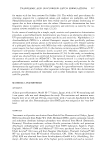
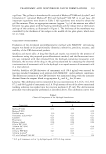
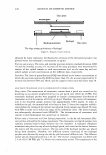
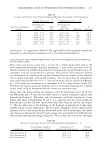
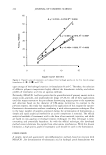
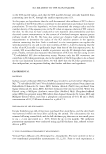
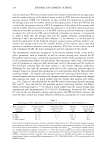
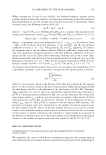
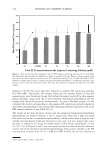
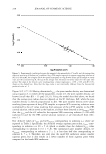
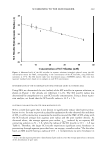
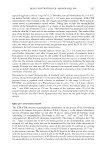
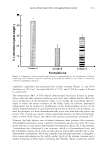
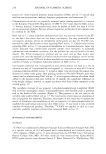
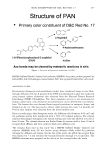
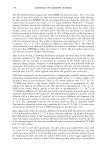
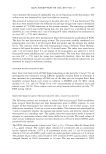
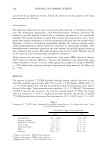
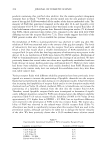
238 :2 - E � a. C) � JOURNAL OF COSMETIC SCIENCE -2.5 0 ---------------------------------- ........ -3 .00 - ....._ -3.5 0 -4. 00 ...... ...... ...... ...... ...... ...... ...... ...... ...... ...... ...... ...... ...... ...... ....._ � A �, A A �A A �•... .......... ........... ............ ...... 4·5 0 0-.- __________ 0""".' 5 -- ___________ 1 .... . 0_ __________ 1 __ 5 0 log R (kohm-cm2) Figure 3. Experimental correlation between the mannitol skin permeability, P (cm/h), and the average skin electrical resistivity, R (kohm-cm2), exhibited by p-FTS samples exposed to aqueous contacting solutions of SCI (0.2-200 mM), the triangles. Each data point corresponds to a log P value of one p-FTS sample at steady state and the associated log R, the log of the average skin electrical resistivity value over the same time period. The slope of the best-fit curve resulting from a linear regression is -0.98 ± 0.06 with R2=0.91, shown as the dashed line. Note that the slope value is not statistically different from the theoretically predicted value of - 1. Figure 3) (13,27,31). Having determined r p o re• the pore number density was determined using equation 5, in which all the parameters, except e/T, the pore number density, are known [recall that dX = 15 µm} (13,31). Using the model described above, we found that the average pore radius does not depend on the SC thickness, dX, while the pore number density is directly proportional to dX. The pore number density (e/T) values resulting from exposure of the p-FTS samples to aqueous SCI contacting solutions were normalized by the s/T value resulting from exposure of the p-FTS samples to the PBS control solution, which served as the baseline, and have been denoted as (e/T)normal· Note that the r p ore and the e/T values for the aqueous SDS contacting solution (1-200 mM) (solution b) and for the PBS control solution (solution c) are reproduced from refer ence 13. Our deduced values of r p or e and (s/T)normal corresponding to solutions a-c above are reported in Table I. Specifically, the deduced average aqueous pore radius, r p or e• corre sponding to solution a is 29 ± 5 .A, which is smaller than the deduced r p o re value corresponding to solution b (33 ± 5 ..A.). The normalized pore number density, (s/ T)normai, corresponding to solution a, 2 ± 1, is less than half that corresponding to solution b, 7 ± 1. Therefore, not only does the mild SCI surfactant induce smaller aqueous pores, but it also results in a lower number of these aqueous pores when compared to the harsh SDS surfactant.

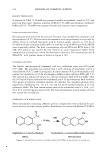
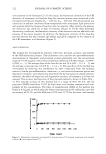
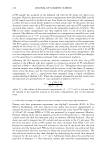
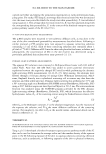
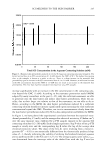
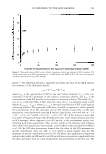
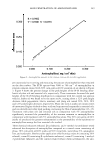
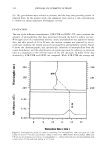
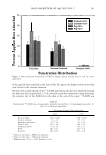
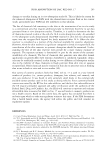
SCI MILDNESS TO THE SKIN BARRIER 239 35 33 31 29 27 25 0 10 20 30 40 50 Concentration of SCI Micelles (mM) Figure 4. Measured radii of the SCI micelles in aqueous solutions (triangles) plotted versus the SCI concentration minus the CMC, corresponding to the concentration of the SCI micelles, using DLS mea surements at 35 ° C. The SCI micelle radii were determined using a CONTIN analysis. The error bars represent standard errors based on six samples at each SCI concentration. DETERMINATION OF THE SCI MICELLE SIZE USING DYNAMIC LIGHT SCATTERING (DLS) Using DLS, we determined the size (radius) of the SCI micelles in aqueous solutions, as shown in Figure 4 (for details, see references 11-13). The SCI micelle radius was determined by extrapolation to a zero SCI micelle concentration. Using a linear regres sion analysis, we found that the SCI micelle radius is 33.5 ± 1 A. PLAUSIBLE EXPLANATION FOR THE SKIN MILDNESS OF SCI SCI is a mild skin agent that is not known to significantly induce skin barrier pertur bation in vivo. In order to provide a plausible explanation for the observed skin mildness of SCI, it will be instructive to examine the micelle size and the CMC of SCI, along with the SCI-induced average skin aqueous pore radius and the pore number density. As discussed above, the average aqueous pore radius, r p o w induced by an aqueous SCI contacting solution is 29 ± 5 A, while the radius of the SCI micelle is 33.5 ± 1 A (see Table I). Therefore, the larger SCI micelle experiences significant steric hindrance in penetrating through aqueous pores that have, on average, a smaller radius.2 On the other hand, an SDS micelle having a radius of 19.5 ± 1 A experiences no steric hindrance in 2 In fact, the skin aqueous pores have a distribution of pore radii (13,32). The average pore radius is the mean of this distribution of pore radii.
Purchased for the exclusive use of nofirst nolast (unknown)
From: SCC Media Library & Resource Center (library.scconline.org)